

446
S. V. Boriskina
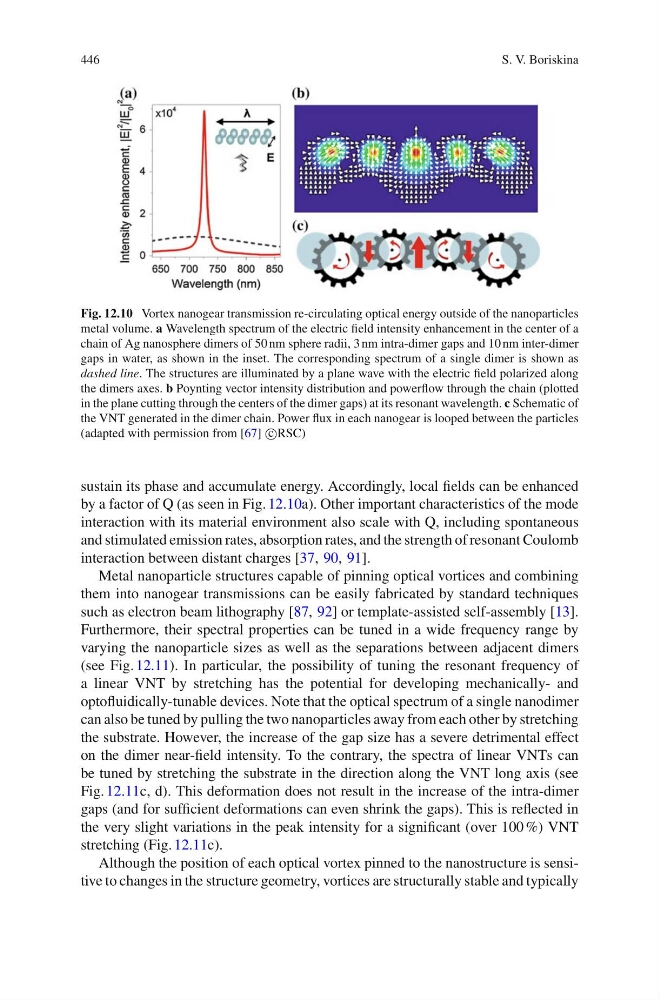
Fig. 12.10 Vortex nanogear transmission re-circulating optical energy outside of the nanoparticles
metal volume. a Wavelength spectrum of the electric field intensity enhancement in the center of a
chain of Ag nanosphere dimers of 50 nm sphere radii, 3 nm intra-dimer gaps and 10 nm inter-dimer
gaps in water, as shown in the inset. The corresponding spectrum of a single dimer is shown as
dashed line. The structures are illuminated by a plane wave with the electric field polarized along
the dimers axes. b Poynting vector intensity distribution and powerflow through the chain (plotted
in the plane cutting through the centers of the dimer gaps) at its resonant wavelength. c Schematic of
the VNT generated in the dimer chain. Power flux in each nanogear is looped between the particles
(adapted with permission from [67] c
∪RSC)
sustain its phase and accumulate energy. Accordingly, local fields can be enhanced
by a factor of Q (as seen in Fig. 12.10a). Other important characteristics of the mode
interaction with its material environment also scale with Q, including spontaneous
and stimulated emission rates, absorption rates, and the strength of resonant Coulomb
interaction between distant charges [37, 90, 91].
Metal nanoparticle structures capable of pinning optical vortices and combining
them into nanogear transmissions can be easily fabricated by standard techniques
such as electron beam lithography [87, 92] or template-assisted self-assembly [13].
Furthermore, their spectral properties can be tuned in a wide frequency range by
varying the nanoparticle sizes as well as the separations between adjacent dimers
(see Fig. 12.11). In particular, the possibility of tuning the resonant frequency of
a linear VNT by stretching has the potential for developing mechanically- and
optofluidically-tunable devices. Note that the optical spectrum of a single nanodimer
can also be tuned by pulling the two nanoparticles away from each other by stretching
the substrate. However, the increase of the gap size has a severe detrimental effect
on the dimer near-field intensity. To the contrary, the spectra of linear VNTs can
be tuned by stretching the substrate in the direction along the VNT long axis (see
Fig. 12.11c, d). This deformation does not result in the increase of the intra-dimer
gaps (and for sufficient deformations can even shrink the gaps). This is reflected in
the very slight variations in the peak intensity for a significant (over 100 %) VNT
stretching (Fig. 12.11c).
Although the position of each optical vortex pinned to the nanostructure is sensitive to changes in the structure geometry, vortices are structurally stable and typically
S. V. Boriskina
Fig. 12.10 Vortex nanogear transmission re-circulating optical energy outside of the nanoparticles
metal volume. a Wavelength spectrum of the electric field intensity enhancement in the center of a
chain of Ag nanosphere dimers of 50 nm sphere radii, 3 nm intra-dimer gaps and 10 nm inter-dimer
gaps in water, as shown in the inset. The corresponding spectrum of a single dimer is shown as
dashed line. The structures are illuminated by a plane wave with the electric field polarized along
the dimers axes. b Poynting vector intensity distribution and powerflow through the chain (plotted
in the plane cutting through the centers of the dimer gaps) at its resonant wavelength. c Schematic of
the VNT generated in the dimer chain. Power flux in each nanogear is looped between the particles
(adapted with permission from [67] c
∪RSC)
sustain its phase and accumulate energy. Accordingly, local fields can be enhanced
by a factor of Q (as seen in Fig. 12.10a). Other important characteristics of the mode
interaction with its material environment also scale with Q, including spontaneous
and stimulated emission rates, absorption rates, and the strength of resonant Coulomb
interaction between distant charges [37, 90, 91].
Metal nanoparticle structures capable of pinning optical vortices and combining
them into nanogear transmissions can be easily fabricated by standard techniques
such as electron beam lithography [87, 92] or template-assisted self-assembly [13].
Furthermore, their spectral properties can be tuned in a wide frequency range by
varying the nanoparticle sizes as well as the separations between adjacent dimers
(see Fig. 12.11). In particular, the possibility of tuning the resonant frequency of
a linear VNT by stretching has the potential for developing mechanically- and
optofluidically-tunable devices. Note that the optical spectrum of a single nanodimer
can also be tuned by pulling the two nanoparticles away from each other by stretching
the substrate. However, the increase of the gap size has a severe detrimental effect
on the dimer near-field intensity. To the contrary, the spectra of linear VNTs can
be tuned by stretching the substrate in the direction along the VNT long axis (see
Fig. 12.11c, d). This deformation does not result in the increase of the intra-dimer
gaps (and for sufficient deformations can even shrink the gaps). This is reflected in
the very slight variations in the peak intensity for a significant (over 100 %) VNT
stretching (Fig. 12.11c).
Although the position of each optical vortex pinned to the nanostructure is sensitive to changes in the structure geometry, vortices are structurally stable and typically