

12 Plasmonics with a Twist: Taming Optical Tornadoes on the Nanoscale
445
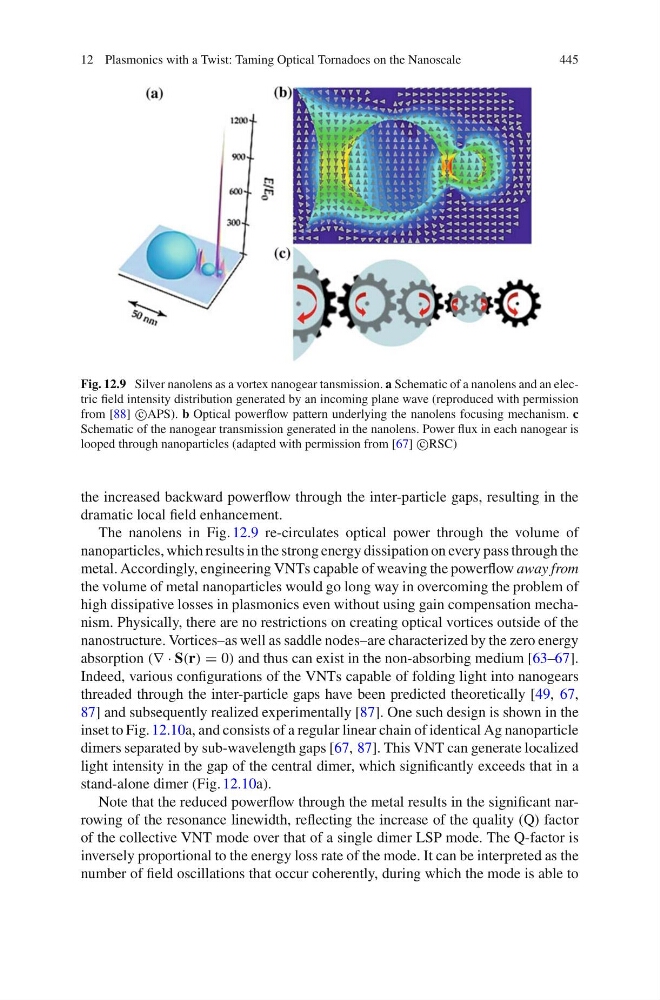
Fig. 12.9 Silver nanolens as a vortex nanogear tansmission. a Schematic of a nanolens and an electric field intensity distribution generated by an incoming plane wave (reproduced with permission
from [88] c
∪APS). b Optical powerflow pattern underlying the nanolens focusing mechanism. c
Schematic of the nanogear transmission generated in the nanolens. Power flux in each nanogear is
looped through nanoparticles (adapted with permission from [67] c
∪RSC)
the increased backward powerflow through the inter-particle gaps, resulting in the
dramatic local field enhancement.
The nanolens in Fig. 12.9 re-circulates optical power through the volume of
nanoparticles, which results in the strong energy dissipation on every pass through the
metal. Accordingly, engineering VNTs capable of weaving the powerflow away from
the volume of metal nanoparticles would go long way in overcoming the problem of
high dissipative losses in plasmonics even without using gain compensation mechanism. Physically, there are no restrictions on creating optical vortices outside of the
nanostructure. Vortices–as well as saddle nodes–are characterized by the zero energy
absorption (≈ · S(r) = 0) and thus can exist in the non-absorbing medium [63–67].
Indeed, various configurations of the VNTs capable of folding light into nanogears
threaded through the inter-particle gaps have been predicted theoretically [49, 67,
87] and subsequently realized experimentally [87]. One such design is shown in the
inset to Fig. 12.10a, and consists of a regular linear chain of identical Ag nanoparticle
dimers separated by sub-wavelength gaps [67, 87]. This VNT can generate localized
light intensity in the gap of the central dimer, which significantly exceeds that in a
stand-alone dimer (Fig. 12.10a).
Note that the reduced powerflow through the metal results in the significant narrowing of the resonance linewidth, reflecting the increase of the quality (Q) factor
of the collective VNT mode over that of a single dimer LSP mode. The Q-factor is
inversely proportional to the energy loss rate of the mode. It can be interpreted as the
number of field oscillations that occur coherently, during which the mode is able to
445
Fig. 12.9 Silver nanolens as a vortex nanogear tansmission. a Schematic of a nanolens and an electric field intensity distribution generated by an incoming plane wave (reproduced with permission
from [88] c
∪APS). b Optical powerflow pattern underlying the nanolens focusing mechanism. c
Schematic of the nanogear transmission generated in the nanolens. Power flux in each nanogear is
looped through nanoparticles (adapted with permission from [67] c
∪RSC)
the increased backward powerflow through the inter-particle gaps, resulting in the
dramatic local field enhancement.
The nanolens in Fig. 12.9 re-circulates optical power through the volume of
nanoparticles, which results in the strong energy dissipation on every pass through the
metal. Accordingly, engineering VNTs capable of weaving the powerflow away from
the volume of metal nanoparticles would go long way in overcoming the problem of
high dissipative losses in plasmonics even without using gain compensation mechanism. Physically, there are no restrictions on creating optical vortices outside of the
nanostructure. Vortices–as well as saddle nodes–are characterized by the zero energy
absorption (≈ · S(r) = 0) and thus can exist in the non-absorbing medium [63–67].
Indeed, various configurations of the VNTs capable of folding light into nanogears
threaded through the inter-particle gaps have been predicted theoretically [49, 67,
87] and subsequently realized experimentally [87]. One such design is shown in the
inset to Fig. 12.10a, and consists of a regular linear chain of identical Ag nanoparticle
dimers separated by sub-wavelength gaps [67, 87]. This VNT can generate localized
light intensity in the gap of the central dimer, which significantly exceeds that in a
stand-alone dimer (Fig. 12.10a).
Note that the reduced powerflow through the metal results in the significant narrowing of the resonance linewidth, reflecting the increase of the quality (Q) factor
of the collective VNT mode over that of a single dimer LSP mode. The Q-factor is
inversely proportional to the energy loss rate of the mode. It can be interpreted as the
number of field oscillations that occur coherently, during which the mode is able to