

12 Plasmonics with a Twist: Taming Optical Tornadoes on the Nanoscale
449
mechanisms underlying this intuitive picture can be revealed by using the mathematical isomorphism between the hydrodynamic equations and the electromagnetic
wave equations separated into phase and amplitude variables, as will be discussed in
the following section.
12.6 Hydrodynamics of Light Flow in Plasmonic
Nanostructures
Maxwell famously pointed out defending his theory of molecular vortices–which
aimed at explaining electromagnetic phenomena mechanically in terms of the interacting vortices in the imaginary fluid ether–that "it is a good thing to have two ways
of looking at a subject and to admit that there are two ways of looking at it” [95]. It
has long been recognized that hydrodynamics offers an alternative way of looking at
electromagnetic waves propagation even in a very general case of dispersive, lossy
and nonlinear media [96–101]. For example, a nonlinear Schrödinger equation that
governs the amplitude of the wave trains propagating through nonlinear medium in
a paraxial approximation can be re-cast in a hydrodynamic form via the Madelung
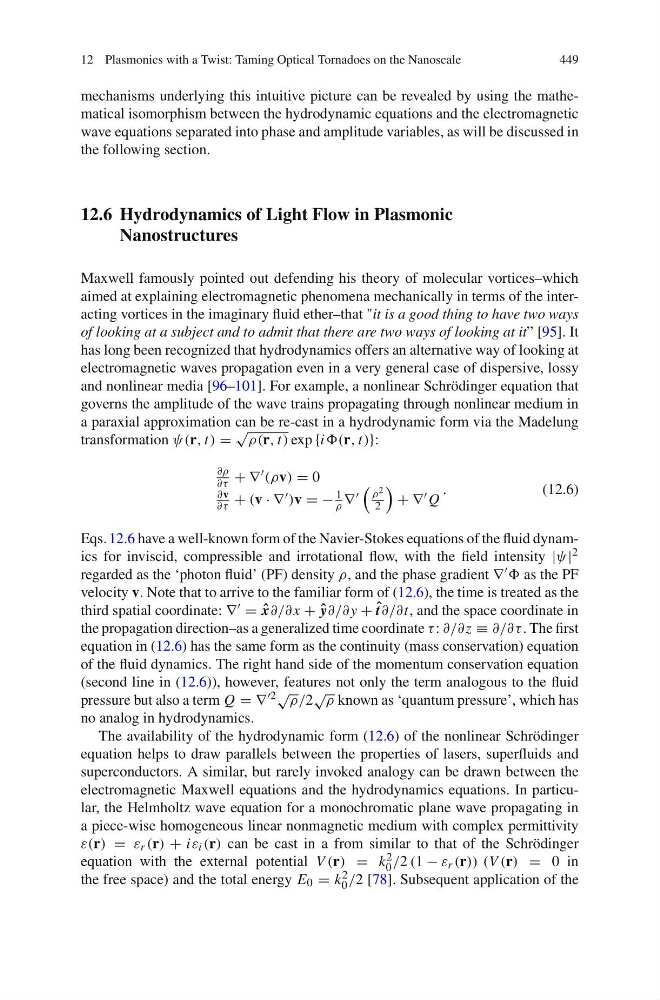
transformation ϕ(r, t) =
√ ε(r, t) exp {iτ(r, t)}:
πε
πΘ + ≈ (εv) = 0
πv
πΘ + (v · ≈ )v = −
1
ε ≈
ε 2
2
+ ≈ Q
.
(12.6)
Eqs. 12.6 have a well-known form of the Navier-Stokes equations of the fluid dynamics for inviscid, compressible and irrotational flow, with the field intensity |ϕ| 2
regarded as the ‘photon fluid’ (PF) density ε, and the phase gradient ≈ τ as the PF
velocity v. Note that to arrive to the familiar form of (12.6), the time is treated as the
third spatial coordinate: ≈ = ˆ
xπ/π x + ˆ
yπ/πy + ˆ
tπ/πt, and the space coordinate in
the propagation direction–as a generalized time coordinate Θ : π/πz ≡ π/πΘ . The first
equation in (12.6) has the same form as the continuity (mass conservation) equation
of the fluid dynamics. The right hand side of the momentum conservation equation
(second line in (12.6)), however, features not only the term analogous to the fluid
pressure but also a term Q = ≈ 2 √
ε/2
√ ε known as ‘quantum pressure’, which has
no analog in hydrodynamics.
The availability of the hydrodynamic form (12.6) of the nonlinear Schrödinger
equation helps to draw parallels between the properties of lasers, superfluids and
superconductors. A similar, but rarely invoked analogy can be drawn between the
electromagnetic Maxwell equations and the hydrodynamics equations. In particular, the Helmholtz wave equation for a monochromatic plane wave propagating in
a piece-wise homogeneous linear nonmagnetic medium with complex permittivity
λ(r) = λ r (r) + iλ i (r) can be cast in a from similar to that of the Schrödinger
equation with the external potential V (r) = k 2
0 /2 (1 − λ r (r)) (V (r) = 0 in
the free space) and the total energy E 0 = k 2
0 /2 [78]. Subsequent application of the
449
mechanisms underlying this intuitive picture can be revealed by using the mathematical isomorphism between the hydrodynamic equations and the electromagnetic
wave equations separated into phase and amplitude variables, as will be discussed in
the following section.
12.6 Hydrodynamics of Light Flow in Plasmonic
Nanostructures
Maxwell famously pointed out defending his theory of molecular vortices–which
aimed at explaining electromagnetic phenomena mechanically in terms of the interacting vortices in the imaginary fluid ether–that "it is a good thing to have two ways
of looking at a subject and to admit that there are two ways of looking at it” [95]. It
has long been recognized that hydrodynamics offers an alternative way of looking at
electromagnetic waves propagation even in a very general case of dispersive, lossy
and nonlinear media [96–101]. For example, a nonlinear Schrödinger equation that
governs the amplitude of the wave trains propagating through nonlinear medium in
a paraxial approximation can be re-cast in a hydrodynamic form via the Madelung
transformation ϕ(r, t) =
√ ε(r, t) exp {iτ(r, t)}:
πε
πΘ + ≈ (εv) = 0
πv
πΘ + (v · ≈ )v = −
1
ε ≈
ε 2
2
+ ≈ Q
.
(12.6)
Eqs. 12.6 have a well-known form of the Navier-Stokes equations of the fluid dynamics for inviscid, compressible and irrotational flow, with the field intensity |ϕ| 2
regarded as the ‘photon fluid’ (PF) density ε, and the phase gradient ≈ τ as the PF
velocity v. Note that to arrive to the familiar form of (12.6), the time is treated as the
third spatial coordinate: ≈ = ˆ
xπ/π x + ˆ
yπ/πy + ˆ
tπ/πt, and the space coordinate in
the propagation direction–as a generalized time coordinate Θ : π/πz ≡ π/πΘ . The first
equation in (12.6) has the same form as the continuity (mass conservation) equation
of the fluid dynamics. The right hand side of the momentum conservation equation
(second line in (12.6)), however, features not only the term analogous to the fluid
pressure but also a term Q = ≈ 2 √
ε/2
√ ε known as ‘quantum pressure’, which has
no analog in hydrodynamics.
The availability of the hydrodynamic form (12.6) of the nonlinear Schrödinger
equation helps to draw parallels between the properties of lasers, superfluids and
superconductors. A similar, but rarely invoked analogy can be drawn between the
electromagnetic Maxwell equations and the hydrodynamics equations. In particular, the Helmholtz wave equation for a monochromatic plane wave propagating in
a piece-wise homogeneous linear nonmagnetic medium with complex permittivity
λ(r) = λ r (r) + iλ i (r) can be cast in a from similar to that of the Schrödinger
equation with the external potential V (r) = k 2
0 /2 (1 − λ r (r)) (V (r) = 0 in
the free space) and the total energy E 0 = k 2
0 /2 [78]. Subsequent application of the