

12 Plasmonics with a Twist: Taming Optical Tornadoes on the Nanoscale
435
by obstacles strategically positioned in the flow path. Accordingly, the focus shifts
to the studies of the Poynting vector (which is a direct analog of a fluid flux) rather
than the electromagnetic field behavior under the influence of nanostructures. Many
interesting hydrodynamic effects can be engineered by a proper design of the obstacles pattern, including convective acceleration or deceleration even in the case of
steady flow, formation of flow vortices–areas of spinning flow of fluid—as well
as flows collisions accompanied by the formation of ‘shock waves’. Electromagnetic analogies of these effects can be invoked in the plasmonic design, offering
new insights into routing, re-circulation, and concentration of optical energy within
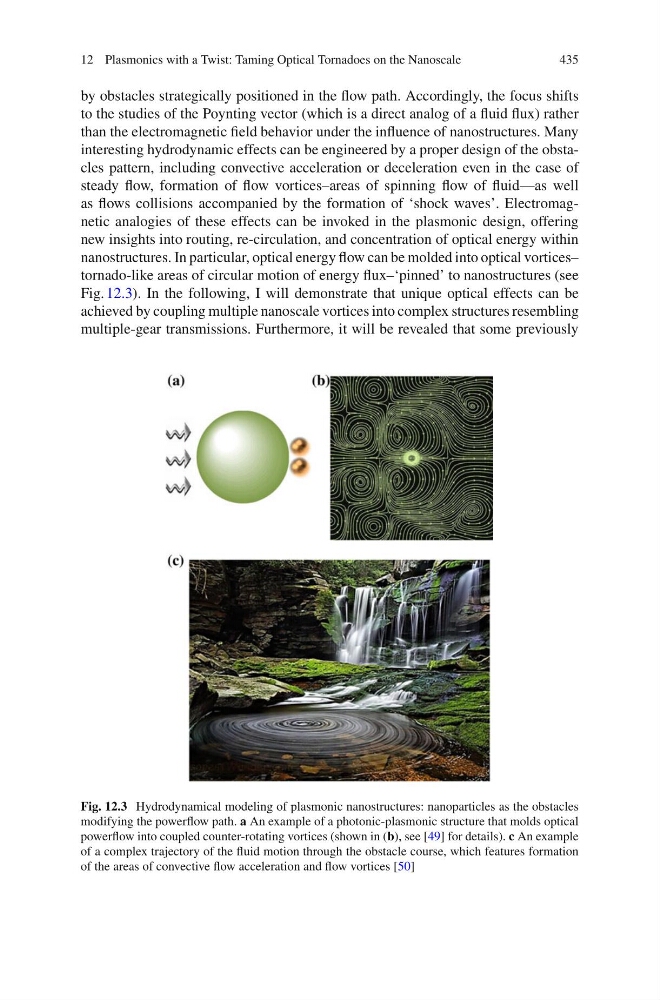
nanostructures. In particular, optical energy flow can be molded into optical vortices–
tornado-like areas of circular motion of energy flux–‘pinned’ to nanostructures (see
Fig. 12.3). In the following, I will demonstrate that unique optical effects can be
achieved by coupling multiple nanoscale vortices into complex structures resembling
multiple-gear transmissions. Furthermore, it will be revealed that some previously
Fig. 12.3 Hydrodynamical modeling of plasmonic nanostructures: nanoparticles as the obstacles
modifying the powerflow path. a An example of a photonic-plasmonic structure that molds optical
powerflow into coupled counter-rotating vortices (shown in (b), see [49] for details). c An example
of a complex trajectory of the fluid motion through the obstacle course, which features formation
of the areas of convective flow acceleration and flow vortices [50]
435
by obstacles strategically positioned in the flow path. Accordingly, the focus shifts
to the studies of the Poynting vector (which is a direct analog of a fluid flux) rather
than the electromagnetic field behavior under the influence of nanostructures. Many
interesting hydrodynamic effects can be engineered by a proper design of the obstacles pattern, including convective acceleration or deceleration even in the case of
steady flow, formation of flow vortices–areas of spinning flow of fluid—as well
as flows collisions accompanied by the formation of ‘shock waves’. Electromagnetic analogies of these effects can be invoked in the plasmonic design, offering
new insights into routing, re-circulation, and concentration of optical energy within
nanostructures. In particular, optical energy flow can be molded into optical vortices–
tornado-like areas of circular motion of energy flux–‘pinned’ to nanostructures (see
Fig. 12.3). In the following, I will demonstrate that unique optical effects can be
achieved by coupling multiple nanoscale vortices into complex structures resembling
multiple-gear transmissions. Furthermore, it will be revealed that some previously
Fig. 12.3 Hydrodynamical modeling of plasmonic nanostructures: nanoparticles as the obstacles
modifying the powerflow path. a An example of a photonic-plasmonic structure that molds optical
powerflow into coupled counter-rotating vortices (shown in (b), see [49] for details). c An example
of a complex trajectory of the fluid motion through the obstacle course, which features formation
of the areas of convective flow acceleration and flow vortices [50]