

434
S. V. Boriskina
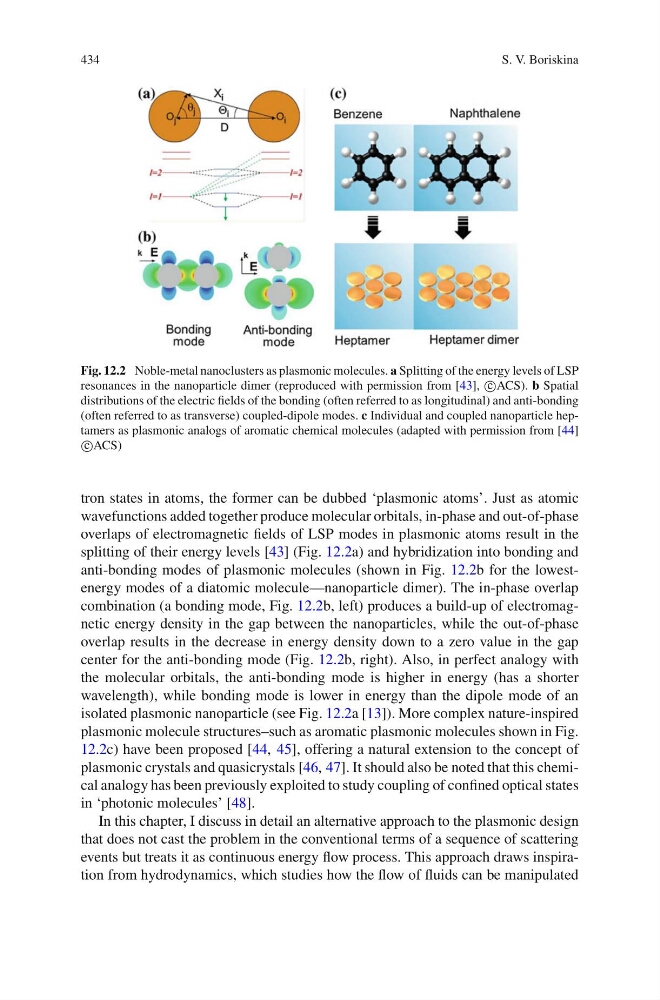
Fig. 12.2 Noble-metal nanoclusters as plasmonic molecules. a Splitting of the energy levels of LSP
resonances in the nanoparticle dimer (reproduced with permission from [43], c
∪ACS). b Spatial
distributions of the electric fields of the bonding (often referred to as longitudinal) and anti-bonding
(often referred to as transverse) coupled-dipole modes. c Individual and coupled nanoparticle heptamers as plasmonic analogs of aromatic chemical molecules (adapted with permission from [44]
c
∪ACS)
tron states in atoms, the former can be dubbed ‘plasmonic atoms’. Just as atomic
wavefunctions added together produce molecular orbitals, in-phase and out-of-phase
overlaps of electromagnetic fields of LSP modes in plasmonic atoms result in the
splitting of their energy levels [43] (Fig. 12.2a) and hybridization into bonding and
anti-bonding modes of plasmonic molecules (shown in Fig. 12.2b for the lowestenergy modes of a diatomic molecule—nanoparticle dimer). The in-phase overlap
combination (a bonding mode, Fig. 12.2b, left) produces a build-up of electromagnetic energy density in the gap between the nanoparticles, while the out-of-phase
overlap results in the decrease in energy density down to a zero value in the gap
center for the anti-bonding mode (Fig. 12.2b, right). Also, in perfect analogy with
the molecular orbitals, the anti-bonding mode is higher in energy (has a shorter
wavelength), while bonding mode is lower in energy than the dipole mode of an
isolated plasmonic nanoparticle (see Fig. 12.2a [13]). More complex nature-inspired
plasmonic molecule structures–such as aromatic plasmonic molecules shown in Fig.
12.2c) have been proposed [44, 45], offering a natural extension to the concept of
plasmonic crystals and quasicrystals [46, 47]. It should also be noted that this chemical analogy has been previously exploited to study coupling of confined optical states
in ‘photonic molecules’ [48].
In this chapter, I discuss in detail an alternative approach to the plasmonic design
that does not cast the problem in the conventional terms of a sequence of scattering
events but treats it as continuous energy flow process. This approach draws inspiration from hydrodynamics, which studies how the flow of fluids can be manipulated
S. V. Boriskina
Fig. 12.2 Noble-metal nanoclusters as plasmonic molecules. a Splitting of the energy levels of LSP
resonances in the nanoparticle dimer (reproduced with permission from [43], c
∪ACS). b Spatial
distributions of the electric fields of the bonding (often referred to as longitudinal) and anti-bonding
(often referred to as transverse) coupled-dipole modes. c Individual and coupled nanoparticle heptamers as plasmonic analogs of aromatic chemical molecules (adapted with permission from [44]
c
∪ACS)
tron states in atoms, the former can be dubbed ‘plasmonic atoms’. Just as atomic
wavefunctions added together produce molecular orbitals, in-phase and out-of-phase
overlaps of electromagnetic fields of LSP modes in plasmonic atoms result in the
splitting of their energy levels [43] (Fig. 12.2a) and hybridization into bonding and
anti-bonding modes of plasmonic molecules (shown in Fig. 12.2b for the lowestenergy modes of a diatomic molecule—nanoparticle dimer). The in-phase overlap
combination (a bonding mode, Fig. 12.2b, left) produces a build-up of electromagnetic energy density in the gap between the nanoparticles, while the out-of-phase
overlap results in the decrease in energy density down to a zero value in the gap
center for the anti-bonding mode (Fig. 12.2b, right). Also, in perfect analogy with
the molecular orbitals, the anti-bonding mode is higher in energy (has a shorter
wavelength), while bonding mode is lower in energy than the dipole mode of an
isolated plasmonic nanoparticle (see Fig. 12.2a [13]). More complex nature-inspired
plasmonic molecule structures–such as aromatic plasmonic molecules shown in Fig.
12.2c) have been proposed [44, 45], offering a natural extension to the concept of
plasmonic crystals and quasicrystals [46, 47]. It should also be noted that this chemical analogy has been previously exploited to study coupling of confined optical states
in ‘photonic molecules’ [48].
In this chapter, I discuss in detail an alternative approach to the plasmonic design
that does not cast the problem in the conventional terms of a sequence of scattering
events but treats it as continuous energy flow process. This approach draws inspiration from hydrodynamics, which studies how the flow of fluids can be manipulated