

12 Plasmonics with a Twist: Taming Optical Tornadoes on the Nanoscale
433
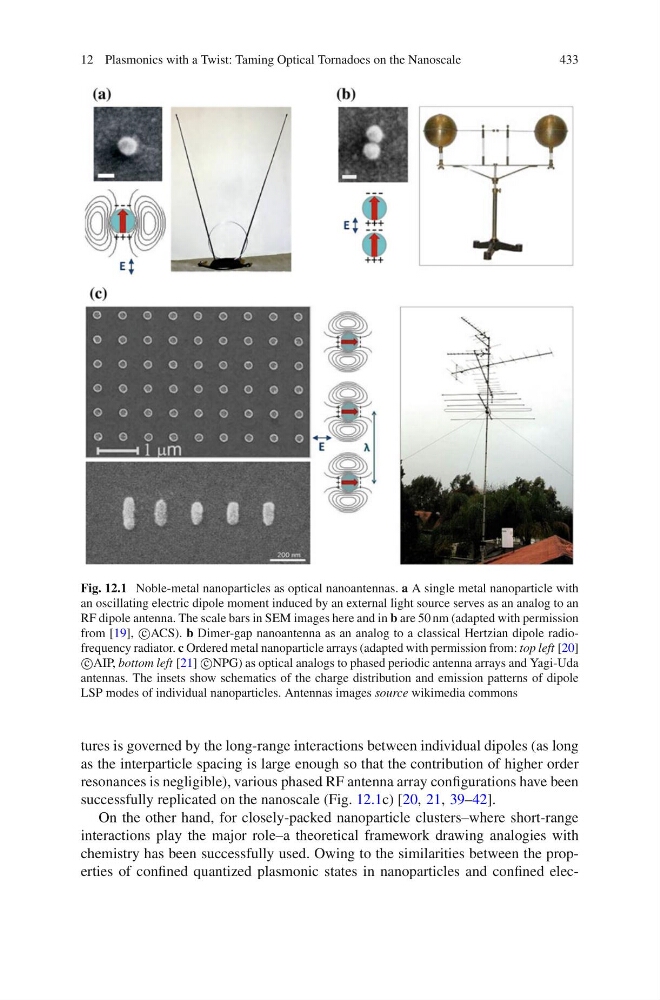
Fig. 12.1 Noble-metal nanoparticles as optical nanoantennas. a A single metal nanoparticle with
an oscillating electric dipole moment induced by an external light source serves as an analog to an
RF dipole antenna. The scale bars in SEM images here and in b are 50 nm (adapted with permission
from [19], c
∪ACS). b Dimer-gap nanoantenna as an analog to a classical Hertzian dipole radiofrequency radiator. c Ordered metal nanoparticle arrays (adapted with permission from: top left [20]
c
∪AIP, bottom left [21] c
∪NPG) as optical analogs to phased periodic antenna arrays and Yagi-Uda
antennas. The insets show schematics of the charge distribution and emission patterns of dipole
LSP modes of individual nanoparticles. Antennas images source wikimedia commons
tures is governed by the long-range interactions between individual dipoles (as long
as the interparticle spacing is large enough so that the contribution of higher order
resonances is negligible), various phased RF antenna array configurations have been
successfully replicated on the nanoscale (Fig. 12.1c) [20, 21, 39–42].
On the other hand, for closely-packed nanoparticle clusters–where short-range
interactions play the major role–a theoretical framework drawing analogies with
chemistry has been successfully used. Owing to the similarities between the properties of confined quantized plasmonic states in nanoparticles and confined elec-
433
Fig. 12.1 Noble-metal nanoparticles as optical nanoantennas. a A single metal nanoparticle with
an oscillating electric dipole moment induced by an external light source serves as an analog to an
RF dipole antenna. The scale bars in SEM images here and in b are 50 nm (adapted with permission
from [19], c
∪ACS). b Dimer-gap nanoantenna as an analog to a classical Hertzian dipole radiofrequency radiator. c Ordered metal nanoparticle arrays (adapted with permission from: top left [20]
c
∪AIP, bottom left [21] c
∪NPG) as optical analogs to phased periodic antenna arrays and Yagi-Uda
antennas. The insets show schematics of the charge distribution and emission patterns of dipole
LSP modes of individual nanoparticles. Antennas images source wikimedia commons
tures is governed by the long-range interactions between individual dipoles (as long
as the interparticle spacing is large enough so that the contribution of higher order
resonances is negligible), various phased RF antenna array configurations have been
successfully replicated on the nanoscale (Fig. 12.1c) [20, 21, 39–42].
On the other hand, for closely-packed nanoparticle clusters–where short-range
interactions play the major role–a theoretical framework drawing analogies with
chemistry has been successfully used. Owing to the similarities between the properties of confined quantized plasmonic states in nanoparticles and confined elec-