

408
A. Pors et al.
800 900 1000 1100 1200 1300 1400 1500
0
0.02
0.04
0.06
0.08
0.1
0.12
0.14
0.16
λ (nm)
σ (μm
2
)
−1
0
1
2
3
4
x 10
−31
|p
x
| (Cm)
λ (nm)
|m
z | (Am
2
)
800 900 1000 1100 1200 1300 1400 1500
0
0.5
1
1.5
2
2.5
3
3.5
x 10
−23
+y: scat
+y: ext
-y: scat
-y: ext
+y
-y
-y
(a)
(b)
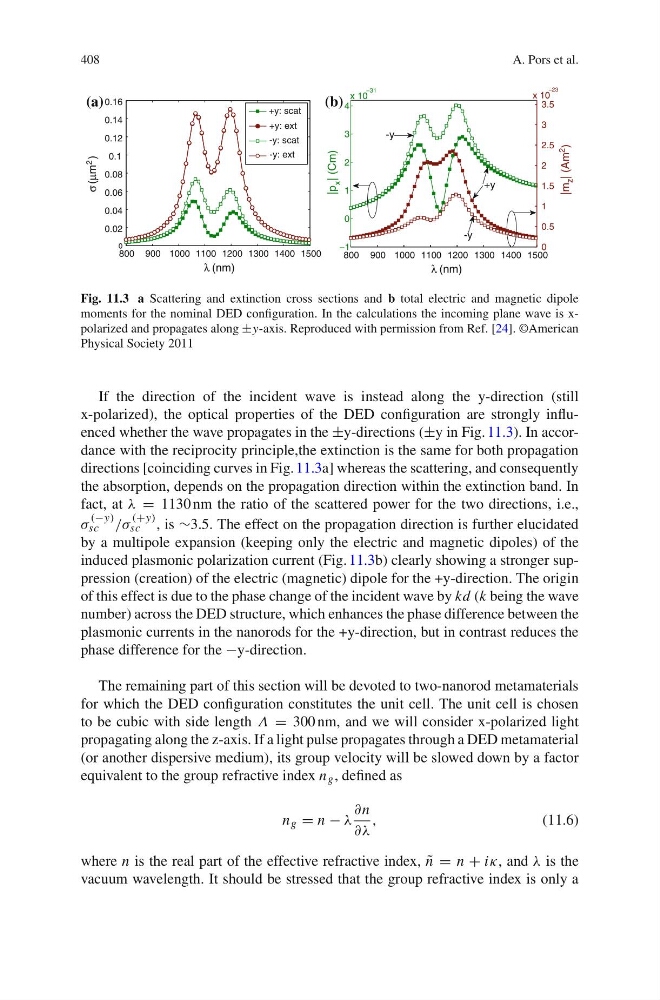
Fig. 11.3 a Scattering and extinction cross sections and b total electric and magnetic dipole
moments for the nominal DED configuration. In the calculations the incoming plane wave is xpolarized and propagates along ±y-axis. Reproduced with permission from Ref. [24]. ©American
Physical Society 2011
If the direction of the incident wave is instead along the y-direction (still
x-polarized), the optical properties of the DED configuration are strongly influenced whether the wave propagates in the ±y-directions (±y in Fig. 11.3). In accordance with the reciprocity principle,the extinction is the same for both propagation
directions [coinciding curves in Fig. 11.3a] whereas the scattering, and consequently
the absorption, depends on the propagation direction within the extinction band. In
fact, at ϕ = 1130 nm the ratio of the scattered power for the two directions, i.e.,
τ
(−y)
sc /τ
(+y)
sc , is ∼3.5. The effect on the propagation direction is further elucidated
by a multipole expansion (keeping only the electric and magnetic dipoles) of the
induced plasmonic polarization current (Fig. 11.3b) clearly showing a stronger suppression (creation) of the electric (magnetic) dipole for the +y-direction. The origin
of this effect is due to the phase change of the incident wave by kd (k being the wave
number) across the DED structure, which enhances the phase difference between the
plasmonic currents in the nanorods for the +y-direction, but in contrast reduces the
phase difference for the −y-direction.
The remaining part of this section will be devoted to two-nanorod metamaterials
for which the DED configuration constitutes the unit cell. The unit cell is chosen
to be cubic with side length Θ = 300 nm, and we will consider x-polarized light
propagating along the z-axis. If a light pulse propagates through a DED metamaterial
(or another dispersive medium), its group velocity will be slowed down by a factor
equivalent to the group refractive index n g , defined as
n g = n − ϕ
ψn
ψϕ
,
(11.6)
where n is the real part of the effective refractive index, ˜
n = n + i∂, and ϕ is the
vacuum wavelength. It should be stressed that the group refractive index is only a
A. Pors et al.
800 900 1000 1100 1200 1300 1400 1500
0
0.02
0.04
0.06
0.08
0.1
0.12
0.14
0.16
λ (nm)
σ (μm
2
)
−1
0
1
2
3
4
x 10
−31
|p
x
| (Cm)
λ (nm)
|m
z | (Am
2
)
800 900 1000 1100 1200 1300 1400 1500
0
0.5
1
1.5
2
2.5
3
3.5
x 10
−23
+y: scat
+y: ext
-y: scat
-y: ext
+y
-y
-y
(a)
(b)
Fig. 11.3 a Scattering and extinction cross sections and b total electric and magnetic dipole
moments for the nominal DED configuration. In the calculations the incoming plane wave is xpolarized and propagates along ±y-axis. Reproduced with permission from Ref. [24]. ©American
Physical Society 2011
If the direction of the incident wave is instead along the y-direction (still
x-polarized), the optical properties of the DED configuration are strongly influenced whether the wave propagates in the ±y-directions (±y in Fig. 11.3). In accordance with the reciprocity principle,the extinction is the same for both propagation
directions [coinciding curves in Fig. 11.3a] whereas the scattering, and consequently
the absorption, depends on the propagation direction within the extinction band. In
fact, at ϕ = 1130 nm the ratio of the scattered power for the two directions, i.e.,
τ
(−y)
sc /τ
(+y)
sc , is ∼3.5. The effect on the propagation direction is further elucidated
by a multipole expansion (keeping only the electric and magnetic dipoles) of the
induced plasmonic polarization current (Fig. 11.3b) clearly showing a stronger suppression (creation) of the electric (magnetic) dipole for the +y-direction. The origin
of this effect is due to the phase change of the incident wave by kd (k being the wave
number) across the DED structure, which enhances the phase difference between the
plasmonic currents in the nanorods for the +y-direction, but in contrast reduces the
phase difference for the −y-direction.
The remaining part of this section will be devoted to two-nanorod metamaterials
for which the DED configuration constitutes the unit cell. The unit cell is chosen
to be cubic with side length Θ = 300 nm, and we will consider x-polarized light
propagating along the z-axis. If a light pulse propagates through a DED metamaterial
(or another dispersive medium), its group velocity will be slowed down by a factor
equivalent to the group refractive index n g , defined as
n g = n − ϕ
ψn
ψϕ
,
(11.6)
where n is the real part of the effective refractive index, ˜
n = n + i∂, and ϕ is the
vacuum wavelength. It should be stressed that the group refractive index is only a