

11 Plasmonic Functionalities Based on Detuned Electrical Dipoles
407
0
10
20
30
|E/E |
0
λ=1065nm
λ=1130nm
λ=1200nm
(a)
(b)
(c)
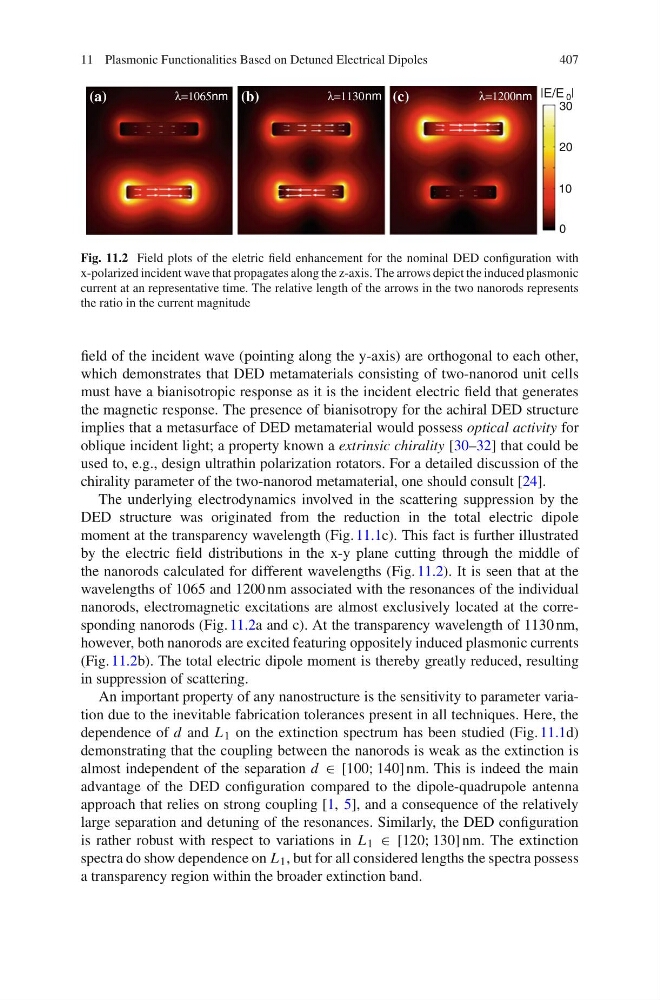
Fig. 11.2 Field plots of the eletric field enhancement for the nominal DED configuration with
x-polarized incident wave that propagates along the z-axis. The arrows depict the induced plasmonic
current at an representative time. The relative length of the arrows in the two nanorods represents
the ratio in the current magnitude
field of the incident wave (pointing along the y-axis) are orthogonal to each other,
which demonstrates that DED metamaterials consisting of two-nanorod unit cells
must have a bianisotropic response as it is the incident electric field that generates
the magnetic response. The presence of bianisotropy for the achiral DED structure
implies that a metasurface of DED metamaterial would possess optical activity for
oblique incident light; a property known a extrinsic chirality [30–32] that could be
used to, e.g., design ultrathin polarization rotators. For a detailed discussion of the
chirality parameter of the two-nanorod metamaterial, one should consult [24].
The underlying electrodynamics involved in the scattering suppression by the
DED structure was originated from the reduction in the total electric dipole
moment at the transparency wavelength (Fig. 11.1c). This fact is further illustrated
by the electric field distributions in the x-y plane cutting through the middle of
the nanorods calculated for different wavelengths (Fig. 11.2). It is seen that at the
wavelengths of 1065 and 1200 nm associated with the resonances of the individual
nanorods, electromagnetic excitations are almost exclusively located at the corresponding nanorods (Fig. 11.2a and c). At the transparency wavelength of 1130 nm,
however, both nanorods are excited featuring oppositely induced plasmonic currents
(Fig. 11.2b). The total electric dipole moment is thereby greatly reduced, resulting
in suppression of scattering.
An important property of any nanostructure is the sensitivity to parameter variation due to the inevitable fabrication tolerances present in all techniques. Here, the
dependence of d and L 1 on the extinction spectrum has been studied (Fig. 11.1d)
demonstrating that the coupling between the nanorods is weak as the extinction is
almost independent of the separation d ∈ [100; 140] nm. This is indeed the main
advantage of the DED configuration compared to the dipole-quadrupole antenna
approach that relies on strong coupling [1, 5], and a consequence of the relatively
large separation and detuning of the resonances. Similarly, the DED configuration
is rather robust with respect to variations in L 1 ∈ [120; 130] nm. The extinction
spectra do show dependence on L 1 , but for all considered lengths the spectra possess
a transparency region within the broader extinction band.
407
0
10
20
30
|E/E |
0
λ=1065nm
λ=1130nm
λ=1200nm
(a)
(b)
(c)
Fig. 11.2 Field plots of the eletric field enhancement for the nominal DED configuration with
x-polarized incident wave that propagates along the z-axis. The arrows depict the induced plasmonic
current at an representative time. The relative length of the arrows in the two nanorods represents
the ratio in the current magnitude
field of the incident wave (pointing along the y-axis) are orthogonal to each other,
which demonstrates that DED metamaterials consisting of two-nanorod unit cells
must have a bianisotropic response as it is the incident electric field that generates
the magnetic response. The presence of bianisotropy for the achiral DED structure
implies that a metasurface of DED metamaterial would possess optical activity for
oblique incident light; a property known a extrinsic chirality [30–32] that could be
used to, e.g., design ultrathin polarization rotators. For a detailed discussion of the
chirality parameter of the two-nanorod metamaterial, one should consult [24].
The underlying electrodynamics involved in the scattering suppression by the
DED structure was originated from the reduction in the total electric dipole
moment at the transparency wavelength (Fig. 11.1c). This fact is further illustrated
by the electric field distributions in the x-y plane cutting through the middle of
the nanorods calculated for different wavelengths (Fig. 11.2). It is seen that at the
wavelengths of 1065 and 1200 nm associated with the resonances of the individual
nanorods, electromagnetic excitations are almost exclusively located at the corresponding nanorods (Fig. 11.2a and c). At the transparency wavelength of 1130 nm,
however, both nanorods are excited featuring oppositely induced plasmonic currents
(Fig. 11.2b). The total electric dipole moment is thereby greatly reduced, resulting
in suppression of scattering.
An important property of any nanostructure is the sensitivity to parameter variation due to the inevitable fabrication tolerances present in all techniques. Here, the
dependence of d and L 1 on the extinction spectrum has been studied (Fig. 11.1d)
demonstrating that the coupling between the nanorods is weak as the extinction is
almost independent of the separation d ∈ [100; 140] nm. This is indeed the main
advantage of the DED configuration compared to the dipole-quadrupole antenna
approach that relies on strong coupling [1, 5], and a consequence of the relatively
large separation and detuning of the resonances. Similarly, the DED configuration
is rather robust with respect to variations in L 1 ∈ [120; 130] nm. The extinction
spectra do show dependence on L 1 , but for all considered lengths the spectra possess
a transparency region within the broader extinction band.