

11 Plasmonic Functionalities Based on Detuned Electrical Dipoles
409
well-defined quantity in regions of normal dispersion (ψn/ψϕ < 0) with relatively
small absorption [23].
Another important parameter that characterizes the DED metamaterial is the loss
associated with wave propagation through the medium. In the following we define
the loss per unit cell (in dB) as
Loss = −10log
exp(−2k 0 ∂π z )
,
(11.7)
where k 0 is the vacuum wave number, and π z is the periodicity in the propagation
direction. In order to evaluate the group refractive index and the loss, we must calculate the effective refractive index of the DED metamaterial. This is done by applying
the eigenvalue-based homogenization method in [24], which computes the effective
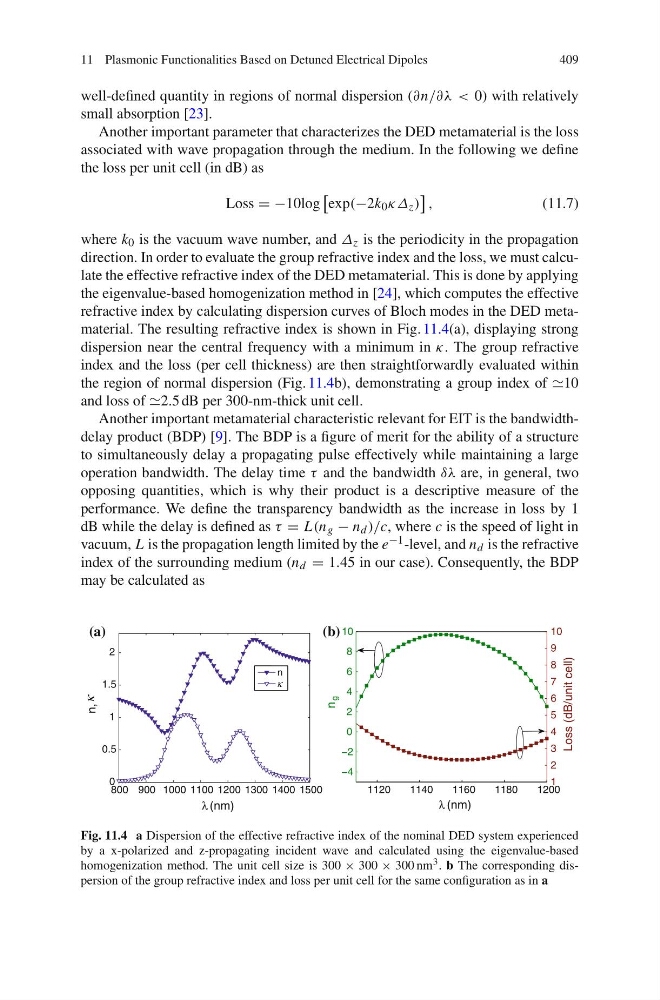
refractive index by calculating dispersion curves of Bloch modes in the DED metamaterial. The resulting refractive index is shown in Fig. 11.4(a), displaying strong
dispersion near the central frequency with a minimum in ∂. The group refractive
index and the loss (per cell thickness) are then straightforwardly evaluated within
the region of normal dispersion (Fig. 11.4b), demonstrating a group index of ∼10
and loss of ∼2.5 dB per 300-nm-thick unit cell.
Another important metamaterial characteristic relevant for EIT is the bandwidthdelay product (BDP) [9]. The BDP is a figure of merit for the ability of a structure
to simultaneously delay a propagating pulse effectively while maintaining a large
operation bandwidth. The delay time δ and the bandwidth αϕ are, in general, two
opposing quantities, which is why their product is a descriptive measure of the
performance. We define the transparency bandwidth as the increase in loss by 1
dB while the delay is defined as δ = L(n g − n d )/c, where c is the speed of light in
vacuum, L is the propagation length limited by the e −1 -level, and n d is the refractive
index of the surrounding medium (n d = 1.45 in our case). Consequently, the BDP
may be calculated as
−4
−2
0
2
4
6
8
10
λ (nm)
1120
1140
1160
1180
1200
1
2
3
4
5
6
7
8
9
10
Loss (dB/unit cell)
800 900 1000 1100 1200 1300 1400 1500
0
0.5
1
1.5
2
λ (nm)
n,
n
κ
n
g
(a)
(b)
κ
Fig. 11.4 a Dispersion of the effective refractive index of the nominal DED system experienced
by a x-polarized and z-propagating incident wave and calculated using the eigenvalue-based
homogenization method. The unit cell size is 300 × 300 × 300 nm 3 . b The corresponding dispersion of the group refractive index and loss per unit cell for the same configuration as in a
409
well-defined quantity in regions of normal dispersion (ψn/ψϕ < 0) with relatively
small absorption [23].
Another important parameter that characterizes the DED metamaterial is the loss
associated with wave propagation through the medium. In the following we define
the loss per unit cell (in dB) as
Loss = −10log
exp(−2k 0 ∂π z )
,
(11.7)
where k 0 is the vacuum wave number, and π z is the periodicity in the propagation
direction. In order to evaluate the group refractive index and the loss, we must calculate the effective refractive index of the DED metamaterial. This is done by applying
the eigenvalue-based homogenization method in [24], which computes the effective
refractive index by calculating dispersion curves of Bloch modes in the DED metamaterial. The resulting refractive index is shown in Fig. 11.4(a), displaying strong
dispersion near the central frequency with a minimum in ∂. The group refractive
index and the loss (per cell thickness) are then straightforwardly evaluated within
the region of normal dispersion (Fig. 11.4b), demonstrating a group index of ∼10
and loss of ∼2.5 dB per 300-nm-thick unit cell.
Another important metamaterial characteristic relevant for EIT is the bandwidthdelay product (BDP) [9]. The BDP is a figure of merit for the ability of a structure
to simultaneously delay a propagating pulse effectively while maintaining a large
operation bandwidth. The delay time δ and the bandwidth αϕ are, in general, two
opposing quantities, which is why their product is a descriptive measure of the
performance. We define the transparency bandwidth as the increase in loss by 1
dB while the delay is defined as δ = L(n g − n d )/c, where c is the speed of light in
vacuum, L is the propagation length limited by the e −1 -level, and n d is the refractive
index of the surrounding medium (n d = 1.45 in our case). Consequently, the BDP
may be calculated as
−4
−2
0
2
4
6
8
10
λ (nm)
1120
1140
1160
1180
1200
1
2
3
4
5
6
7
8
9
10
Loss (dB/unit cell)
800 900 1000 1100 1200 1300 1400 1500
0
0.5
1
1.5
2
λ (nm)
n,
n
κ
n
g
(a)
(b)
κ
Fig. 11.4 a Dispersion of the effective refractive index of the nominal DED system experienced
by a x-polarized and z-propagating incident wave and calculated using the eigenvalue-based
homogenization method. The unit cell size is 300 × 300 × 300 nm 3 . b The corresponding dispersion of the group refractive index and loss per unit cell for the same configuration as in a