

396
P. Lalanne and H. Liu
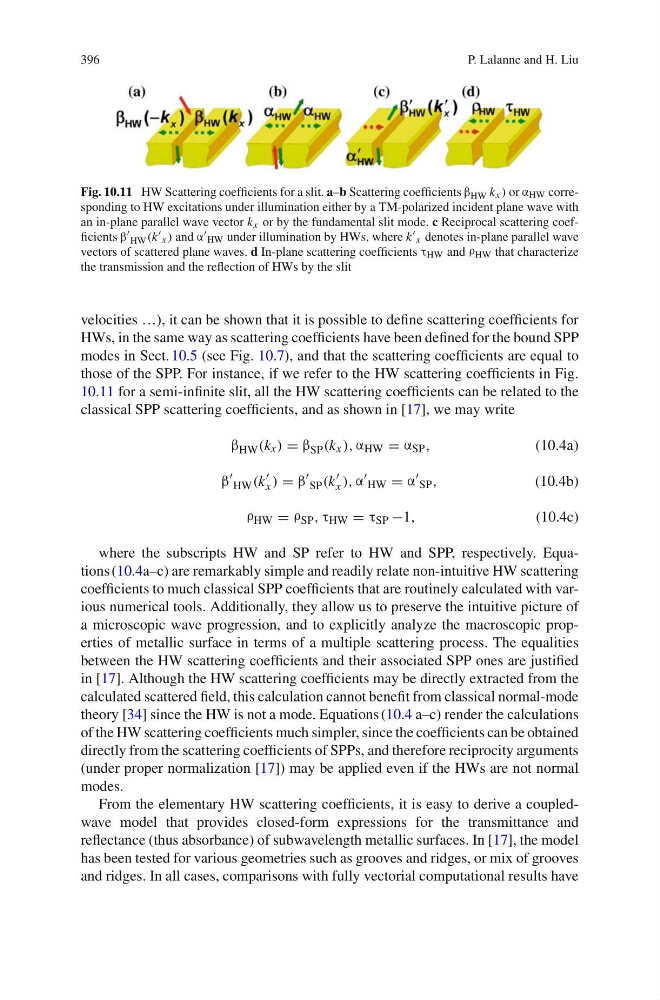
Fig. 10.11 HW Scattering coefficients for a slit. a–b Scattering coefficients β HW k x ) or α HW corresponding to HW excitations under illumination either by a TM-polarized incident plane wave with
an in-plane parallel wave vector k x or by the fundamental slit mode. c Reciprocal scattering coefficients β
∪
HW (k ∪ x ) and α ∪ HW under illumination by HWs, where k ∪ x denotes in-plane parallel wave
vectors of scattered plane waves. d In-plane scattering coefficients τ HW and ρ HW that characterize
the transmission and the reflection of HWs by the slit
velocities …), it can be shown that it is possible to define scattering coefficients for
HWs, in the same way as scattering coefficients have been defined for the bound SPP
modes in Sect. 10.5 (see Fig. 10.7), and that the scattering coefficients are equal to
those of the SPP. For instance, if we refer to the HW scattering coefficients in Fig.
10.11 for a semi-infinite slit, all the HW scattering coefficients can be related to the
classical SPP scattering coefficients, and as shown in [17], we may write
β HW (k x ) = β SP (k x ), α HW = α SP ,
(10.4a)
β
∪
HW (k
∪
x ) = β
∪
SP (k
∪
x ), α
∪
HW = α
∪
SP ,
(10.4b)
ρ HW = ρ SP , τ HW = τ SP −1,
(10.4c)
where the subscripts HW and SP refer to HW and SPP, respectively. Equations (10.4a–c) are remarkably simple and readily relate non-intuitive HW scattering
coefficients to much classical SPP coefficients that are routinely calculated with various numerical tools. Additionally, they allow us to preserve the intuitive picture of
a microscopic wave progression, and to explicitly analyze the macroscopic properties of metallic surface in terms of a multiple scattering process. The equalities
between the HW scattering coefficients and their associated SPP ones are justified
in [17]. Although the HW scattering coefficients may be directly extracted from the
calculated scattered field, this calculation cannot benefit from classical normal-mode
theory [34] since the HW is not a mode. Equations (10.4 a–c) render the calculations
of the HW scattering coefficients much simpler, since the coefficients can be obtained
directly from the scattering coefficients of SPPs, and therefore reciprocity arguments
(under proper normalization [17]) may be applied even if the HWs are not normal
modes.
From the elementary HW scattering coefficients, it is easy to derive a coupledwave model that provides closed-form expressions for the transmittance and
reflectance (thus absorbance) of subwavelength metallic surfaces. In [17], the model
has been tested for various geometries such as grooves and ridges, or mix of grooves
and ridges. In all cases, comparisons with fully vectorial computational results have
P. Lalanne and H. Liu
Fig. 10.11 HW Scattering coefficients for a slit. a–b Scattering coefficients β HW k x ) or α HW corresponding to HW excitations under illumination either by a TM-polarized incident plane wave with
an in-plane parallel wave vector k x or by the fundamental slit mode. c Reciprocal scattering coefficients β
∪
HW (k ∪ x ) and α ∪ HW under illumination by HWs, where k ∪ x denotes in-plane parallel wave
vectors of scattered plane waves. d In-plane scattering coefficients τ HW and ρ HW that characterize
the transmission and the reflection of HWs by the slit
velocities …), it can be shown that it is possible to define scattering coefficients for
HWs, in the same way as scattering coefficients have been defined for the bound SPP
modes in Sect. 10.5 (see Fig. 10.7), and that the scattering coefficients are equal to
those of the SPP. For instance, if we refer to the HW scattering coefficients in Fig.
10.11 for a semi-infinite slit, all the HW scattering coefficients can be related to the
classical SPP scattering coefficients, and as shown in [17], we may write
β HW (k x ) = β SP (k x ), α HW = α SP ,
(10.4a)
β
∪
HW (k
∪
x ) = β
∪
SP (k
∪
x ), α
∪
HW = α
∪
SP ,
(10.4b)
ρ HW = ρ SP , τ HW = τ SP −1,
(10.4c)
where the subscripts HW and SP refer to HW and SPP, respectively. Equations (10.4a–c) are remarkably simple and readily relate non-intuitive HW scattering
coefficients to much classical SPP coefficients that are routinely calculated with various numerical tools. Additionally, they allow us to preserve the intuitive picture of
a microscopic wave progression, and to explicitly analyze the macroscopic properties of metallic surface in terms of a multiple scattering process. The equalities
between the HW scattering coefficients and their associated SPP ones are justified
in [17]. Although the HW scattering coefficients may be directly extracted from the
calculated scattered field, this calculation cannot benefit from classical normal-mode
theory [34] since the HW is not a mode. Equations (10.4 a–c) render the calculations
of the HW scattering coefficients much simpler, since the coefficients can be obtained
directly from the scattering coefficients of SPPs, and therefore reciprocity arguments
(under proper normalization [17]) may be applied even if the HWs are not normal
modes.
From the elementary HW scattering coefficients, it is easy to derive a coupledwave model that provides closed-form expressions for the transmittance and
reflectance (thus absorbance) of subwavelength metallic surfaces. In [17], the model
has been tested for various geometries such as grooves and ridges, or mix of grooves
and ridges. In all cases, comparisons with fully vectorial computational results have