

10 Waves on Subwalength Metallic Surfaces: A Microscopic View Point
395
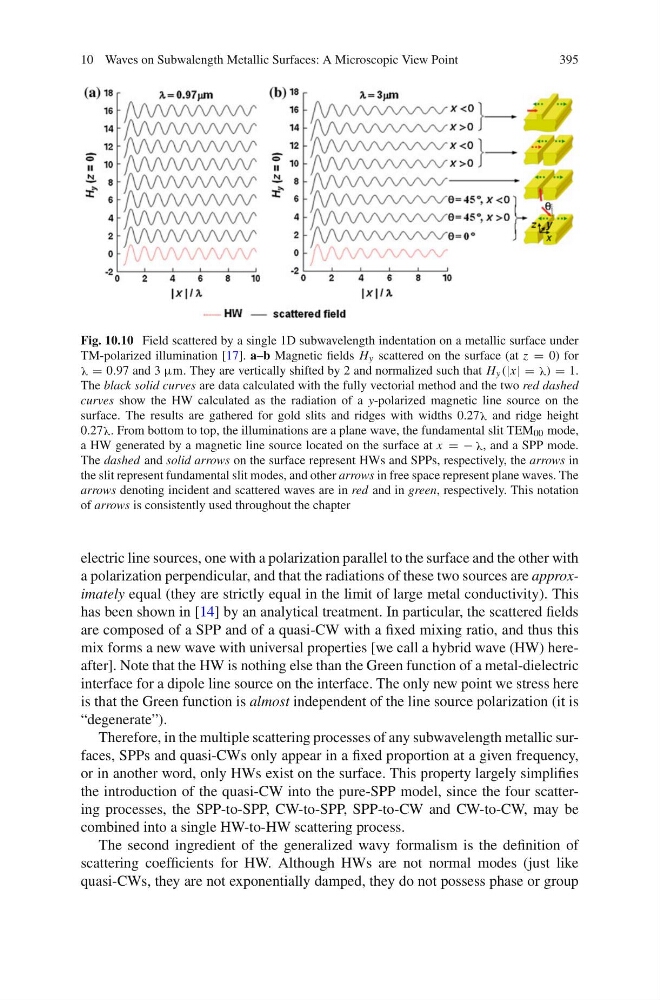
Fig. 10.10 Field scattered by a single 1D subwavelength indentation on a metallic surface under
TM-polarized illumination [17]. a–b Magnetic fields H y scattered on the surface (at z = 0) for
λ = 0.97 and 3 μm. They are vertically shifted by 2 and normalized such that H y (|x| = λ) = 1.
The black solid curves are data calculated with the fully vectorial method and the two red dashed
curves show the HW calculated as the radiation of a y-polarized magnetic line source on the
surface. The results are gathered for gold slits and ridges with widths 0.27λ and ridge height
0.27λ. From bottom to top, the illuminations are a plane wave, the fundamental slit TEM 00 mode,
a HW generated by a magnetic line source located on the surface at x = − λ, and a SPP mode.
The dashed and solid arrows on the surface represent HWs and SPPs, respectively, the arrows in
the slit represent fundamental slit modes, and other arrows in free space represent plane waves. The
arrows denoting incident and scattered waves are in red and in green, respectively. This notation
of arrows is consistently used throughout the chapter
electric line sources, one with a polarization parallel to the surface and the other with
a polarization perpendicular, and that the radiations of these two sources are approximately equal (they are strictly equal in the limit of large metal conductivity). This
has been shown in [14] by an analytical treatment. In particular, the scattered fields
are composed of a SPP and of a quasi-CW with a fixed mixing ratio, and thus this
mix forms a new wave with universal properties [we call a hybrid wave (HW) hereafter]. Note that the HW is nothing else than the Green function of a metal-dielectric
interface for a dipole line source on the interface. The only new point we stress here
is that the Green function is almost independent of the line source polarization (it is
“degenerate”).
Therefore, in the multiple scattering processes of any subwavelength metallic surfaces, SPPs and quasi-CWs only appear in a fixed proportion at a given frequency,
or in another word, only HWs exist on the surface. This property largely simplifies
the introduction of the quasi-CW into the pure-SPP model, since the four scattering processes, the SPP-to-SPP, CW-to-SPP, SPP-to-CW and CW-to-CW, may be
combined into a single HW-to-HW scattering process.
The second ingredient of the generalized wavy formalism is the definition of
scattering coefficients for HW. Although HWs are not normal modes (just like
quasi-CWs, they are not exponentially damped, they do not possess phase or group
395
Fig. 10.10 Field scattered by a single 1D subwavelength indentation on a metallic surface under
TM-polarized illumination [17]. a–b Magnetic fields H y scattered on the surface (at z = 0) for
λ = 0.97 and 3 μm. They are vertically shifted by 2 and normalized such that H y (|x| = λ) = 1.
The black solid curves are data calculated with the fully vectorial method and the two red dashed
curves show the HW calculated as the radiation of a y-polarized magnetic line source on the
surface. The results are gathered for gold slits and ridges with widths 0.27λ and ridge height
0.27λ. From bottom to top, the illuminations are a plane wave, the fundamental slit TEM 00 mode,
a HW generated by a magnetic line source located on the surface at x = − λ, and a SPP mode.
The dashed and solid arrows on the surface represent HWs and SPPs, respectively, the arrows in
the slit represent fundamental slit modes, and other arrows in free space represent plane waves. The
arrows denoting incident and scattered waves are in red and in green, respectively. This notation
of arrows is consistently used throughout the chapter
electric line sources, one with a polarization parallel to the surface and the other with
a polarization perpendicular, and that the radiations of these two sources are approximately equal (they are strictly equal in the limit of large metal conductivity). This
has been shown in [14] by an analytical treatment. In particular, the scattered fields
are composed of a SPP and of a quasi-CW with a fixed mixing ratio, and thus this
mix forms a new wave with universal properties [we call a hybrid wave (HW) hereafter]. Note that the HW is nothing else than the Green function of a metal-dielectric
interface for a dipole line source on the interface. The only new point we stress here
is that the Green function is almost independent of the line source polarization (it is
“degenerate”).
Therefore, in the multiple scattering processes of any subwavelength metallic surfaces, SPPs and quasi-CWs only appear in a fixed proportion at a given frequency,
or in another word, only HWs exist on the surface. This property largely simplifies
the introduction of the quasi-CW into the pure-SPP model, since the four scattering processes, the SPP-to-SPP, CW-to-SPP, SPP-to-CW and CW-to-CW, may be
combined into a single HW-to-HW scattering process.
The second ingredient of the generalized wavy formalism is the definition of
scattering coefficients for HW. Although HWs are not normal modes (just like
quasi-CWs, they are not exponentially damped, they do not possess phase or group