

394
P. Lalanne and H. Liu
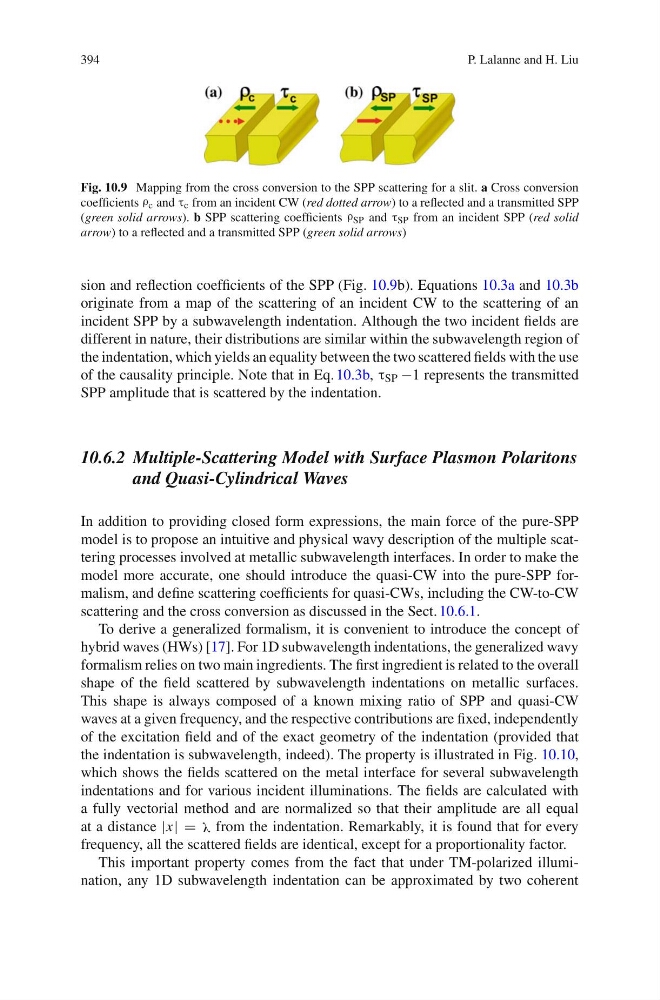
Fig. 10.9 Mapping from the cross conversion to the SPP scattering for a slit. a Cross conversion
coefficients ρ c and τ c from an incident CW (red dotted arrow) to a reflected and a transmitted SPP
(green solid arrows). b SPP scattering coefficients ρ SP and τ SP from an incident SPP (red solid
arrow) to a reflected and a transmitted SPP (green solid arrows)
sion and reflection coefficients of the SPP (Fig. 10.9b). Equations 10.3a and 10.3b
originate from a map of the scattering of an incident CW to the scattering of an
incident SPP by a subwavelength indentation. Although the two incident fields are
different in nature, their distributions are similar within the subwavelength region of
the indentation, which yields an equality between the two scattered fields with the use
of the causality principle. Note that in Eq. 10.3b, τ SP −1 represents the transmitted
SPP amplitude that is scattered by the indentation.
10.6.2 Multiple-Scattering Model with Surface Plasmon Polaritons
and Quasi-Cylindrical Waves
In addition to providing closed form expressions, the main force of the pure-SPP
model is to propose an intuitive and physical wavy description of the multiple scattering processes involved at metallic subwavelength interfaces. In order to make the
model more accurate, one should introduce the quasi-CW into the pure-SPP formalism, and define scattering coefficients for quasi-CWs, including the CW-to-CW
scattering and the cross conversion as discussed in the Sect. 10.6.1.
To derive a generalized formalism, it is convenient to introduce the concept of
hybrid waves (HWs) [17]. For 1D subwavelength indentations, the generalized wavy
formalism relies on two main ingredients. The first ingredient is related to the overall
shape of the field scattered by subwavelength indentations on metallic surfaces.
This shape is always composed of a known mixing ratio of SPP and quasi-CW
waves at a given frequency, and the respective contributions are fixed, independently
of the excitation field and of the exact geometry of the indentation (provided that
the indentation is subwavelength, indeed). The property is illustrated in Fig. 10.10,
which shows the fields scattered on the metal interface for several subwavelength
indentations and for various incident illuminations. The fields are calculated with
a fully vectorial method and are normalized so that their amplitude are all equal
at a distance |x| = λ from the indentation. Remarkably, it is found that for every
frequency, all the scattered fields are identical, except for a proportionality factor.
This important property comes from the fact that under TM-polarized illumination, any 1D subwavelength indentation can be approximated by two coherent
P. Lalanne and H. Liu
Fig. 10.9 Mapping from the cross conversion to the SPP scattering for a slit. a Cross conversion
coefficients ρ c and τ c from an incident CW (red dotted arrow) to a reflected and a transmitted SPP
(green solid arrows). b SPP scattering coefficients ρ SP and τ SP from an incident SPP (red solid
arrow) to a reflected and a transmitted SPP (green solid arrows)
sion and reflection coefficients of the SPP (Fig. 10.9b). Equations 10.3a and 10.3b
originate from a map of the scattering of an incident CW to the scattering of an
incident SPP by a subwavelength indentation. Although the two incident fields are
different in nature, their distributions are similar within the subwavelength region of
the indentation, which yields an equality between the two scattered fields with the use
of the causality principle. Note that in Eq. 10.3b, τ SP −1 represents the transmitted
SPP amplitude that is scattered by the indentation.
10.6.2 Multiple-Scattering Model with Surface Plasmon Polaritons
and Quasi-Cylindrical Waves
In addition to providing closed form expressions, the main force of the pure-SPP
model is to propose an intuitive and physical wavy description of the multiple scattering processes involved at metallic subwavelength interfaces. In order to make the
model more accurate, one should introduce the quasi-CW into the pure-SPP formalism, and define scattering coefficients for quasi-CWs, including the CW-to-CW
scattering and the cross conversion as discussed in the Sect. 10.6.1.
To derive a generalized formalism, it is convenient to introduce the concept of
hybrid waves (HWs) [17]. For 1D subwavelength indentations, the generalized wavy
formalism relies on two main ingredients. The first ingredient is related to the overall
shape of the field scattered by subwavelength indentations on metallic surfaces.
This shape is always composed of a known mixing ratio of SPP and quasi-CW
waves at a given frequency, and the respective contributions are fixed, independently
of the excitation field and of the exact geometry of the indentation (provided that
the indentation is subwavelength, indeed). The property is illustrated in Fig. 10.10,
which shows the fields scattered on the metal interface for several subwavelength
indentations and for various incident illuminations. The fields are calculated with
a fully vectorial method and are normalized so that their amplitude are all equal
at a distance |x| = λ from the indentation. Remarkably, it is found that for every
frequency, all the scattered fields are identical, except for a proportionality factor.
This important property comes from the fact that under TM-polarized illumination, any 1D subwavelength indentation can be approximated by two coherent