

10 Waves on Subwalength Metallic Surfaces: A Microscopic View Point
397
revealed that the generalized formalism is highly accurate, even when the indentation
dimensions are as large as λ /3. Similar results have been reported in [12, 15] for
other geometries. The generalized formalism has also been successfully applied for
the EOT, see [17] for details. In the generalized formalism, the reflection coefficientr A
of the fundamental supermode of the hole array is given by
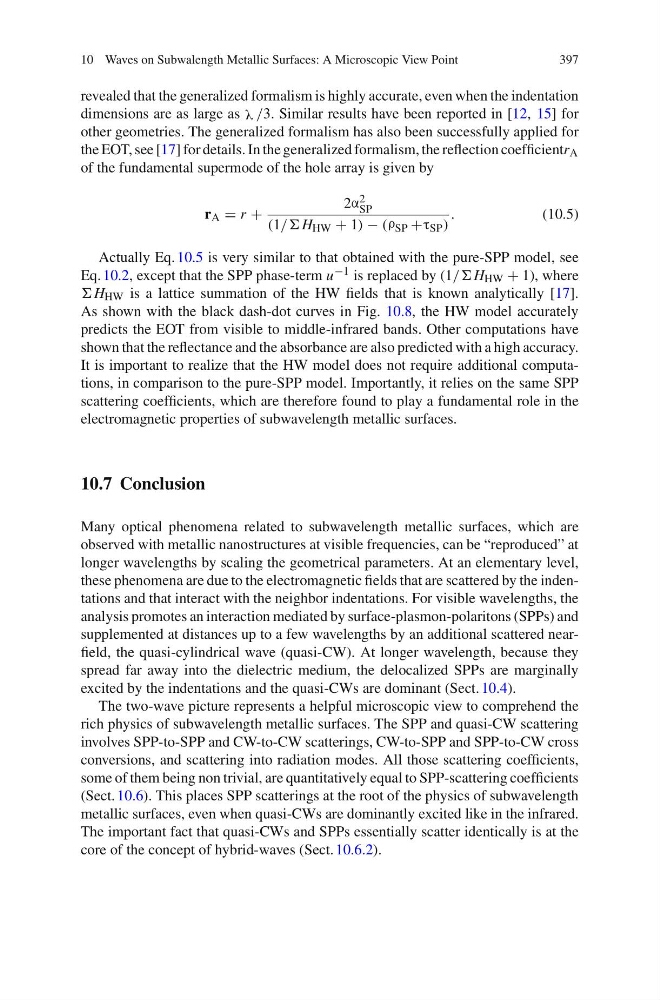
r A = r +
2α 2
SP
(1/λ H HW + 1) − ( ρ SP +τ SP )
.
(10.5)
Actually Eq. 10.5 is very similar to that obtained with the pure-SPP model, see
Eq. 10.2, except that the SPP phase-term u −1 is replaced by (1/λ H HW + 1), where
λ H HW is a lattice summation of the HW fields that is known analytically [17].
As shown with the black dash-dot curves in Fig. 10.8, the HW model accurately
predicts the EOT from visible to middle-infrared bands. Other computations have
shown that the reflectance and the absorbance are also predicted with a high accuracy.
It is important to realize that the HW model does not require additional computations, in comparison to the pure-SPP model. Importantly, it relies on the same SPP
scattering coefficients, which are therefore found to play a fundamental role in the
electromagnetic properties of subwavelength metallic surfaces.
10.7 Conclusion
Many optical phenomena related to subwavelength metallic surfaces, which are
observed with metallic nanostructures at visible frequencies, can be “reproduced” at
longer wavelengths by scaling the geometrical parameters. At an elementary level,
these phenomena are due to the electromagnetic fields that are scattered by the indentations and that interact with the neighbor indentations. For visible wavelengths, the
analysis promotes an interaction mediated by surface-plasmon-polaritons (SPPs) and
supplemented at distances up to a few wavelengths by an additional scattered nearfield, the quasi-cylindrical wave (quasi-CW). At longer wavelength, because they
spread far away into the dielectric medium, the delocalized SPPs are marginally
excited by the indentations and the quasi-CWs are dominant (Sect. 10.4).
The two-wave picture represents a helpful microscopic view to comprehend the
rich physics of subwavelength metallic surfaces. The SPP and quasi-CW scattering
involves SPP-to-SPP and CW-to-CW scatterings, CW-to-SPP and SPP-to-CW cross
conversions, and scattering into radiation modes. All those scattering coefficients,
some of them being non trivial, are quantitatively equal to SPP-scattering coefficients
(Sect. 10.6). This places SPP scatterings at the root of the physics of subwavelength
metallic surfaces, even when quasi-CWs are dominantly excited like in the infrared.
The important fact that quasi-CWs and SPPs essentially scatter identically is at the
core of the concept of hybrid-waves (Sect. 10.6.2).
397
revealed that the generalized formalism is highly accurate, even when the indentation
dimensions are as large as λ /3. Similar results have been reported in [12, 15] for
other geometries. The generalized formalism has also been successfully applied for
the EOT, see [17] for details. In the generalized formalism, the reflection coefficientr A
of the fundamental supermode of the hole array is given by
r A = r +
2α 2
SP
(1/λ H HW + 1) − ( ρ SP +τ SP )
.
(10.5)
Actually Eq. 10.5 is very similar to that obtained with the pure-SPP model, see
Eq. 10.2, except that the SPP phase-term u −1 is replaced by (1/λ H HW + 1), where
λ H HW is a lattice summation of the HW fields that is known analytically [17].
As shown with the black dash-dot curves in Fig. 10.8, the HW model accurately
predicts the EOT from visible to middle-infrared bands. Other computations have
shown that the reflectance and the absorbance are also predicted with a high accuracy.
It is important to realize that the HW model does not require additional computations, in comparison to the pure-SPP model. Importantly, it relies on the same SPP
scattering coefficients, which are therefore found to play a fundamental role in the
electromagnetic properties of subwavelength metallic surfaces.
10.7 Conclusion
Many optical phenomena related to subwavelength metallic surfaces, which are
observed with metallic nanostructures at visible frequencies, can be “reproduced” at
longer wavelengths by scaling the geometrical parameters. At an elementary level,
these phenomena are due to the electromagnetic fields that are scattered by the indentations and that interact with the neighbor indentations. For visible wavelengths, the
analysis promotes an interaction mediated by surface-plasmon-polaritons (SPPs) and
supplemented at distances up to a few wavelengths by an additional scattered nearfield, the quasi-cylindrical wave (quasi-CW). At longer wavelength, because they
spread far away into the dielectric medium, the delocalized SPPs are marginally
excited by the indentations and the quasi-CWs are dominant (Sect. 10.4).
The two-wave picture represents a helpful microscopic view to comprehend the
rich physics of subwavelength metallic surfaces. The SPP and quasi-CW scattering
involves SPP-to-SPP and CW-to-CW scatterings, CW-to-SPP and SPP-to-CW cross
conversions, and scattering into radiation modes. All those scattering coefficients,
some of them being non trivial, are quantitatively equal to SPP-scattering coefficients
(Sect. 10.6). This places SPP scatterings at the root of the physics of subwavelength
metallic surfaces, even when quasi-CWs are dominantly excited like in the infrared.
The important fact that quasi-CWs and SPPs essentially scatter identically is at the
core of the concept of hybrid-waves (Sect. 10.6.2).