

386
P. Lalanne and H. Liu
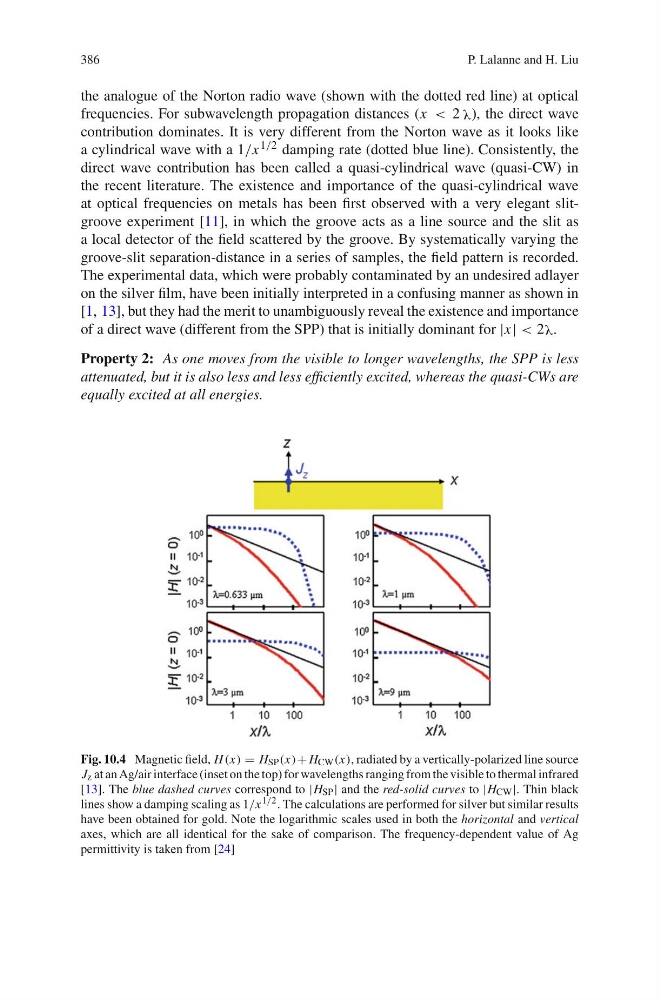
the analogue of the Norton radio wave (shown with the dotted red line) at optical
frequencies. For subwavelength propagation distances (x < 2 λ), the direct wave
contribution dominates. It is very different from the Norton wave as it looks like
a cylindrical wave with a 1/x 1/2 damping rate (dotted blue line). Consistently, the
direct wave contribution has been called a quasi-cylindrical wave (quasi-CW) in
the recent literature. The existence and importance of the quasi-cylindrical wave
at optical frequencies on metals has been first observed with a very elegant slitgroove experiment [11], in which the groove acts as a line source and the slit as
a local detector of the field scattered by the groove. By systematically varying the
groove-slit separation-distance in a series of samples, the field pattern is recorded.
The experimental data, which were probably contaminated by an undesired adlayer
on the silver film, have been initially interpreted in a confusing manner as shown in
[1, 13], but they had the merit to unambiguously reveal the existence and importance
of a direct wave (different from the SPP) that is initially dominant for |x| < 2λ.
Property 2: As one moves from the visible to longer wavelengths, the SPP is less
attenuated, but it is also less and less efficiently excited, whereas the quasi-CWs are
equally excited at all energies.
Fig. 10.4 Magnetic field, H (x) = H SP (x)+ H CW (x), radiated by a vertically-polarized line source
J z at an Ag/air interface (inset on the top) for wavelengths ranging from the visible to thermal infrared
[13]. The blue dashed curves correspond to |H SP | and the red-solid curves to |H CW |. Thin black
lines show a damping scaling as 1/x 1/2 . The calculations are performed for silver but similar results
have been obtained for gold. Note the logarithmic scales used in both the horizontal and vertical
axes, which are all identical for the sake of comparison. The frequency-dependent value of Ag
permittivity is taken from [24]
P. Lalanne and H. Liu
the analogue of the Norton radio wave (shown with the dotted red line) at optical
frequencies. For subwavelength propagation distances (x < 2 λ), the direct wave
contribution dominates. It is very different from the Norton wave as it looks like
a cylindrical wave with a 1/x 1/2 damping rate (dotted blue line). Consistently, the
direct wave contribution has been called a quasi-cylindrical wave (quasi-CW) in
the recent literature. The existence and importance of the quasi-cylindrical wave
at optical frequencies on metals has been first observed with a very elegant slitgroove experiment [11], in which the groove acts as a line source and the slit as
a local detector of the field scattered by the groove. By systematically varying the
groove-slit separation-distance in a series of samples, the field pattern is recorded.
The experimental data, which were probably contaminated by an undesired adlayer
on the silver film, have been initially interpreted in a confusing manner as shown in
[1, 13], but they had the merit to unambiguously reveal the existence and importance
of a direct wave (different from the SPP) that is initially dominant for |x| < 2λ.
Property 2: As one moves from the visible to longer wavelengths, the SPP is less
attenuated, but it is also less and less efficiently excited, whereas the quasi-CWs are
equally excited at all energies.
Fig. 10.4 Magnetic field, H (x) = H SP (x)+ H CW (x), radiated by a vertically-polarized line source
J z at an Ag/air interface (inset on the top) for wavelengths ranging from the visible to thermal infrared
[13]. The blue dashed curves correspond to |H SP | and the red-solid curves to |H CW |. Thin black
lines show a damping scaling as 1/x 1/2 . The calculations are performed for silver but similar results
have been obtained for gold. Note the logarithmic scales used in both the horizontal and vertical
axes, which are all identical for the sake of comparison. The frequency-dependent value of Ag
permittivity is taken from [24]