

10 Waves on Subwalength Metallic Surfaces: A Microscopic View Point
385
Referring to Fig. 10.2, a subwavelength indentation invariant along the y-axis
(the z-axis being perpendicular to the surface) and illuminated with a plane wave
polarized in the x-z plane (Fig. 10.2a), can be replaced by two electric line sources in
the dipolar approximation (Fig. 10.2b), one J z being polarized perpendicularly to the
interface (along the z-axis) and the other one J x parallel to the interface (along the
x-axis). Concerning the field scattered on the surface (this is the field that is responsible for the electromagnetic interaction between the indentations on the surface),
three important properties are worth mentioning here.
Property 1: The field radiated on the surface by each individual line source can
be decomposed into a SPP mode and a quasi-cylindrical wave (quasi-CW), which
represents a “direct” contribution from the source.
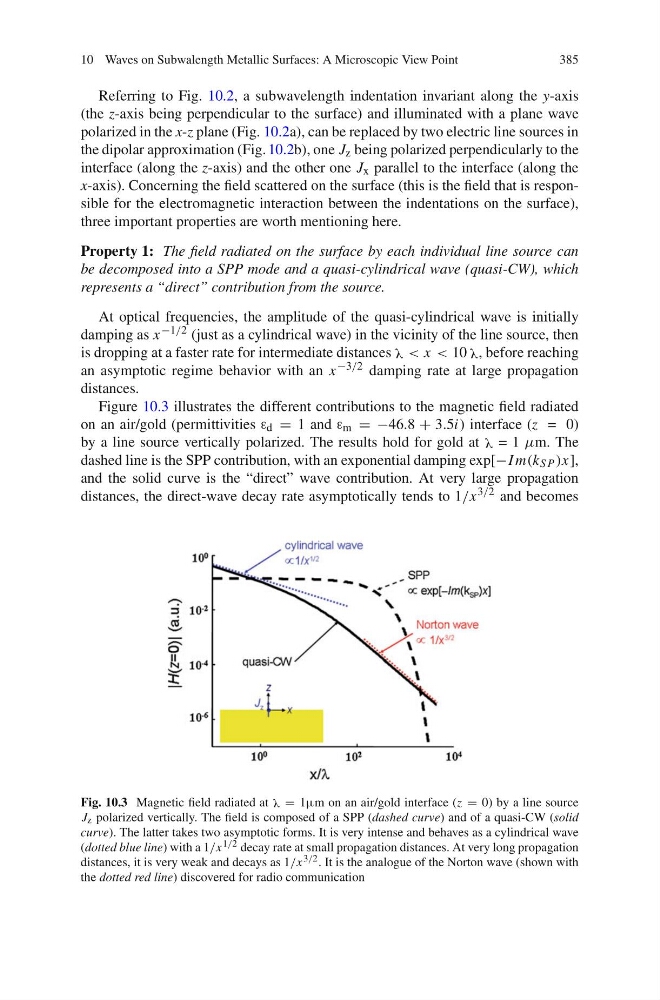
At optical frequencies, the amplitude of the quasi-cylindrical wave is initially
damping as x −1/2 (just as a cylindrical wave) in the vicinity of the line source, then
is dropping at a faster rate for intermediate distances λ < x < 10 λ, before reaching
an asymptotic regime behavior with an x −3/2 damping rate at large propagation
distances.
Figure 10.3 illustrates the different contributions to the magnetic field radiated
on an air/gold (permittivities ε d = 1 and ε m = −46.8 + 3.5i) interface (z = 0)
by a line source vertically polarized. The results hold for gold at λ = 1 μm. The
dashed line is the SPP contribution, with an exponential damping exp[−I m(k S P )x],
and the solid curve is the “direct” wave contribution. At very large propagation
distances, the direct-wave decay rate asymptotically tends to 1/x 3/2 and becomes
Fig. 10.3 Magnetic field radiated at λ = 1μm on an air/gold interface (z = 0) by a line source
J z polarized vertically. The field is composed of a SPP (dashed curve) and of a quasi-CW (solid
curve). The latter takes two asymptotic forms. It is very intense and behaves as a cylindrical wave
(dotted blue line) with a 1/x 1/2 decay rate at small propagation distances. At very long propagation
distances, it is very weak and decays as 1/x 3/2 . It is the analogue of the Norton wave (shown with
the dotted red line) discovered for radio communication
385
Referring to Fig. 10.2, a subwavelength indentation invariant along the y-axis
(the z-axis being perpendicular to the surface) and illuminated with a plane wave
polarized in the x-z plane (Fig. 10.2a), can be replaced by two electric line sources in
the dipolar approximation (Fig. 10.2b), one J z being polarized perpendicularly to the
interface (along the z-axis) and the other one J x parallel to the interface (along the
x-axis). Concerning the field scattered on the surface (this is the field that is responsible for the electromagnetic interaction between the indentations on the surface),
three important properties are worth mentioning here.
Property 1: The field radiated on the surface by each individual line source can
be decomposed into a SPP mode and a quasi-cylindrical wave (quasi-CW), which
represents a “direct” contribution from the source.
At optical frequencies, the amplitude of the quasi-cylindrical wave is initially
damping as x −1/2 (just as a cylindrical wave) in the vicinity of the line source, then
is dropping at a faster rate for intermediate distances λ < x < 10 λ, before reaching
an asymptotic regime behavior with an x −3/2 damping rate at large propagation
distances.
Figure 10.3 illustrates the different contributions to the magnetic field radiated
on an air/gold (permittivities ε d = 1 and ε m = −46.8 + 3.5i) interface (z = 0)
by a line source vertically polarized. The results hold for gold at λ = 1 μm. The
dashed line is the SPP contribution, with an exponential damping exp[−I m(k S P )x],
and the solid curve is the “direct” wave contribution. At very large propagation
distances, the direct-wave decay rate asymptotically tends to 1/x 3/2 and becomes
Fig. 10.3 Magnetic field radiated at λ = 1μm on an air/gold interface (z = 0) by a line source
J z polarized vertically. The field is composed of a SPP (dashed curve) and of a quasi-CW (solid
curve). The latter takes two asymptotic forms. It is very intense and behaves as a cylindrical wave
(dotted blue line) with a 1/x 1/2 decay rate at small propagation distances. At very long propagation
distances, it is very weak and decays as 1/x 3/2 . It is the analogue of the Norton wave (shown with
the dotted red line) discovered for radio communication