

384
P. Lalanne and H. Liu
The big success of introducing a bounded SPP mode to convincingly explain the
experimental red shift is a milestone result, and since Fano’s work our understanding of Wood’s anomalies is intimately linked to the resonant excitation of SPPs.
The last decade has proved that this vision is simplistic and that, although Fano’s
approach is remarkable in predicting the resonant wavelength, Rayleigh and Fano’s
interpretations should be actually “combined” to provide a quantitative analysis of
Wood’s anomalies.
10.4 Field Scattered on Metal Surfaces by Subwavelength
Indentations
The waves scattered on the surface of a metal film by a tiny indentation are at the
essence of the optical properties of metallic subwavelength surfaces. Provided that
the indention is small enough (in practice, dimensions should be smaller than λ /3),
it is convenient to consider asymptotically small indentations. For 1D indentations,
such as grooves or ridges like in Wood’s experiment, the equivalent sources are Dirac
line sources. When the polarization of the incident wave is parallel to the indentation, the field radiated on the surface is nearly zero. In that case often referred to as
TE polarization, the indentations are all independent and the field scattered by all
indentations is simply the superposition of the field scattered by every indentation.
This “trivial” case is not discussed hereafter. The TM polarization case is much more
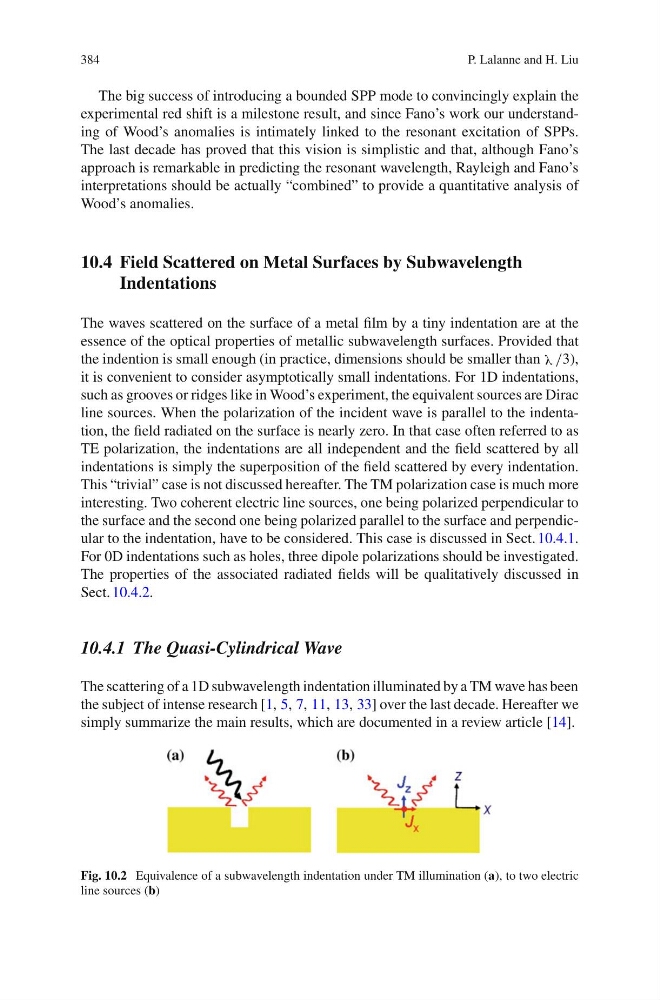
interesting. Two coherent electric line sources, one being polarized perpendicular to
the surface and the second one being polarized parallel to the surface and perpendicular to the indentation, have to be considered. This case is discussed in Sect. 10.4.1.
For 0D indentations such as holes, three dipole polarizations should be investigated.
The properties of the associated radiated fields will be qualitatively discussed in
Sect. 10.4.2.
10.4.1 The Quasi-Cylindrical Wave
The scattering of a 1D subwavelength indentation illuminated by a TM wave has been
the subject of intense research [1, 5, 7, 11, 13, 33] over the last decade. Hereafter we
simply summarize the main results, which are documented in a review article [14].
Fig. 10.2 Equivalence of a subwavelength indentation under TM illumination (a), to two electric
line sources (b)
P. Lalanne and H. Liu
The big success of introducing a bounded SPP mode to convincingly explain the
experimental red shift is a milestone result, and since Fano’s work our understanding of Wood’s anomalies is intimately linked to the resonant excitation of SPPs.
The last decade has proved that this vision is simplistic and that, although Fano’s
approach is remarkable in predicting the resonant wavelength, Rayleigh and Fano’s
interpretations should be actually “combined” to provide a quantitative analysis of
Wood’s anomalies.
10.4 Field Scattered on Metal Surfaces by Subwavelength
Indentations
The waves scattered on the surface of a metal film by a tiny indentation are at the
essence of the optical properties of metallic subwavelength surfaces. Provided that
the indention is small enough (in practice, dimensions should be smaller than λ /3),
it is convenient to consider asymptotically small indentations. For 1D indentations,
such as grooves or ridges like in Wood’s experiment, the equivalent sources are Dirac
line sources. When the polarization of the incident wave is parallel to the indentation, the field radiated on the surface is nearly zero. In that case often referred to as
TE polarization, the indentations are all independent and the field scattered by all
indentations is simply the superposition of the field scattered by every indentation.
This “trivial” case is not discussed hereafter. The TM polarization case is much more
interesting. Two coherent electric line sources, one being polarized perpendicular to
the surface and the second one being polarized parallel to the surface and perpendicular to the indentation, have to be considered. This case is discussed in Sect. 10.4.1.
For 0D indentations such as holes, three dipole polarizations should be investigated.
The properties of the associated radiated fields will be qualitatively discussed in
Sect. 10.4.2.
10.4.1 The Quasi-Cylindrical Wave
The scattering of a 1D subwavelength indentation illuminated by a TM wave has been
the subject of intense research [1, 5, 7, 11, 13, 33] over the last decade. Hereafter we
simply summarize the main results, which are documented in a review article [14].
Fig. 10.2 Equivalence of a subwavelength indentation under TM illumination (a), to two electric
line sources (b)