

10 Waves on Subwalength Metallic Surfaces: A Microscopic View Point
383
the energy transport between adjacent grooves. It is retrospectively interesting and
amazing to see how the surface wave, which is nothing else than the SPP of the flat
interface, is introduced in Fano’s model. U. Fano first considered the parallel propagation constants of the modes of a glass plate sandwiched between a metal and a
vacuum and asks himself “Is there left any mode when the thickness of the glass layer
vanishes?”. By solving analytically the bi-interface problem, he showed that one and
only one bound mode (the SPP) exists in the limit of vanishingly small glass thicknesses for TM polarization, with a complex propagation constant whose real part is
always slightly larger than the modulus k 0 of the wave-vector in a vacuum. He therefore made the ansatz that Wood’s anomaly originates from a collective resonance of
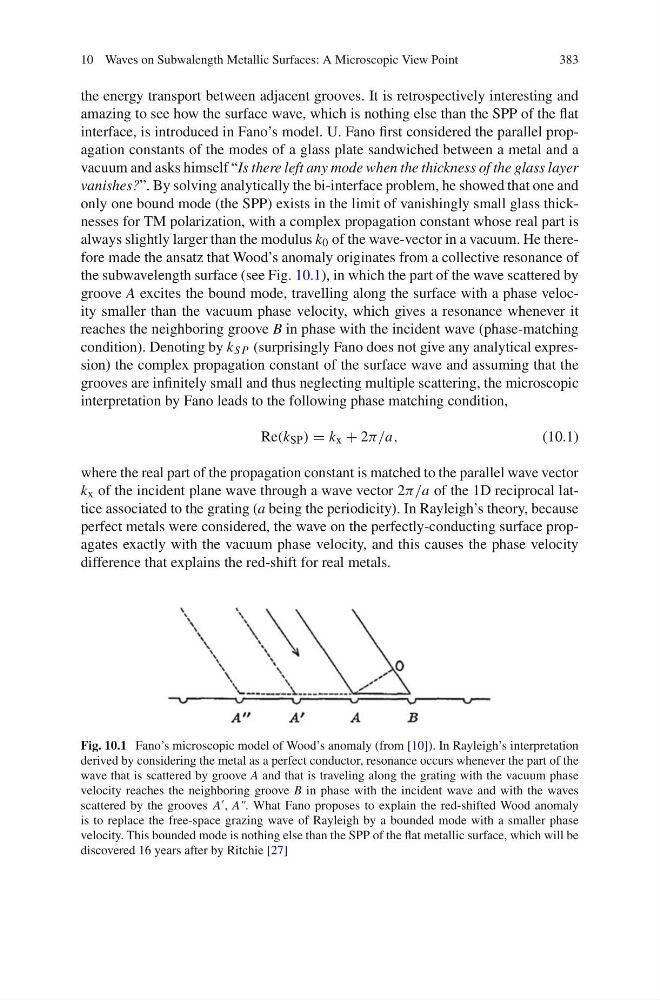
the subwavelength surface (see Fig. 10.1), in which the part of the wave scattered by
groove A excites the bound mode, travelling along the surface with a phase velocity smaller than the vacuum phase velocity, which gives a resonance whenever it
reaches the neighboring groove B in phase with the incident wave (phase-matching
condition). Denoting by k S P (surprisingly Fano does not give any analytical expression) the complex propagation constant of the surface wave and assuming that the
grooves are infinitely small and thus neglecting multiple scattering, the microscopic
interpretation by Fano leads to the following phase matching condition,
Re(k SP ) = k x + 2ε/a,
(10.1)
where the real part of the propagation constant is matched to the parallel wave vector
k x of the incident plane wave through a wave vector 2ε/a of the 1D reciprocal lattice associated to the grating (a being the periodicity). In Rayleigh’s theory, because
perfect metals were considered, the wave on the perfectly-conducting surface propagates exactly with the vacuum phase velocity, and this causes the phase velocity
difference that explains the red-shift for real metals.
Fig. 10.1 Fano’s microscopic model of Wood’s anomaly (from [10]). In Rayleigh’s interpretation
derived by considering the metal as a perfect conductor, resonance occurs whenever the part of the
wave that is scattered by groove A and that is traveling along the grating with the vacuum phase
velocity reaches the neighboring groove B in phase with the incident wave and with the waves
scattered by the grooves A ∪ , A". What Fano proposes to explain the red-shifted Wood anomaly
is to replace the free-space grazing wave of Rayleigh by a bounded mode with a smaller phase
velocity. This bounded mode is nothing else than the SPP of the flat metallic surface, which will be
discovered 16 years after by Ritchie [27]
383
the energy transport between adjacent grooves. It is retrospectively interesting and
amazing to see how the surface wave, which is nothing else than the SPP of the flat
interface, is introduced in Fano’s model. U. Fano first considered the parallel propagation constants of the modes of a glass plate sandwiched between a metal and a
vacuum and asks himself “Is there left any mode when the thickness of the glass layer
vanishes?”. By solving analytically the bi-interface problem, he showed that one and
only one bound mode (the SPP) exists in the limit of vanishingly small glass thicknesses for TM polarization, with a complex propagation constant whose real part is
always slightly larger than the modulus k 0 of the wave-vector in a vacuum. He therefore made the ansatz that Wood’s anomaly originates from a collective resonance of
the subwavelength surface (see Fig. 10.1), in which the part of the wave scattered by
groove A excites the bound mode, travelling along the surface with a phase velocity smaller than the vacuum phase velocity, which gives a resonance whenever it
reaches the neighboring groove B in phase with the incident wave (phase-matching
condition). Denoting by k S P (surprisingly Fano does not give any analytical expression) the complex propagation constant of the surface wave and assuming that the
grooves are infinitely small and thus neglecting multiple scattering, the microscopic
interpretation by Fano leads to the following phase matching condition,
Re(k SP ) = k x + 2ε/a,
(10.1)
where the real part of the propagation constant is matched to the parallel wave vector
k x of the incident plane wave through a wave vector 2ε/a of the 1D reciprocal lattice associated to the grating (a being the periodicity). In Rayleigh’s theory, because
perfect metals were considered, the wave on the perfectly-conducting surface propagates exactly with the vacuum phase velocity, and this causes the phase velocity
difference that explains the red-shift for real metals.
Fig. 10.1 Fano’s microscopic model of Wood’s anomaly (from [10]). In Rayleigh’s interpretation
derived by considering the metal as a perfect conductor, resonance occurs whenever the part of the
wave that is scattered by groove A and that is traveling along the grating with the vacuum phase
velocity reaches the neighboring groove B in phase with the incident wave and with the waves
scattered by the grooves A ∪ , A". What Fano proposes to explain the red-shifted Wood anomaly
is to replace the free-space grazing wave of Rayleigh by a bounded mode with a smaller phase
velocity. This bounded mode is nothing else than the SPP of the flat metallic surface, which will be
discovered 16 years after by Ritchie [27]