

350
L. D. Negro et al.
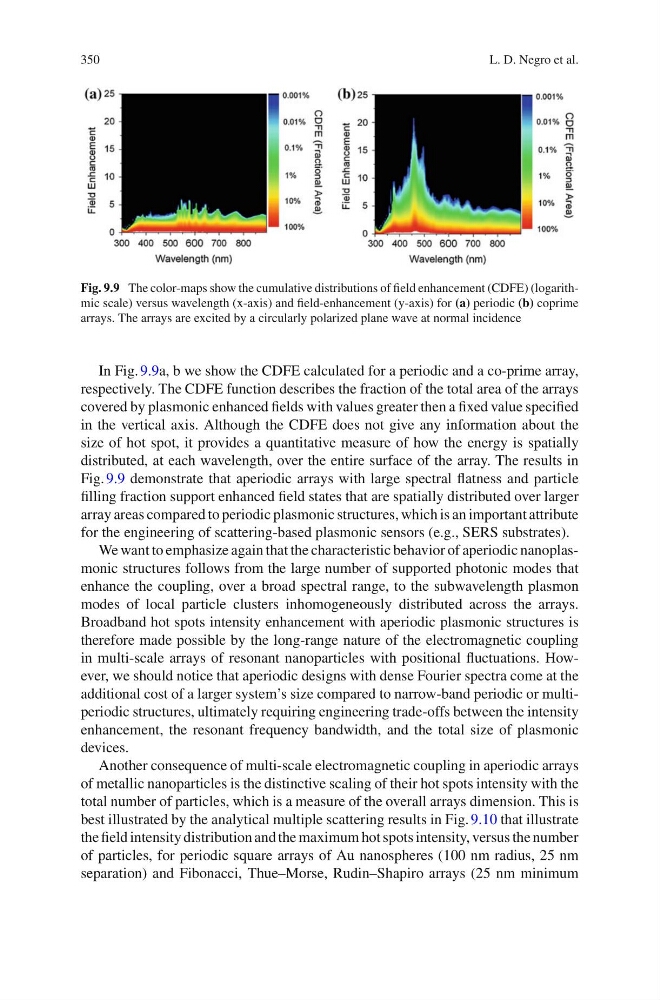
Fig. 9.9 The color-maps show the cumulative distributions of field enhancement (CDFE) (logarithmic scale) versus wavelength (x-axis) and field-enhancement (y-axis) for (a) periodic (b) coprime
arrays. The arrays are excited by a circularly polarized plane wave at normal incidence
In Fig. 9.9a, b we show the CDFE calculated for a periodic and a co-prime array,
respectively. The CDFE function describes the fraction of the total area of the arrays
covered by plasmonic enhanced fields with values greater then a fixed value specified
in the vertical axis. Although the CDFE does not give any information about the
size of hot spot, it provides a quantitative measure of how the energy is spatially
distributed, at each wavelength, over the entire surface of the array. The results in
Fig. 9.9 demonstrate that aperiodic arrays with large spectral flatness and particle
filling fraction support enhanced field states that are spatially distributed over larger
array areas compared to periodic plasmonic structures, which is an important attribute
for the engineering of scattering-based plasmonic sensors (e.g., SERS substrates).
We want to emphasize again that the characteristic behavior of aperiodic nanoplasmonic structures follows from the large number of supported photonic modes that
enhance the coupling, over a broad spectral range, to the subwavelength plasmon
modes of local particle clusters inhomogeneously distributed across the arrays.
Broadband hot spots intensity enhancement with aperiodic plasmonic structures is
therefore made possible by the long-range nature of the electromagnetic coupling
in multi-scale arrays of resonant nanoparticles with positional fluctuations. However, we should notice that aperiodic designs with dense Fourier spectra come at the
additional cost of a larger system’s size compared to narrow-band periodic or multiperiodic structures, ultimately requiring engineering trade-offs between the intensity
enhancement, the resonant frequency bandwidth, and the total size of plasmonic
devices.
Another consequence of multi-scale electromagnetic coupling in aperiodic arrays
of metallic nanoparticles is the distinctive scaling of their hot spots intensity with the
total number of particles, which is a measure of the overall arrays dimension. This is
best illustrated by the analytical multiple scattering results in Fig. 9.10 that illustrate
the field intensity distribution and the maximum hot spots intensity, versus the number
of particles, for periodic square arrays of Au nanospheres (100 nm radius, 25 nm
separation) and Fibonacci, Thue–Morse, Rudin–Shapiro arrays (25 nm minimum
L. D. Negro et al.
Fig. 9.9 The color-maps show the cumulative distributions of field enhancement (CDFE) (logarithmic scale) versus wavelength (x-axis) and field-enhancement (y-axis) for (a) periodic (b) coprime
arrays. The arrays are excited by a circularly polarized plane wave at normal incidence
In Fig. 9.9a, b we show the CDFE calculated for a periodic and a co-prime array,
respectively. The CDFE function describes the fraction of the total area of the arrays
covered by plasmonic enhanced fields with values greater then a fixed value specified
in the vertical axis. Although the CDFE does not give any information about the
size of hot spot, it provides a quantitative measure of how the energy is spatially
distributed, at each wavelength, over the entire surface of the array. The results in
Fig. 9.9 demonstrate that aperiodic arrays with large spectral flatness and particle
filling fraction support enhanced field states that are spatially distributed over larger
array areas compared to periodic plasmonic structures, which is an important attribute
for the engineering of scattering-based plasmonic sensors (e.g., SERS substrates).
We want to emphasize again that the characteristic behavior of aperiodic nanoplasmonic structures follows from the large number of supported photonic modes that
enhance the coupling, over a broad spectral range, to the subwavelength plasmon
modes of local particle clusters inhomogeneously distributed across the arrays.
Broadband hot spots intensity enhancement with aperiodic plasmonic structures is
therefore made possible by the long-range nature of the electromagnetic coupling
in multi-scale arrays of resonant nanoparticles with positional fluctuations. However, we should notice that aperiodic designs with dense Fourier spectra come at the
additional cost of a larger system’s size compared to narrow-band periodic or multiperiodic structures, ultimately requiring engineering trade-offs between the intensity
enhancement, the resonant frequency bandwidth, and the total size of plasmonic
devices.
Another consequence of multi-scale electromagnetic coupling in aperiodic arrays
of metallic nanoparticles is the distinctive scaling of their hot spots intensity with the
total number of particles, which is a measure of the overall arrays dimension. This is
best illustrated by the analytical multiple scattering results in Fig. 9.10 that illustrate
the field intensity distribution and the maximum hot spots intensity, versus the number
of particles, for periodic square arrays of Au nanospheres (100 nm radius, 25 nm
separation) and Fibonacci, Thue–Morse, Rudin–Shapiro arrays (25 nm minimum