

9 Aperiodic Order in Nanoplasmonics
351
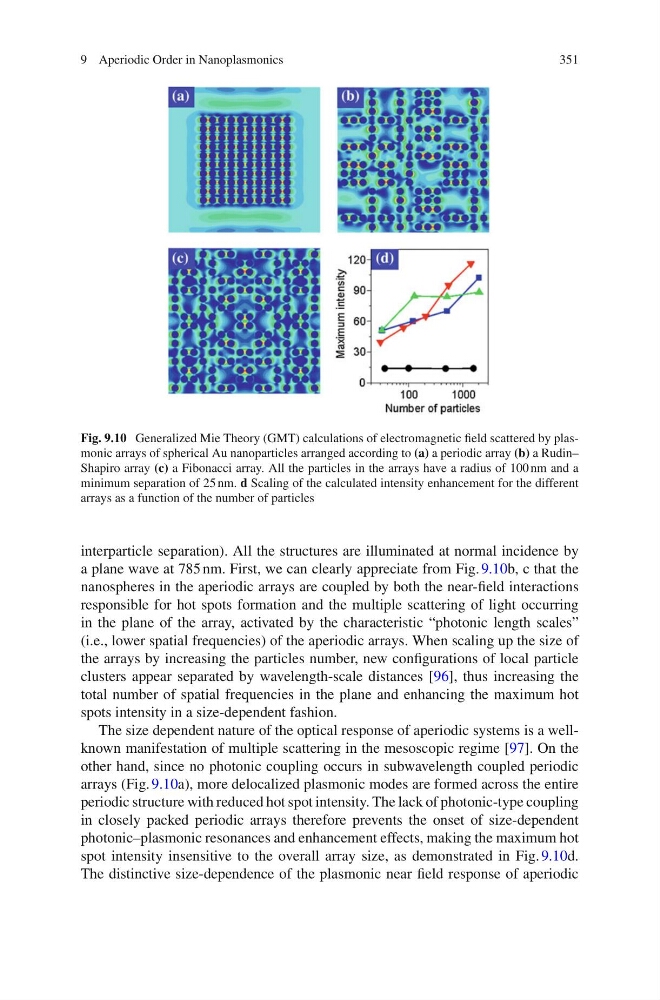
Fig. 9.10 Generalized Mie Theory (GMT) calculations of electromagnetic field scattered by plasmonic arrays of spherical Au nanoparticles arranged according to (a) a periodic array (b) a Rudin–
Shapiro array (c) a Fibonacci array. All the particles in the arrays have a radius of 100 nm and a
minimum separation of 25 nm. d Scaling of the calculated intensity enhancement for the different
arrays as a function of the number of particles
interparticle separation). All the structures are illuminated at normal incidence by
a plane wave at 785 nm. First, we can clearly appreciate from Fig. 9.10b, c that the
nanospheres in the aperiodic arrays are coupled by both the near-field interactions
responsible for hot spots formation and the multiple scattering of light occurring
in the plane of the array, activated by the characteristic “photonic length scales”
(i.e., lower spatial frequencies) of the aperiodic arrays. When scaling up the size of
the arrays by increasing the particles number, new configurations of local particle
clusters appear separated by wavelength-scale distances [96], thus increasing the
total number of spatial frequencies in the plane and enhancing the maximum hot
spots intensity in a size-dependent fashion.
The size dependent nature of the optical response of aperiodic systems is a wellknown manifestation of multiple scattering in the mesoscopic regime [97]. On the
other hand, since no photonic coupling occurs in subwavelength coupled periodic
arrays (Fig. 9.10a), more delocalized plasmonic modes are formed across the entire
periodic structure with reduced hot spot intensity. The lack of photonic-type coupling
in closely packed periodic arrays therefore prevents the onset of size-dependent
photonic–plasmonic resonances and enhancement effects, making the maximum hot
spot intensity insensitive to the overall array size, as demonstrated in Fig. 9.10d.
The distinctive size-dependence of the plasmonic near field response of aperiodic
351
Fig. 9.10 Generalized Mie Theory (GMT) calculations of electromagnetic field scattered by plasmonic arrays of spherical Au nanoparticles arranged according to (a) a periodic array (b) a Rudin–
Shapiro array (c) a Fibonacci array. All the particles in the arrays have a radius of 100 nm and a
minimum separation of 25 nm. d Scaling of the calculated intensity enhancement for the different
arrays as a function of the number of particles
interparticle separation). All the structures are illuminated at normal incidence by
a plane wave at 785 nm. First, we can clearly appreciate from Fig. 9.10b, c that the
nanospheres in the aperiodic arrays are coupled by both the near-field interactions
responsible for hot spots formation and the multiple scattering of light occurring
in the plane of the array, activated by the characteristic “photonic length scales”
(i.e., lower spatial frequencies) of the aperiodic arrays. When scaling up the size of
the arrays by increasing the particles number, new configurations of local particle
clusters appear separated by wavelength-scale distances [96], thus increasing the
total number of spatial frequencies in the plane and enhancing the maximum hot
spots intensity in a size-dependent fashion.
The size dependent nature of the optical response of aperiodic systems is a wellknown manifestation of multiple scattering in the mesoscopic regime [97]. On the
other hand, since no photonic coupling occurs in subwavelength coupled periodic
arrays (Fig. 9.10a), more delocalized plasmonic modes are formed across the entire
periodic structure with reduced hot spot intensity. The lack of photonic-type coupling
in closely packed periodic arrays therefore prevents the onset of size-dependent
photonic–plasmonic resonances and enhancement effects, making the maximum hot
spot intensity insensitive to the overall array size, as demonstrated in Fig. 9.10d.
The distinctive size-dependence of the plasmonic near field response of aperiodic