

9 Aperiodic Order in Nanoplasmonics
341
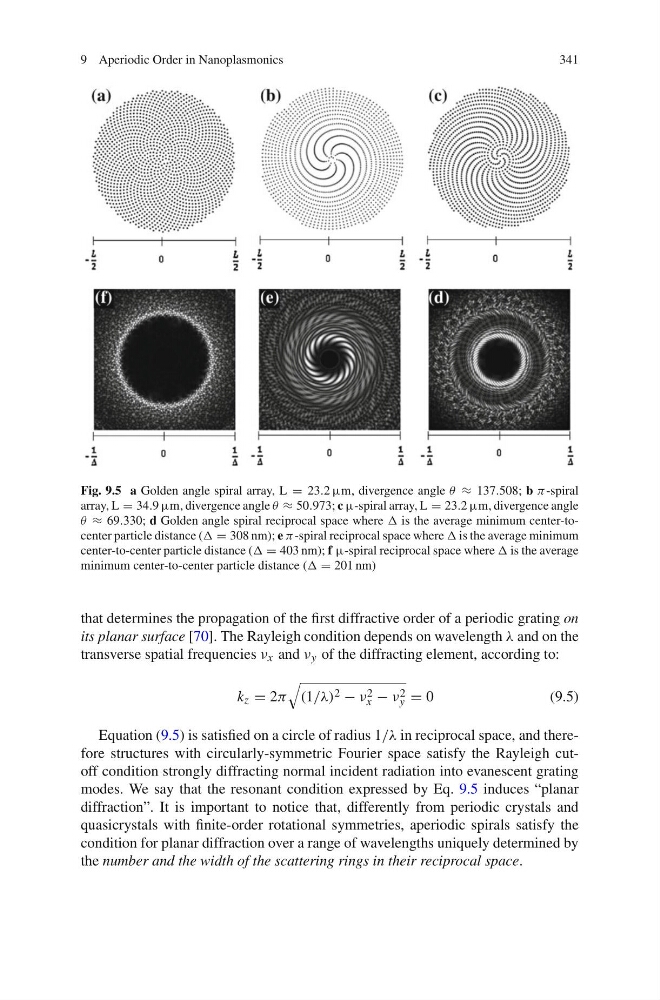
Fig. 9.5 a Golden angle spiral array, L = 23.2 μm, divergence angle Δ ≈ 137.508; b ϕ -spiral
array, L = 34.9 μm, divergence angle Δ ≈ 50.973; c μ-spiral array, L = 23.2 μm, divergence angle
Δ ≈ 69.330; d Golden angle spiral reciprocal space where π is the average minimum center-tocenter particle distance (π = 308 nm); e ϕ -spiral reciprocal space where π is the average minimum
center-to-center particle distance (π = 403 nm); f μ-spiral reciprocal space where π is the average
minimum center-to-center particle distance (π = 201 nm)
that determines the propagation of the first diffractive order of a periodic grating on
its planar surface [70]. The Rayleigh condition depends on wavelength ∂ and on the
transverse spatial frequencies τ x and τ y of the diffracting element, according to:
k z = 2ϕ
(1/∂) 2 − τ 2
x − τ 2
y = 0
(9.5)
Equation (9.5) is satisfied on a circle of radius 1/∂ in reciprocal space, and therefore structures with circularly-symmetric Fourier space satisfy the Rayleigh cutoff condition strongly diffracting normal incident radiation into evanescent grating
modes. We say that the resonant condition expressed by Eq. 9.5 induces “planar
diffraction”. It is important to notice that, differently from periodic crystals and
quasicrystals with finite-order rotational symmetries, aperiodic spirals satisfy the
condition for planar diffraction over a range of wavelengths uniquely determined by
the number and the width of the scattering rings in their reciprocal space.
341
Fig. 9.5 a Golden angle spiral array, L = 23.2 μm, divergence angle Δ ≈ 137.508; b ϕ -spiral
array, L = 34.9 μm, divergence angle Δ ≈ 50.973; c μ-spiral array, L = 23.2 μm, divergence angle
Δ ≈ 69.330; d Golden angle spiral reciprocal space where π is the average minimum center-tocenter particle distance (π = 308 nm); e ϕ -spiral reciprocal space where π is the average minimum
center-to-center particle distance (π = 403 nm); f μ-spiral reciprocal space where π is the average
minimum center-to-center particle distance (π = 201 nm)
that determines the propagation of the first diffractive order of a periodic grating on
its planar surface [70]. The Rayleigh condition depends on wavelength ∂ and on the
transverse spatial frequencies τ x and τ y of the diffracting element, according to:
k z = 2ϕ
(1/∂) 2 − τ 2
x − τ 2
y = 0
(9.5)
Equation (9.5) is satisfied on a circle of radius 1/∂ in reciprocal space, and therefore structures with circularly-symmetric Fourier space satisfy the Rayleigh cutoff condition strongly diffracting normal incident radiation into evanescent grating
modes. We say that the resonant condition expressed by Eq. 9.5 induces “planar
diffraction”. It is important to notice that, differently from periodic crystals and
quasicrystals with finite-order rotational symmetries, aperiodic spirals satisfy the
condition for planar diffraction over a range of wavelengths uniquely determined by
the number and the width of the scattering rings in their reciprocal space.