

340
L. D. Negro et al.
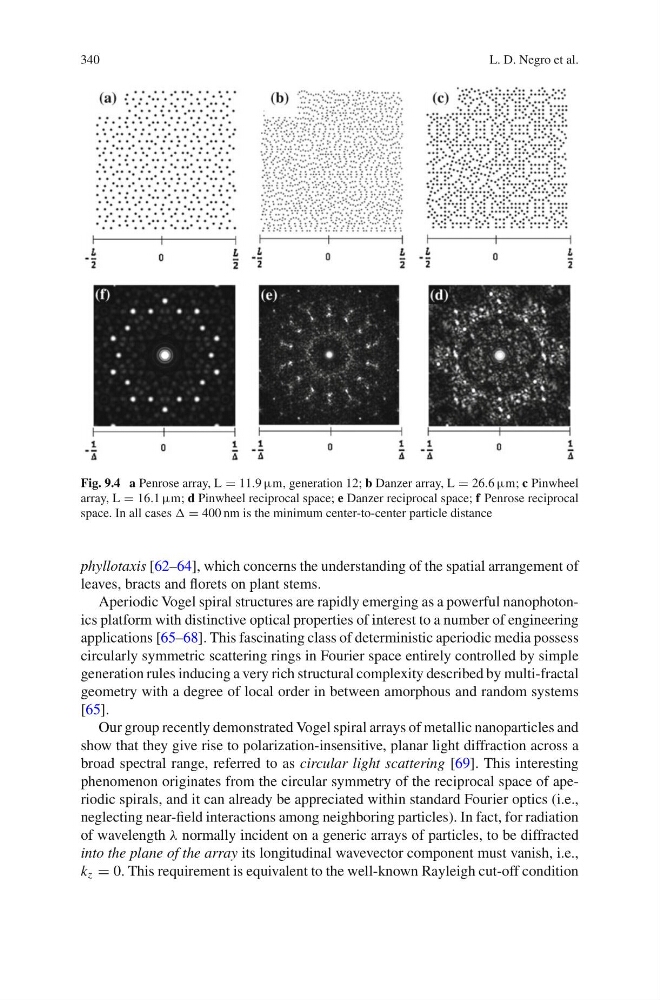
Fig. 9.4 a Penrose array, L = 11.9 μm, generation 12; b Danzer array, L = 26.6 μm; c Pinwheel
array, L = 16.1 μm; d Pinwheel reciprocal space; e Danzer reciprocal space; f Penrose reciprocal
space. In all cases π = 400 nm is the minimum center-to-center particle distance
phyllotaxis [62–64], which concerns the understanding of the spatial arrangement of
leaves, bracts and florets on plant stems.
Aperiodic Vogel spiral structures are rapidly emerging as a powerful nanophotonics platform with distinctive optical properties of interest to a number of engineering
applications [65–68]. This fascinating class of deterministic aperiodic media possess
circularly symmetric scattering rings in Fourier space entirely controlled by simple
generation rules inducing a very rich structural complexity described by multi-fractal
geometry with a degree of local order in between amorphous and random systems
[65].
Our group recently demonstrated Vogel spiral arrays of metallic nanoparticles and
show that they give rise to polarization-insensitive, planar light diffraction across a
broad spectral range, referred to as circular light scattering [69]. This interesting
phenomenon originates from the circular symmetry of the reciprocal space of aperiodic spirals, and it can already be appreciated within standard Fourier optics (i.e.,
neglecting near-field interactions among neighboring particles). In fact, for radiation
of wavelength ∂ normally incident on a generic arrays of particles, to be diffracted
into the plane of the array its longitudinal wavevector component must vanish, i.e.,
k z = 0. This requirement is equivalent to the well-known Rayleigh cut-off condition
L. D. Negro et al.
Fig. 9.4 a Penrose array, L = 11.9 μm, generation 12; b Danzer array, L = 26.6 μm; c Pinwheel
array, L = 16.1 μm; d Pinwheel reciprocal space; e Danzer reciprocal space; f Penrose reciprocal
space. In all cases π = 400 nm is the minimum center-to-center particle distance
phyllotaxis [62–64], which concerns the understanding of the spatial arrangement of
leaves, bracts and florets on plant stems.
Aperiodic Vogel spiral structures are rapidly emerging as a powerful nanophotonics platform with distinctive optical properties of interest to a number of engineering
applications [65–68]. This fascinating class of deterministic aperiodic media possess
circularly symmetric scattering rings in Fourier space entirely controlled by simple
generation rules inducing a very rich structural complexity described by multi-fractal
geometry with a degree of local order in between amorphous and random systems
[65].
Our group recently demonstrated Vogel spiral arrays of metallic nanoparticles and
show that they give rise to polarization-insensitive, planar light diffraction across a
broad spectral range, referred to as circular light scattering [69]. This interesting
phenomenon originates from the circular symmetry of the reciprocal space of aperiodic spirals, and it can already be appreciated within standard Fourier optics (i.e.,
neglecting near-field interactions among neighboring particles). In fact, for radiation
of wavelength ∂ normally incident on a generic arrays of particles, to be diffracted
into the plane of the array its longitudinal wavevector component must vanish, i.e.,
k z = 0. This requirement is equivalent to the well-known Rayleigh cut-off condition