

342
L. D. Negro et al.
This property is ideal to enhance light-matter coupling on planar substrates
[69], leading to thin-film solar cell enhancement [67], light emission enhancement
[66, 71], and enhanced second harmonic generation [68], as further discussed in
Sect. 9.3. Moreover, we recently discovered that Vogel spiral arrays of Au nanoparticles support distinctive scattering resonances carrying orbital angular momentum
(OAM), potentially leading to novel applications in singular optics and cryptography
[69, 72, 73].
Vogel spiral arrays can be obtained in polar coordinates (r, θ) by the relations
[13, 74, 75]:
r n = a 0
√
n
Δ n = nγ
(9.6)
where n = 0, 1, 2, . . . is an integer index, a 0 is a constant scaling factor, and γ is
an irrational number known as the divergence angle. This gives the constant angle
between successive particles in the spiral array. When γ ≈ 137.5086 ◦ , it approximates an irrational number known as the “golden angle”, we obtain the so-called
Fibonacci golden angle spiral (GA), shown in Fig. 9.5a. The golden angle γ is related
to the famous Fibonacci golden number ϕ = (1 +
√
5)/2 ≈ 1.618 by the relation
γ = 360/ ϕ 2 .
The structure of a GA spiral can be decomposed into clockwise and counterclockwise families of out-spiraling lines of particles, known as parastichies, which stretch
out from the center of the structures. Interestingly, the number of spiral arms in each
family of parastichies is given by consecutive Fibonacci numbers [74]. Moreover,
since the golden angle is an irrational number, the GA spiral lacks both translational
and rotational symmetry. Accordingly, its spatial Fourier spectrum does not exhibit
well-defined Bragg peaks, as for standard photonic crystals and quasicrystals, but
rather features a diffuse circular ring whose spectral position is determined by the
particles geometry (Fig. 9.5f). Interestingly, Vogel’s spirals with remarkably different structural properties can be obtained by choosing only slightly different values
of divergence angle, thus providing the opportunity to control and explore distinctively different degrees of aperiodic structural complexity. We show in Figs. 9.5b, c
two examples of Vogel spirals, known as ϕ and μ-spirals, obtained using the following divergence angles γ ϕ = 309.03 ◦ and γ μ = 290.67 ◦ , respectively. These
structures feature a rotationally symmetric Fourier space with remarkable structural
complexity, as demonstrated by Fig. 9.5d, e.
Recently, Dal Negro et al. [73] developed an analytical model that captured in
closed form solution the spectral properties of arbitrary Vogel spiral arrays. Within the
framework of scalar Fourier optics, we showed that the complex Fourier spectrum
(i.e., Fraunhofer diffraction pattern) of arbitrary Vogel spirals is described by the
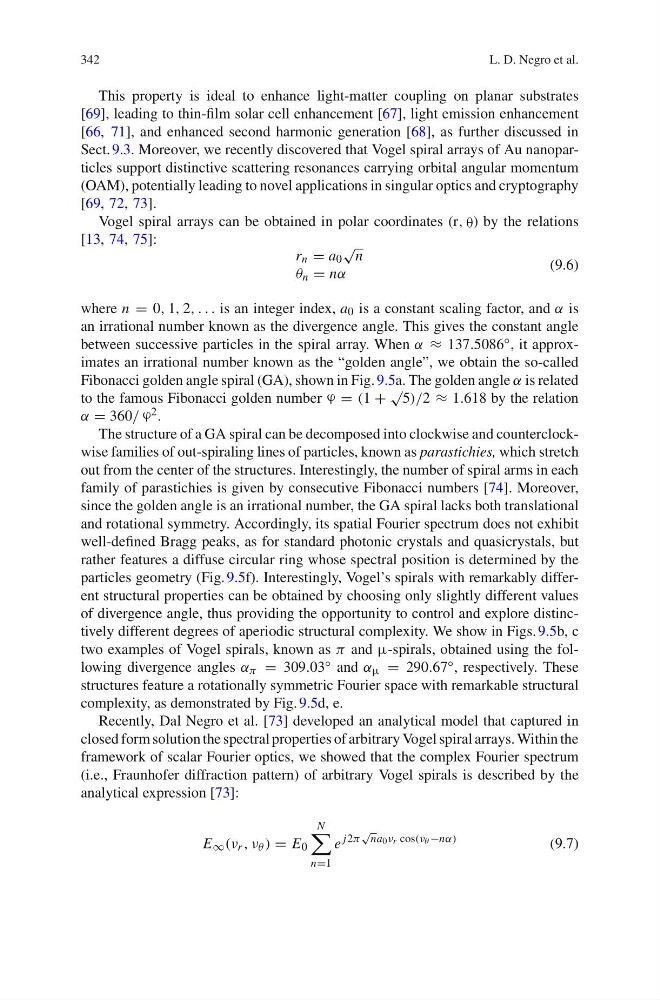
analytical expression [73]:
E √ (τ r , τ Δ ) = E 0
N
n=1
e
j2ϕ
√
na 0 τ r cos(τ Δ −nγ)
(9.7)
L. D. Negro et al.
This property is ideal to enhance light-matter coupling on planar substrates
[69], leading to thin-film solar cell enhancement [67], light emission enhancement
[66, 71], and enhanced second harmonic generation [68], as further discussed in
Sect. 9.3. Moreover, we recently discovered that Vogel spiral arrays of Au nanoparticles support distinctive scattering resonances carrying orbital angular momentum
(OAM), potentially leading to novel applications in singular optics and cryptography
[69, 72, 73].
Vogel spiral arrays can be obtained in polar coordinates (r, θ) by the relations
[13, 74, 75]:
r n = a 0
√
n
Δ n = nγ
(9.6)
where n = 0, 1, 2, . . . is an integer index, a 0 is a constant scaling factor, and γ is
an irrational number known as the divergence angle. This gives the constant angle
between successive particles in the spiral array. When γ ≈ 137.5086 ◦ , it approximates an irrational number known as the “golden angle”, we obtain the so-called
Fibonacci golden angle spiral (GA), shown in Fig. 9.5a. The golden angle γ is related
to the famous Fibonacci golden number ϕ = (1 +
√
5)/2 ≈ 1.618 by the relation
γ = 360/ ϕ 2 .
The structure of a GA spiral can be decomposed into clockwise and counterclockwise families of out-spiraling lines of particles, known as parastichies, which stretch
out from the center of the structures. Interestingly, the number of spiral arms in each
family of parastichies is given by consecutive Fibonacci numbers [74]. Moreover,
since the golden angle is an irrational number, the GA spiral lacks both translational
and rotational symmetry. Accordingly, its spatial Fourier spectrum does not exhibit
well-defined Bragg peaks, as for standard photonic crystals and quasicrystals, but
rather features a diffuse circular ring whose spectral position is determined by the
particles geometry (Fig. 9.5f). Interestingly, Vogel’s spirals with remarkably different structural properties can be obtained by choosing only slightly different values
of divergence angle, thus providing the opportunity to control and explore distinctively different degrees of aperiodic structural complexity. We show in Figs. 9.5b, c
two examples of Vogel spirals, known as ϕ and μ-spirals, obtained using the following divergence angles γ ϕ = 309.03 ◦ and γ μ = 290.67 ◦ , respectively. These
structures feature a rotationally symmetric Fourier space with remarkable structural
complexity, as demonstrated by Fig. 9.5d, e.
Recently, Dal Negro et al. [73] developed an analytical model that captured in
closed form solution the spectral properties of arbitrary Vogel spiral arrays. Within the
framework of scalar Fourier optics, we showed that the complex Fourier spectrum
(i.e., Fraunhofer diffraction pattern) of arbitrary Vogel spirals is described by the
analytical expression [73]:
E √ (τ r , τ Δ ) = E 0
N
n=1
e
j2ϕ
√
na 0 τ r cos(τ Δ −nγ)
(9.7)