

320
P. Ben-Abdallah et al.
electron-hole pair whereas photons with energies hν larger than the band gap E g
produce electron with an excess energy hν − E g which is lost when the electron
relaxes to the bottom of the conduction band. This limit can be overcome with
a monochromatic source if the emission frequency is slightly above with the gap
energy of the semiconductor. In this case η approaches unity. To achieve this goal,
it is necessary to design a filter that transmit the photons with the right energy and
recycles the other photons. However, such a system is efficient only if the recycling
process does not suffer from losses. In practice, the best efficiencies obtained are still
below 15 %.
In the near-field, the heat flux can be several orders of magnitude larger than that
of a black body, so that near-field TPV conversion [8, 67, 86, 92, 94] seems to be
a promising technology for production of electricity as it can enhance the current
generation per unit area. This may be of great interest for small portable generators.
In addition, the efficiency should benefit from near-field for two reasons. On one
hand, the near-field emitter can become spectrally selective, on the other hand, the
fill factor is increased when the current is increased.
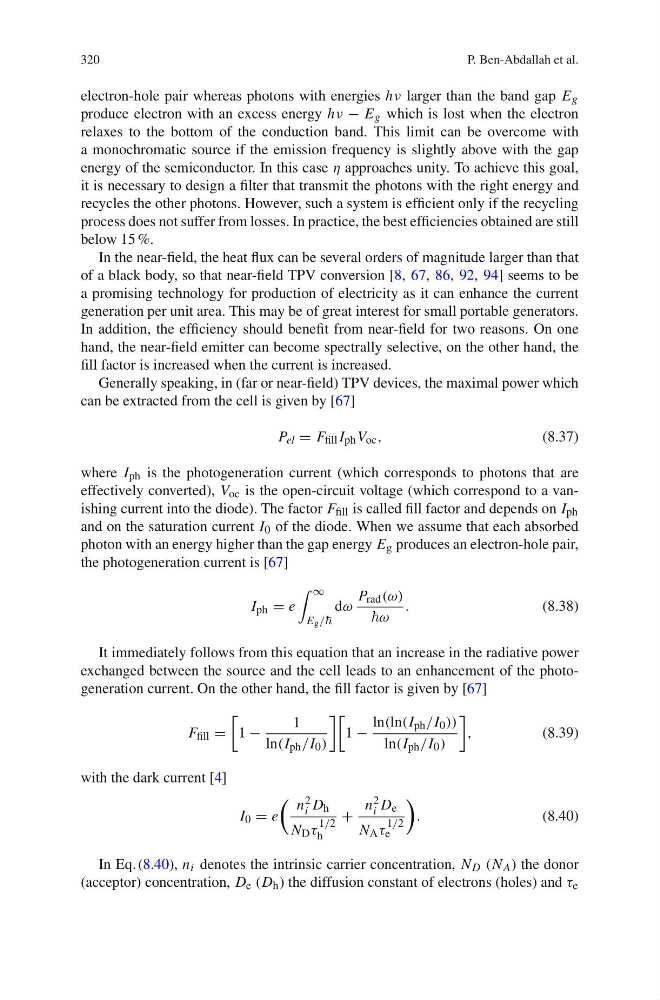
Generally speaking, in (far or near-field) TPV devices, the maximal power which
can be extracted from the cell is given by [67]
P el = F fill I ph V oc ,
(8.37)
where I ph is the photogeneration current (which corresponds to photons that are
effectively converted), V oc is the open-circuit voltage (which correspond to a vanishing current into the diode). The factor F fill is called fill factor and depends on I ph
and on the saturation current I 0 of the diode. When we assume that each absorbed
photon with an energy higher than the gap energy E g produces an electron-hole pair,
the photogeneration current is [67]
I ph = e
∞
E g /
dω
P rad (ω)
ω
.
(8.38)
It immediately follows from this equation that an increase in the radiative power
exchanged between the source and the cell leads to an enhancement of the photogeneration current. On the other hand, the fill factor is given by [67]
F fill =
1 −
1
ln(I ph /I 0 )
1 −
ln(ln(I ph /I 0 ))
ln(I ph /I 0 )
,
(8.39)
with the dark current [4]
I 0 = e
n 2
i D h
N D τ
1/2
h
+
n 2
i D e
N A τ
1/2
e
.
(8.40)
In Eq. (8.40), n i denotes the intrinsic carrier concentration, N D (N A ) the donor
(acceptor) concentration, D e (D h ) the diffusion constant of electrons (holes) and τ e
P. Ben-Abdallah et al.
electron-hole pair whereas photons with energies hν larger than the band gap E g
produce electron with an excess energy hν − E g which is lost when the electron
relaxes to the bottom of the conduction band. This limit can be overcome with
a monochromatic source if the emission frequency is slightly above with the gap
energy of the semiconductor. In this case η approaches unity. To achieve this goal,
it is necessary to design a filter that transmit the photons with the right energy and
recycles the other photons. However, such a system is efficient only if the recycling
process does not suffer from losses. In practice, the best efficiencies obtained are still
below 15 %.
In the near-field, the heat flux can be several orders of magnitude larger than that
of a black body, so that near-field TPV conversion [8, 67, 86, 92, 94] seems to be
a promising technology for production of electricity as it can enhance the current
generation per unit area. This may be of great interest for small portable generators.
In addition, the efficiency should benefit from near-field for two reasons. On one
hand, the near-field emitter can become spectrally selective, on the other hand, the
fill factor is increased when the current is increased.
Generally speaking, in (far or near-field) TPV devices, the maximal power which
can be extracted from the cell is given by [67]
P el = F fill I ph V oc ,
(8.37)
where I ph is the photogeneration current (which corresponds to photons that are
effectively converted), V oc is the open-circuit voltage (which correspond to a vanishing current into the diode). The factor F fill is called fill factor and depends on I ph
and on the saturation current I 0 of the diode. When we assume that each absorbed
photon with an energy higher than the gap energy E g produces an electron-hole pair,
the photogeneration current is [67]
I ph = e
∞
E g /
dω
P rad (ω)
ω
.
(8.38)
It immediately follows from this equation that an increase in the radiative power
exchanged between the source and the cell leads to an enhancement of the photogeneration current. On the other hand, the fill factor is given by [67]
F fill =
1 −
1
ln(I ph /I 0 )
1 −
ln(ln(I ph /I 0 ))
ln(I ph /I 0 )
,
(8.39)
with the dark current [4]
I 0 = e
n 2
i D h
N D τ
1/2
h
+
n 2
i D e
N A τ
1/2
e
.
(8.40)
In Eq. (8.40), n i denotes the intrinsic carrier concentration, N D (N A ) the donor
(acceptor) concentration, D e (D h ) the diffusion constant of electrons (holes) and τ e