

8 Controlling Thermal Radiation with Surface Waves
321
(a)
(b)
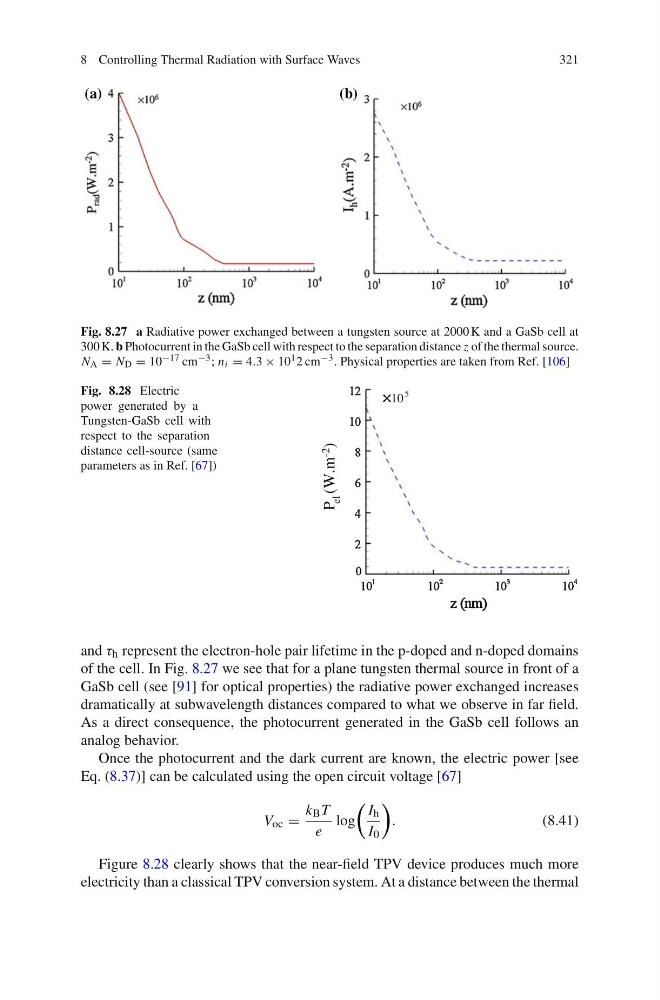
Fig. 8.27 a Radiative power exchanged between a tungsten source at 2000 K and a GaSb cell at
300 K. b Photocurrent in the GaSb cell with respect to the separation distance z of the thermal source.
N A = N D = 10 −17 cm −3 ; n i = 4.3 × 10 1 2 cm −3 . Physical properties are taken from Ref. [106]
Fig. 8.28 Electric
power generated by a
Tungsten-GaSb cell with
respect to the separation
distance cell-source (same
parameters as in Ref. [67])
m
and τ h represent the electron-hole pair lifetime in the p-doped and n-doped domains
of the cell. In Fig. 8.27 we see that for a plane tungsten thermal source in front of a
GaSb cell (see [91] for optical properties) the radiative power exchanged increases
dramatically at subwavelength distances compared to what we observe in far field.
As a direct consequence, the photocurrent generated in the GaSb cell follows an
analog behavior.
Once the photocurrent and the dark current are known, the electric power [see
Eq. (8.37)] can be calculated using the open circuit voltage [67]
V oc =
k B T
e
log
I h
I 0
.
(8.41)
Figure 8.28 clearly shows that the near-field TPV device produces much more
electricity than a classical TPV conversion system. At a distance between the thermal
321
(a)
(b)
Fig. 8.27 a Radiative power exchanged between a tungsten source at 2000 K and a GaSb cell at
300 K. b Photocurrent in the GaSb cell with respect to the separation distance z of the thermal source.
N A = N D = 10 −17 cm −3 ; n i = 4.3 × 10 1 2 cm −3 . Physical properties are taken from Ref. [106]
Fig. 8.28 Electric
power generated by a
Tungsten-GaSb cell with
respect to the separation
distance cell-source (same
parameters as in Ref. [67])
m
and τ h represent the electron-hole pair lifetime in the p-doped and n-doped domains
of the cell. In Fig. 8.27 we see that for a plane tungsten thermal source in front of a
GaSb cell (see [91] for optical properties) the radiative power exchanged increases
dramatically at subwavelength distances compared to what we observe in far field.
As a direct consequence, the photocurrent generated in the GaSb cell follows an
analog behavior.
Once the photocurrent and the dark current are known, the electric power [see
Eq. (8.37)] can be calculated using the open circuit voltage [67]
V oc =
k B T
e
log
I h
I 0
.
(8.41)
Figure 8.28 clearly shows that the near-field TPV device produces much more
electricity than a classical TPV conversion system. At a distance between the thermal