

8 Controlling Thermal Radiation with Surface Waves
319
a thin region around the κ = ω/c over a broad spectral range contributes to the
transfer. It corresponds to a spectral region where the real part of the permittivity is
negative. In summary, VO2 can change from a metallic emitter to a dielectric emitter
supporting surface phonon-polaritons.
The considerable difference in optical and electrical properties between the amorphous and crystalline states of some PCMs opens the door to several applications. For
example, it is possible to actively control the heat flux by switching the PCM. This
can be done as fast as 100 ns [126]. Note that not only the modulation is quick, but it
was also shown [121] that for certain distances the switching changes the heat flux
by one order of magnitude and that the cycle is fairly repeatable (10 7 –10 12 times),
making it a good candidate for possible applications in thermal management and for
designing thermal transistors.
8.2.5.3 Near-Field Energy Conversion
Thermophotovoltaic (TPV) devices [28] are energy conversion systems that generate
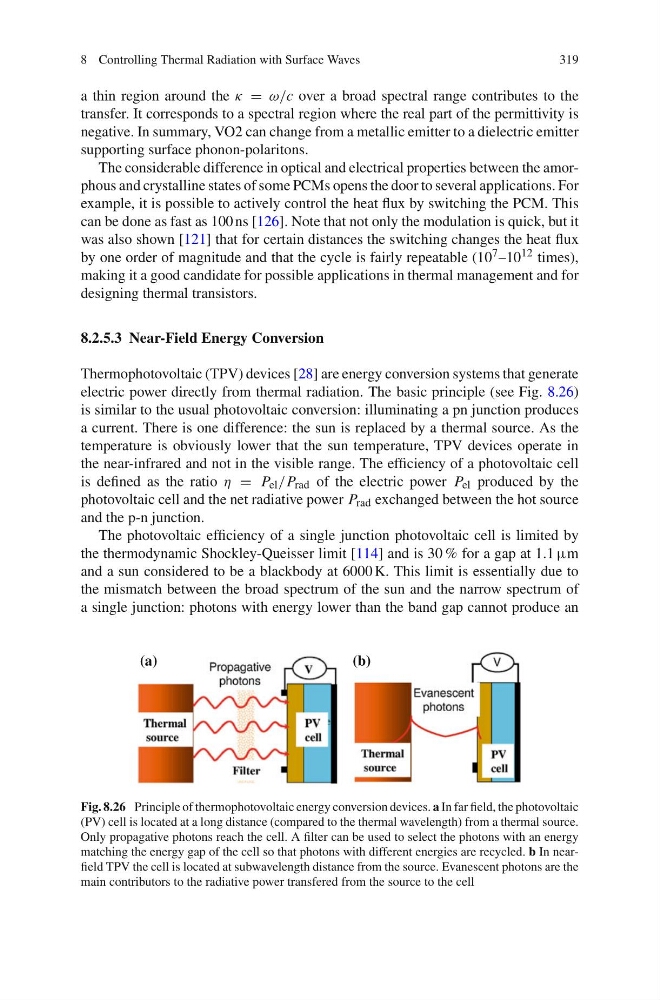
electric power directly from thermal radiation. The basic principle (see Fig. 8.26)
is similar to the usual photovoltaic conversion: illuminating a pn junction produces
a current. There is one difference: the sun is replaced by a thermal source. As the
temperature is obviously lower that the sun temperature, TPV devices operate in
the near-infrared and not in the visible range. The efficiency of a photovoltaic cell
is defined as the ratio η = P el /P rad of the electric power P el produced by the
photovoltaic cell and the net radiative power P rad exchanged between the hot source
and the p-n junction.
The photovoltaic efficiency of a single junction photovoltaic cell is limited by
the thermodynamic Shockley-Queisser limit [114] and is 30 % for a gap at 1.1 µm
and a sun considered to be a blackbody at 6000 K. This limit is essentially due to
the mismatch between the broad spectrum of the sun and the narrow spectrum of
a single junction: photons with energy lower than the band gap cannot produce an
(a)
(b)
Fig. 8.26 Principle of thermophotovoltaic energy conversion devices. a In far field, the photovoltaic
(PV) cell is located at a long distance (compared to the thermal wavelength) from a thermal source.
Only propagative photons reach the cell. A filter can be used to select the photons with an energy
matching the energy gap of the cell so that photons with different energies are recycled. b In nearfield TPV the cell is located at subwavelength distance from the source. Evanescent photons are the
main contributors to the radiative power transfered from the source to the cell
319
a thin region around the κ = ω/c over a broad spectral range contributes to the
transfer. It corresponds to a spectral region where the real part of the permittivity is
negative. In summary, VO2 can change from a metallic emitter to a dielectric emitter
supporting surface phonon-polaritons.
The considerable difference in optical and electrical properties between the amorphous and crystalline states of some PCMs opens the door to several applications. For
example, it is possible to actively control the heat flux by switching the PCM. This
can be done as fast as 100 ns [126]. Note that not only the modulation is quick, but it
was also shown [121] that for certain distances the switching changes the heat flux
by one order of magnitude and that the cycle is fairly repeatable (10 7 –10 12 times),
making it a good candidate for possible applications in thermal management and for
designing thermal transistors.
8.2.5.3 Near-Field Energy Conversion
Thermophotovoltaic (TPV) devices [28] are energy conversion systems that generate
electric power directly from thermal radiation. The basic principle (see Fig. 8.26)
is similar to the usual photovoltaic conversion: illuminating a pn junction produces
a current. There is one difference: the sun is replaced by a thermal source. As the
temperature is obviously lower that the sun temperature, TPV devices operate in
the near-infrared and not in the visible range. The efficiency of a photovoltaic cell
is defined as the ratio η = P el /P rad of the electric power P el produced by the
photovoltaic cell and the net radiative power P rad exchanged between the hot source
and the p-n junction.
The photovoltaic efficiency of a single junction photovoltaic cell is limited by
the thermodynamic Shockley-Queisser limit [114] and is 30 % for a gap at 1.1 µm
and a sun considered to be a blackbody at 6000 K. This limit is essentially due to
the mismatch between the broad spectrum of the sun and the narrow spectrum of
a single junction: photons with energy lower than the band gap cannot produce an
(a)
(b)
Fig. 8.26 Principle of thermophotovoltaic energy conversion devices. a In far field, the photovoltaic
(PV) cell is located at a long distance (compared to the thermal wavelength) from a thermal source.
Only propagative photons reach the cell. A filter can be used to select the photons with an energy
matching the energy gap of the cell so that photons with different energies are recycled. b In nearfield TPV the cell is located at subwavelength distance from the source. Evanescent photons are the
main contributors to the radiative power transfered from the source to the cell