

318
P. Ben-Abdallah et al.
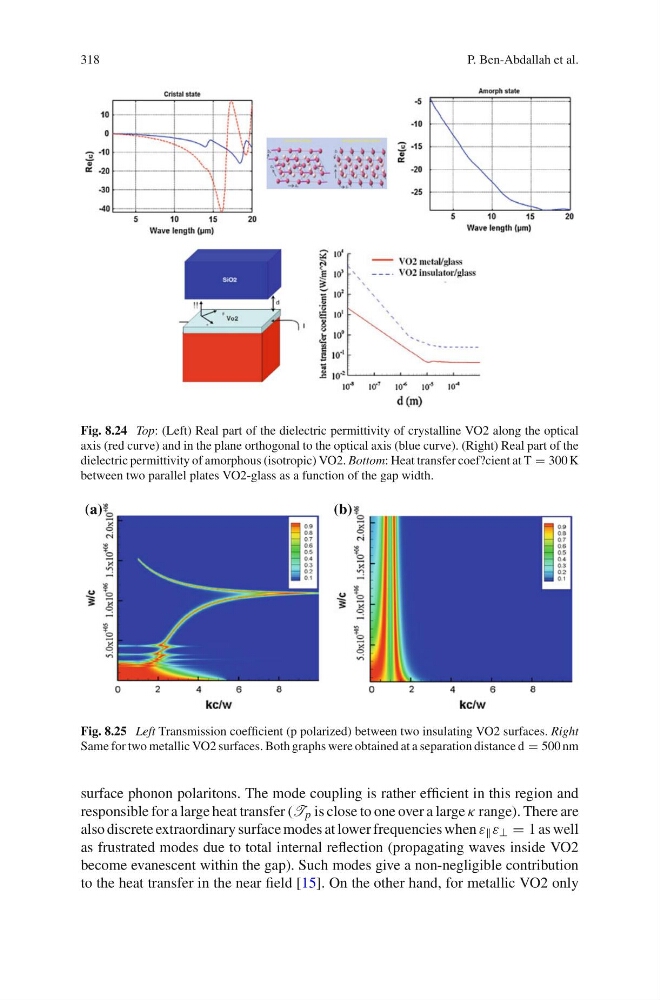
Fig. 8.24 Top: (Left) Real part of the dielectric permittivity of crystalline VO2 along the optical
axis (red curve) and in the plane orthogonal to the optical axis (blue curve). (Right) Real part of the
dielectric permittivity of amorphous (isotropic) VO2. Bottom: Heat transfer coef?cient at T = 300 K
between two parallel plates VO2-glass as a function of the gap width.
(a)
(b)
Fig. 8.25 Left Transmission coefficient (p polarized) between two insulating VO2 surfaces. Right
Same for two metallic VO2 surfaces. Both graphs were obtained at a separation distance d = 500 nm
surface phonon polaritons. The mode coupling is rather efficient in this region and
responsible for a large heat transfer (T p is close to one over a large κ range). There are
also discrete extraordinary surface modes at lower frequencies when ε ≥ ε ≤ = 1 as well
as frustrated modes due to total internal reflection (propagating waves inside VO2
become evanescent within the gap). Such modes give a non-negligible contribution
to the heat transfer in the near field [15]. On the other hand, for metallic VO2 only
P. Ben-Abdallah et al.
Fig. 8.24 Top: (Left) Real part of the dielectric permittivity of crystalline VO2 along the optical
axis (red curve) and in the plane orthogonal to the optical axis (blue curve). (Right) Real part of the
dielectric permittivity of amorphous (isotropic) VO2. Bottom: Heat transfer coef?cient at T = 300 K
between two parallel plates VO2-glass as a function of the gap width.
(a)
(b)
Fig. 8.25 Left Transmission coefficient (p polarized) between two insulating VO2 surfaces. Right
Same for two metallic VO2 surfaces. Both graphs were obtained at a separation distance d = 500 nm
surface phonon polaritons. The mode coupling is rather efficient in this region and
responsible for a large heat transfer (T p is close to one over a large κ range). There are
also discrete extraordinary surface modes at lower frequencies when ε ≥ ε ≤ = 1 as well
as frustrated modes due to total internal reflection (propagating waves inside VO2
become evanescent within the gap). Such modes give a non-negligible contribution
to the heat transfer in the near field [15]. On the other hand, for metallic VO2 only