

8 Controlling Thermal Radiation with Surface Waves
313
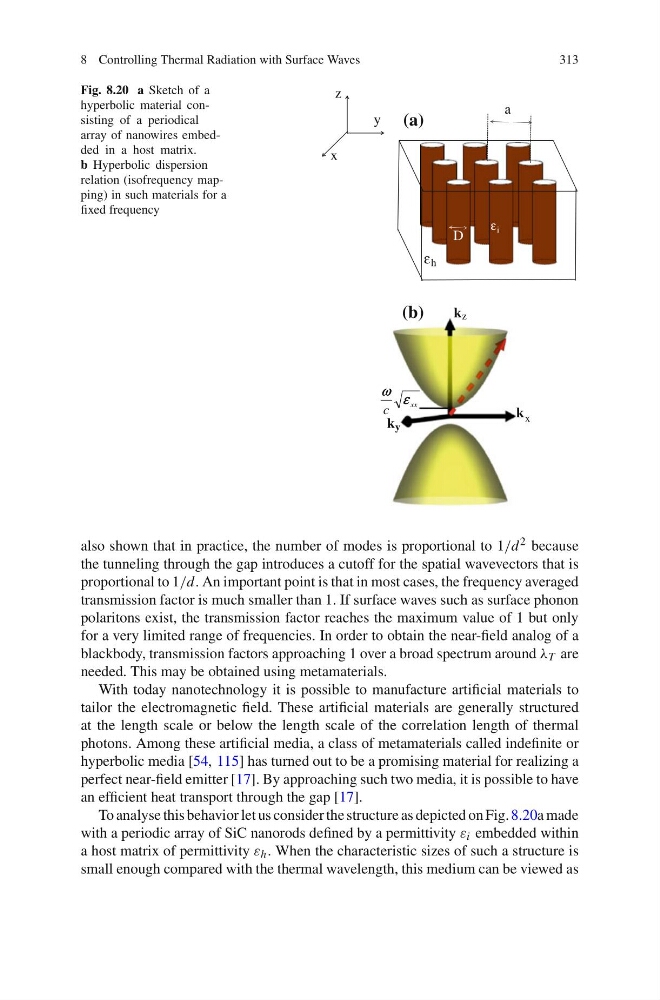
Fig. 8.20 a Sketch of a
hyperbolic material consisting of a periodical
array of nanowires embedded in a host matrix.
b Hyperbolic dispersion
relation (isofrequency mapping) in such materials for a
fixed frequency
x
y
z
a
D
ε i
ε h
(a)
xx
c
ε ε
ε
k y
(b)
ω ω
k z
x
k
also shown that in practice, the number of modes is proportional to 1/d 2 because
the tunneling through the gap introduces a cutoff for the spatial wavevectors that is
proportional to 1/d. An important point is that in most cases, the frequency averaged
transmission factor is much smaller than 1. If surface waves such as surface phonon
polaritons exist, the transmission factor reaches the maximum value of 1 but only
for a very limited range of frequencies. In order to obtain the near-field analog of a
blackbody, transmission factors approaching 1 over a broad spectrum around λ T are
needed. This may be obtained using metamaterials.
With today nanotechnology it is possible to manufacture artificial materials to
tailor the electromagnetic field. These artificial materials are generally structured
at the length scale or below the length scale of the correlation length of thermal
photons. Among these artificial media, a class of metamaterials called indefinite or
hyperbolic media [54, 115] has turned out to be a promising material for realizing a
perfect near-field emitter [17]. By approaching such two media, it is possible to have
an efficient heat transport through the gap [17].
To analyse this behavior let us consider the structure as depicted on Fig. 8.20a made
with a periodic array of SiC nanorods defined by a permittivity ε i embedded within
a host matrix of permittivity ε h . When the characteristic sizes of such a structure is
small enough compared with the thermal wavelength, this medium can be viewed as
313
Fig. 8.20 a Sketch of a
hyperbolic material consisting of a periodical
array of nanowires embedded in a host matrix.
b Hyperbolic dispersion
relation (isofrequency mapping) in such materials for a
fixed frequency
x
y
z
a
D
ε i
ε h
(a)
xx
c
ε ε
ε
k y
(b)
ω ω
k z
x
k
also shown that in practice, the number of modes is proportional to 1/d 2 because
the tunneling through the gap introduces a cutoff for the spatial wavevectors that is
proportional to 1/d. An important point is that in most cases, the frequency averaged
transmission factor is much smaller than 1. If surface waves such as surface phonon
polaritons exist, the transmission factor reaches the maximum value of 1 but only
for a very limited range of frequencies. In order to obtain the near-field analog of a
blackbody, transmission factors approaching 1 over a broad spectrum around λ T are
needed. This may be obtained using metamaterials.
With today nanotechnology it is possible to manufacture artificial materials to
tailor the electromagnetic field. These artificial materials are generally structured
at the length scale or below the length scale of the correlation length of thermal
photons. Among these artificial media, a class of metamaterials called indefinite or
hyperbolic media [54, 115] has turned out to be a promising material for realizing a
perfect near-field emitter [17]. By approaching such two media, it is possible to have
an efficient heat transport through the gap [17].
To analyse this behavior let us consider the structure as depicted on Fig. 8.20a made
with a periodic array of SiC nanorods defined by a permittivity ε i embedded within
a host matrix of permittivity ε h . When the characteristic sizes of such a structure is
small enough compared with the thermal wavelength, this medium can be viewed as