

312
P. Ben-Abdallah et al.
0.001
0.01
0.1
1
10
4
10
3
10
2
10
1
1
10
-1
10
-2
mean transmission coefficient
κλ th
d = 10nm
d = 100nm
d = 1000 nm
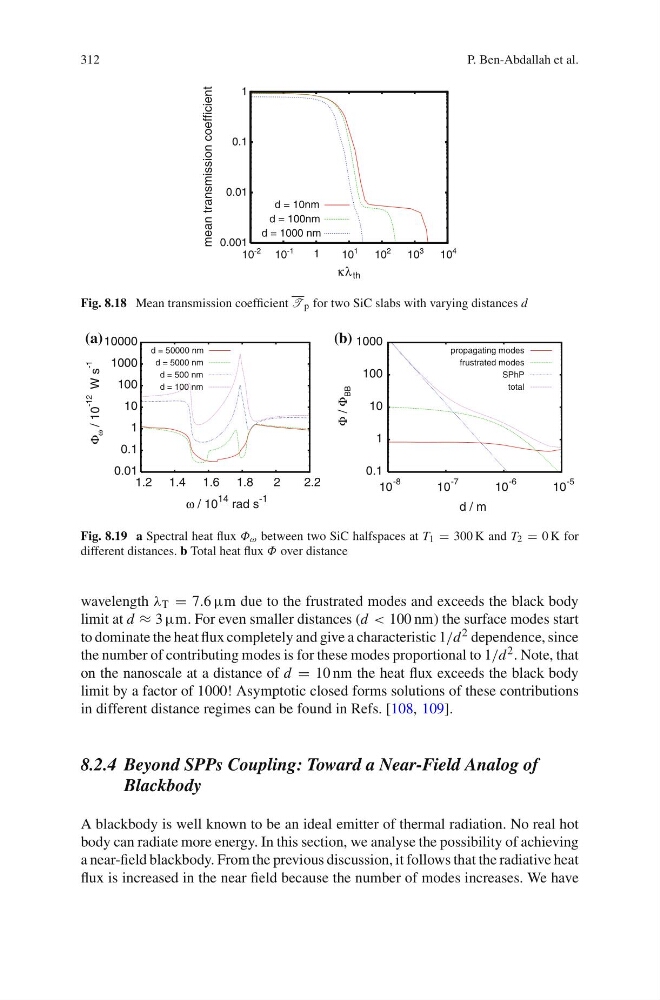
Fig. 8.18 Mean transmission coefficient T p for two SiC slabs with varying distances d
0.01
0.1
1
10
100
1000
10000
1.2 1.4 1.6 1.8
2
2.2
Φ
ω / 10
-12
W s
-1
ω / 10
14 rad s
-1
d = 50000 nm
d = 5000 nm
d = 500 nm
d = 100 nm
0.1
1
10
100
1000
10
-8
10
-7
10
-6
10
-5
Φ /
Φ
BB
d / m
propagating modes
frustrated modes
SPhP
total
(a)
(b)
Fig. 8.19 a Spectral heat flux Φ ω between two SiC halfspaces at T 1 = 300 K and T 2 = 0 K for
different distances. b Total heat flux Φ over distance
wavelength λ T = 7.6 µm due to the frustrated modes and exceeds the black body
limit at d ∗ 3 µm. For even smaller distances (d < 100 nm) the surface modes start
to dominate the heat flux completely and give a characteristic 1/d 2 dependence, since
the number of contributing modes is for these modes proportional to 1/d 2 . Note, that
on the nanoscale at a distance of d = 10 nm the heat flux exceeds the black body
limit by a factor of 1000! Asymptotic closed forms solutions of these contributions
in different distance regimes can be found in Refs. [108, 109].
8.2.4 Beyond SPPs Coupling: Toward a Near-Field Analog of
Blackbody
A blackbody is well known to be an ideal emitter of thermal radiation. No real hot
body can radiate more energy. In this section, we analyse the possibility of achieving
a near-field blackbody. From the previous discussion, it follows that the radiative heat
flux is increased in the near field because the number of modes increases. We have
P. Ben-Abdallah et al.
0.001
0.01
0.1
1
10
4
10
3
10
2
10
1
1
10
-1
10
-2
mean transmission coefficient
κλ th
d = 10nm
d = 100nm
d = 1000 nm
Fig. 8.18 Mean transmission coefficient T p for two SiC slabs with varying distances d
0.01
0.1
1
10
100
1000
10000
1.2 1.4 1.6 1.8
2
2.2
Φ
ω / 10
-12
W s
-1
ω / 10
14 rad s
-1
d = 50000 nm
d = 5000 nm
d = 500 nm
d = 100 nm
0.1
1
10
100
1000
10
-8
10
-7
10
-6
10
-5
Φ /
Φ
BB
d / m
propagating modes
frustrated modes
SPhP
total
(a)
(b)
Fig. 8.19 a Spectral heat flux Φ ω between two SiC halfspaces at T 1 = 300 K and T 2 = 0 K for
different distances. b Total heat flux Φ over distance
wavelength λ T = 7.6 µm due to the frustrated modes and exceeds the black body
limit at d ∗ 3 µm. For even smaller distances (d < 100 nm) the surface modes start
to dominate the heat flux completely and give a characteristic 1/d 2 dependence, since
the number of contributing modes is for these modes proportional to 1/d 2 . Note, that
on the nanoscale at a distance of d = 10 nm the heat flux exceeds the black body
limit by a factor of 1000! Asymptotic closed forms solutions of these contributions
in different distance regimes can be found in Refs. [108, 109].
8.2.4 Beyond SPPs Coupling: Toward a Near-Field Analog of
Blackbody
A blackbody is well known to be an ideal emitter of thermal radiation. No real hot
body can radiate more energy. In this section, we analyse the possibility of achieving
a near-field blackbody. From the previous discussion, it follows that the radiative heat
flux is increased in the near field because the number of modes increases. We have