

314
P. Ben-Abdallah et al.
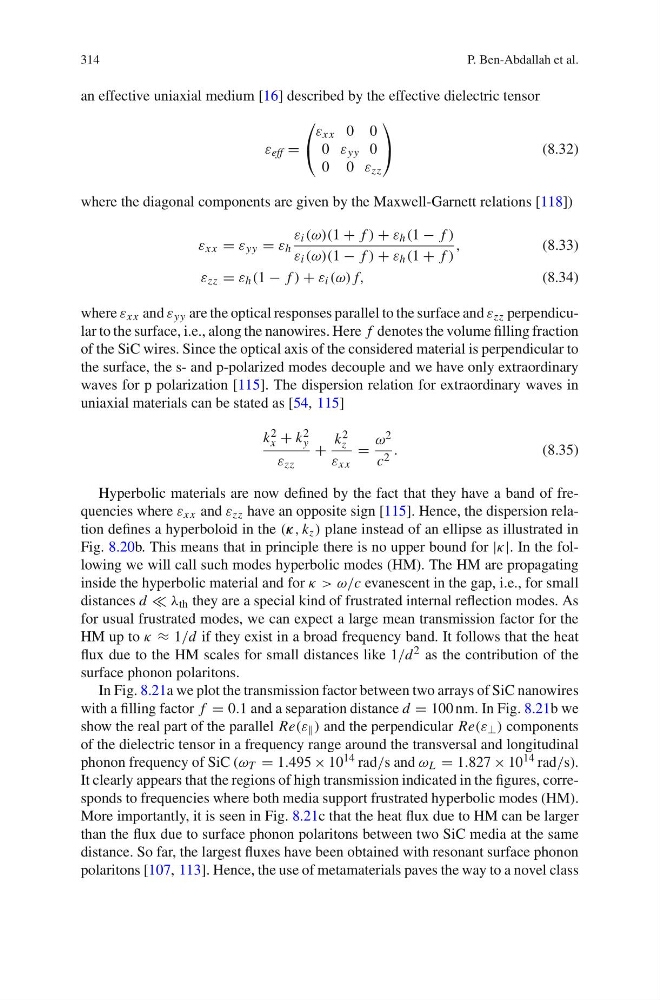
an effective uniaxial medium [16] described by the effective dielectric tensor
ε eff =
⎛
⎝
ε x x 0 0
0 ε yy 0
0 0 ε zz
⎞
⎠
(8.32)
where the diagonal components are given by the Maxwell-Garnett relations [118])
ε x x = ε yy = ε h
ε i (ω)(1 + f ) + ε h (1 − f )
ε i (ω)(1 − f ) + ε h (1 + f )
,
(8.33)
ε zz = ε h (1 − f ) + ε i (ω) f,
(8.34)
where ε x x and ε yy are the optical responses parallel to the surface and ε zz perpendicular to the surface, i.e., along the nanowires. Here f denotes the volume filling fraction
of the SiC wires. Since the optical axis of the considered material is perpendicular to
the surface, the s- and p-polarized modes decouple and we have only extraordinary
waves for p polarization [115]. The dispersion relation for extraordinary waves in
uniaxial materials can be stated as [54, 115]
k 2
x + k 2
y
ε zz
+
k 2
z
ε x x
=
ω 2
c 2 .
(8.35)
Hyperbolic materials are now defined by the fact that they have a band of frequencies where ε x x and ε zz have an opposite sign [115]. Hence, the dispersion relation defines a hyperboloid in the (κ, k z ) plane instead of an ellipse as illustrated in
Fig. 8.20b. This means that in principle there is no upper bound for |κ|. In the following we will call such modes hyperbolic modes (HM). The HM are propagating
inside the hyperbolic material and for κ > ω/c evanescent in the gap, i.e., for small
distances d ∞ λ th they are a special kind of frustrated internal reflection modes. As
for usual frustrated modes, we can expect a large mean transmission factor for the
HM up to κ ∗ 1/d if they exist in a broad frequency band. It follows that the heat
flux due to the HM scales for small distances like 1/d 2 as the contribution of the
surface phonon polaritons.
In Fig. 8.21a we plot the transmission factor between two arrays of SiC nanowires
with a filling factor f = 0.1 and a separation distance d = 100 nm. In Fig. 8.21b we
show the real part of the parallel Re(ε ≥ ) and the perpendicular Re(ε ≤ ) components
of the dielectric tensor in a frequency range around the transversal and longitudinal
phonon frequency of SiC (ω T = 1.495 × 10 14 rad/s and ω L = 1.827 × 10 14 rad/s).
It clearly appears that the regions of high transmission indicated in the figures, corresponds to frequencies where both media support frustrated hyperbolic modes (HM).
More importantly, it is seen in Fig. 8.21c that the heat flux due to HM can be larger
than the flux due to surface phonon polaritons between two SiC media at the same
distance. So far, the largest fluxes have been obtained with resonant surface phonon
polaritons [107, 113]. Hence, the use of metamaterials paves the way to a novel class
P. Ben-Abdallah et al.
an effective uniaxial medium [16] described by the effective dielectric tensor
ε eff =
⎛
⎝
ε x x 0 0
0 ε yy 0
0 0 ε zz
⎞
⎠
(8.32)
where the diagonal components are given by the Maxwell-Garnett relations [118])
ε x x = ε yy = ε h
ε i (ω)(1 + f ) + ε h (1 − f )
ε i (ω)(1 − f ) + ε h (1 + f )
,
(8.33)
ε zz = ε h (1 − f ) + ε i (ω) f,
(8.34)
where ε x x and ε yy are the optical responses parallel to the surface and ε zz perpendicular to the surface, i.e., along the nanowires. Here f denotes the volume filling fraction
of the SiC wires. Since the optical axis of the considered material is perpendicular to
the surface, the s- and p-polarized modes decouple and we have only extraordinary
waves for p polarization [115]. The dispersion relation for extraordinary waves in
uniaxial materials can be stated as [54, 115]
k 2
x + k 2
y
ε zz
+
k 2
z
ε x x
=
ω 2
c 2 .
(8.35)
Hyperbolic materials are now defined by the fact that they have a band of frequencies where ε x x and ε zz have an opposite sign [115]. Hence, the dispersion relation defines a hyperboloid in the (κ, k z ) plane instead of an ellipse as illustrated in
Fig. 8.20b. This means that in principle there is no upper bound for |κ|. In the following we will call such modes hyperbolic modes (HM). The HM are propagating
inside the hyperbolic material and for κ > ω/c evanescent in the gap, i.e., for small
distances d ∞ λ th they are a special kind of frustrated internal reflection modes. As
for usual frustrated modes, we can expect a large mean transmission factor for the
HM up to κ ∗ 1/d if they exist in a broad frequency band. It follows that the heat
flux due to the HM scales for small distances like 1/d 2 as the contribution of the
surface phonon polaritons.
In Fig. 8.21a we plot the transmission factor between two arrays of SiC nanowires
with a filling factor f = 0.1 and a separation distance d = 100 nm. In Fig. 8.21b we
show the real part of the parallel Re(ε ≥ ) and the perpendicular Re(ε ≤ ) components
of the dielectric tensor in a frequency range around the transversal and longitudinal
phonon frequency of SiC (ω T = 1.495 × 10 14 rad/s and ω L = 1.827 × 10 14 rad/s).
It clearly appears that the regions of high transmission indicated in the figures, corresponds to frequencies where both media support frustrated hyperbolic modes (HM).
More importantly, it is seen in Fig. 8.21c that the heat flux due to HM can be larger
than the flux due to surface phonon polaritons between two SiC media at the same
distance. So far, the largest fluxes have been obtained with resonant surface phonon
polaritons [107, 113]. Hence, the use of metamaterials paves the way to a novel class