

8 Controlling Thermal Radiation with Surface Waves
307
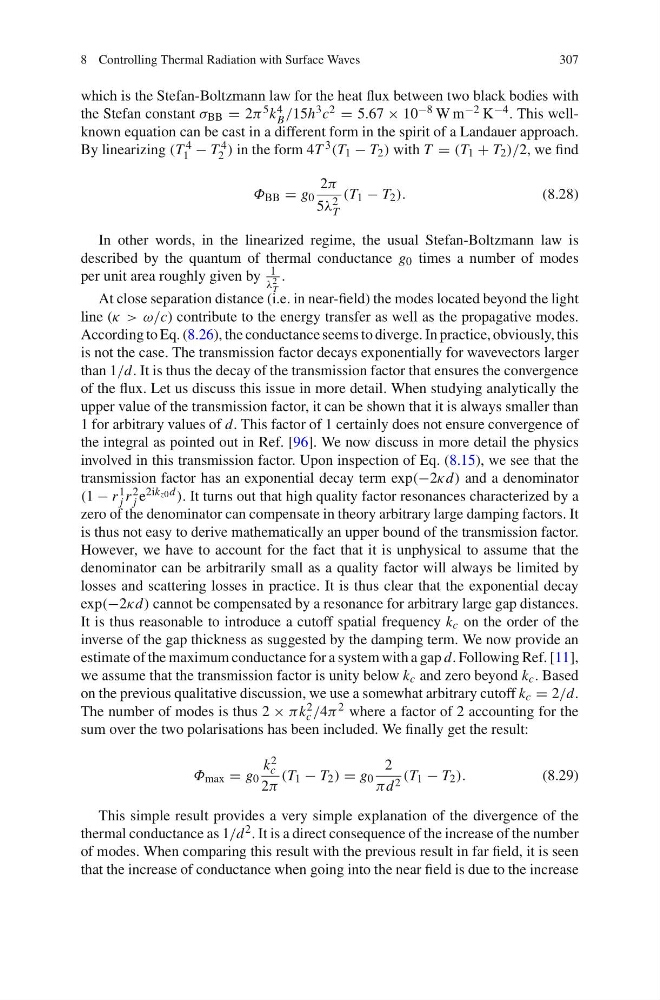
which is the Stefan-Boltzmann law for the heat flux between two black bodies with
the Stefan constant σ BB = 2π 5 k 4
B /15h 3 c 2 = 5.67 × 10 −8 W m −2 K −4 . This wellknown equation can be cast in a different form in the spirit of a Landauer approach.
By linearizing (T 4
1 − T 4
2 ) in the form 4T 3 (T 1 − T 2 ) with T = (T 1 + T 2 )/2, we find
Φ BB = g 0
2π
5λ 2
T
(T 1 − T 2 ).
(8.28)
In other words, in the linearized regime, the usual Stefan-Boltzmann law is
described by the quantum of thermal conductance g 0 times a number of modes
per unit area roughly given by
1
λ 2
T
.
At close separation distance (i.e. in near-field) the modes located beyond the light
line (κ > ω/c) contribute to the energy transfer as well as the propagative modes.
According to Eq. (8.26), the conductance seems to diverge. In practice, obviously, this
is not the case. The transmission factor decays exponentially for wavevectors larger
than 1/d. It is thus the decay of the transmission factor that ensures the convergence
of the flux. Let us discuss this issue in more detail. When studying analytically the
upper value of the transmission factor, it can be shown that it is always smaller than
1 for arbitrary values of d. This factor of 1 certainly does not ensure convergence of
the integral as pointed out in Ref. [96]. We now discuss in more detail the physics
involved in this transmission factor. Upon inspection of Eq. (8.15), we see that the
transmission factor has an exponential decay term exp(−2κd) and a denominator
(1 − r 1
j r 2
j e 2ik z0 d ). It turns out that high quality factor resonances characterized by a
zero of the denominator can compensate in theory arbitrary large damping factors. It
is thus not easy to derive mathematically an upper bound of the transmission factor.
However, we have to account for the fact that it is unphysical to assume that the
denominator can be arbitrarily small as a quality factor will always be limited by
losses and scattering losses in practice. It is thus clear that the exponential decay
exp(−2κd) cannot be compensated by a resonance for arbitrary large gap distances.
It is thus reasonable to introduce a cutoff spatial frequency k c on the order of the
inverse of the gap thickness as suggested by the damping term. We now provide an
estimate of the maximum conductance for a system with a gap d. Following Ref. [11],
we assume that the transmission factor is unity below k c and zero beyond k c . Based
on the previous qualitative discussion, we use a somewhat arbitrary cutoff k c = 2/d.
The number of modes is thus 2 × π k 2
c /4π 2 where a factor of 2 accounting for the
sum over the two polarisations has been included. We finally get the result:
Φ max = g 0
k 2
c
2π
(T 1 − T 2 ) = g 0
2
π d 2 (T 1 − T 2 ).
(8.29)
This simple result provides a very simple explanation of the divergence of the
thermal conductance as 1/d 2 . It is a direct consequence of the increase of the number
of modes. When comparing this result with the previous result in far field, it is seen
that the increase of conductance when going into the near field is due to the increase
307
which is the Stefan-Boltzmann law for the heat flux between two black bodies with
the Stefan constant σ BB = 2π 5 k 4
B /15h 3 c 2 = 5.67 × 10 −8 W m −2 K −4 . This wellknown equation can be cast in a different form in the spirit of a Landauer approach.
By linearizing (T 4
1 − T 4
2 ) in the form 4T 3 (T 1 − T 2 ) with T = (T 1 + T 2 )/2, we find
Φ BB = g 0
2π
5λ 2
T
(T 1 − T 2 ).
(8.28)
In other words, in the linearized regime, the usual Stefan-Boltzmann law is
described by the quantum of thermal conductance g 0 times a number of modes
per unit area roughly given by
1
λ 2
T
.
At close separation distance (i.e. in near-field) the modes located beyond the light
line (κ > ω/c) contribute to the energy transfer as well as the propagative modes.
According to Eq. (8.26), the conductance seems to diverge. In practice, obviously, this
is not the case. The transmission factor decays exponentially for wavevectors larger
than 1/d. It is thus the decay of the transmission factor that ensures the convergence
of the flux. Let us discuss this issue in more detail. When studying analytically the
upper value of the transmission factor, it can be shown that it is always smaller than
1 for arbitrary values of d. This factor of 1 certainly does not ensure convergence of
the integral as pointed out in Ref. [96]. We now discuss in more detail the physics
involved in this transmission factor. Upon inspection of Eq. (8.15), we see that the
transmission factor has an exponential decay term exp(−2κd) and a denominator
(1 − r 1
j r 2
j e 2ik z0 d ). It turns out that high quality factor resonances characterized by a
zero of the denominator can compensate in theory arbitrary large damping factors. It
is thus not easy to derive mathematically an upper bound of the transmission factor.
However, we have to account for the fact that it is unphysical to assume that the
denominator can be arbitrarily small as a quality factor will always be limited by
losses and scattering losses in practice. It is thus clear that the exponential decay
exp(−2κd) cannot be compensated by a resonance for arbitrary large gap distances.
It is thus reasonable to introduce a cutoff spatial frequency k c on the order of the
inverse of the gap thickness as suggested by the damping term. We now provide an
estimate of the maximum conductance for a system with a gap d. Following Ref. [11],
we assume that the transmission factor is unity below k c and zero beyond k c . Based
on the previous qualitative discussion, we use a somewhat arbitrary cutoff k c = 2/d.
The number of modes is thus 2 × π k 2
c /4π 2 where a factor of 2 accounting for the
sum over the two polarisations has been included. We finally get the result:
Φ max = g 0
k 2
c
2π
(T 1 − T 2 ) = g 0
2
π d 2 (T 1 − T 2 ).
(8.29)
This simple result provides a very simple explanation of the divergence of the
thermal conductance as 1/d 2 . It is a direct consequence of the increase of the number
of modes. When comparing this result with the previous result in far field, it is seen
that the increase of conductance when going into the near field is due to the increase