

308
P. Ben-Abdallah et al.
in the number of modes. Our rough estimate shows that the ratio of the number
of modes is given by (λ T /d) 2 . This yields a factor 4 × 10 4 for λ T = 10 µm and
d = 50 nm. Let us insist on the fact that we have assumed unit transmission factor
for all the modes below cutoff. In what follows, we discuss this issue and show that
in most cases, the transmission factors are much lower than 1.
We finally discuss the existence of a cutoff of fundamental nature. The macroscopic model of a dielectric constant does not include information on the microscopic
structure of the material. Yet, it is well known that for polar materials, there is a cutoff value for the phonons spatial wave vectors given by π/a , where a is the lattice
constant. This is the limit of the first Brillouin zone. This sets an ultimate limit to the
heat flux and removes the 1/d 2 divergence.
8.2.3 Heat Transfer Mediated by Photon Tunneling
8.2.3.1 Frustrated Modes
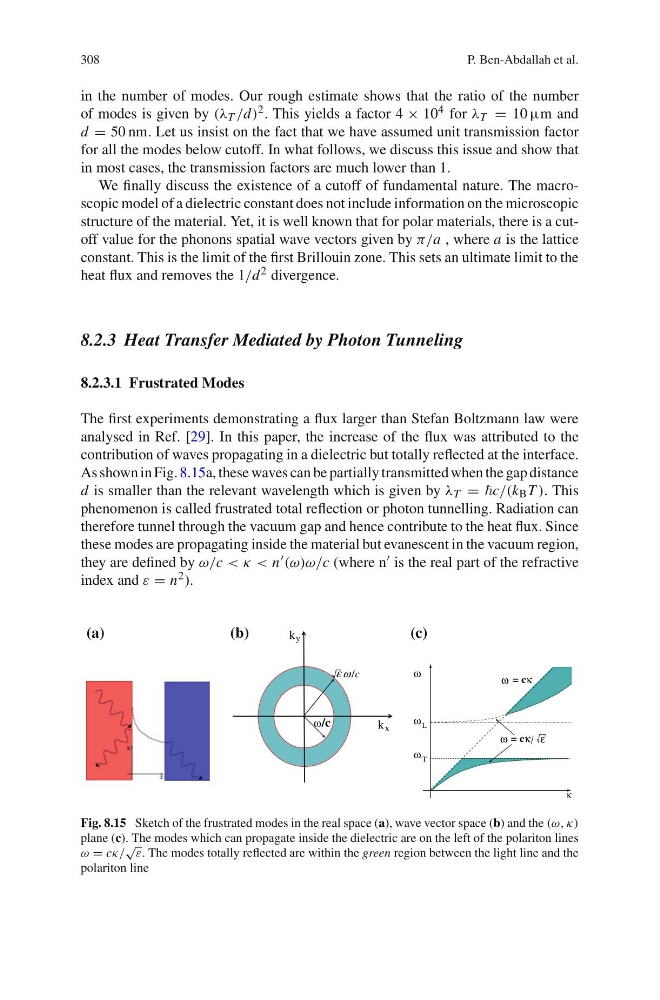
The first experiments demonstrating a flux larger than Stefan Boltzmann law were
analysed in Ref. [29]. In this paper, the increase of the flux was attributed to the
contribution of waves propagating in a dielectric but totally reflected at the interface.
As shown in Fig. 8.15a, these waves can be partially transmitted when the gap distance
d is smaller than the relevant wavelength which is given by λ T = c/(k B T ). This
phenomenon is called frustrated total reflection or photon tunnelling. Radiation can
therefore tunnel through the vacuum gap and hence contribute to the heat flux. Since
these modes are propagating inside the material but evanescent in the vacuum region,
they are defined by ω/c < κ < n ≈ (ω)ω/c (where n ≈ is the real part of the refractive
index and ε = n 2 ).
(a)
k y
k x
ω/c
c
/
ω
ε
(b)
= c
= c
L
T
κ
κ
κ
ω
ε
ω
ω
ω
ω
(c)
Fig. 8.15 Sketch of the frustrated modes in the real space (a), wave vector space (b) and the (ω, κ)
plane (c). The modes which can propagate inside the dielectric are on the left of the polariton lines
ω = cκ/
√
ε. The modes totally reflected are within the green region between the light line and the
polariton line
P. Ben-Abdallah et al.
in the number of modes. Our rough estimate shows that the ratio of the number
of modes is given by (λ T /d) 2 . This yields a factor 4 × 10 4 for λ T = 10 µm and
d = 50 nm. Let us insist on the fact that we have assumed unit transmission factor
for all the modes below cutoff. In what follows, we discuss this issue and show that
in most cases, the transmission factors are much lower than 1.
We finally discuss the existence of a cutoff of fundamental nature. The macroscopic model of a dielectric constant does not include information on the microscopic
structure of the material. Yet, it is well known that for polar materials, there is a cutoff value for the phonons spatial wave vectors given by π/a , where a is the lattice
constant. This is the limit of the first Brillouin zone. This sets an ultimate limit to the
heat flux and removes the 1/d 2 divergence.
8.2.3 Heat Transfer Mediated by Photon Tunneling
8.2.3.1 Frustrated Modes
The first experiments demonstrating a flux larger than Stefan Boltzmann law were
analysed in Ref. [29]. In this paper, the increase of the flux was attributed to the
contribution of waves propagating in a dielectric but totally reflected at the interface.
As shown in Fig. 8.15a, these waves can be partially transmitted when the gap distance
d is smaller than the relevant wavelength which is given by λ T = c/(k B T ). This
phenomenon is called frustrated total reflection or photon tunnelling. Radiation can
therefore tunnel through the vacuum gap and hence contribute to the heat flux. Since
these modes are propagating inside the material but evanescent in the vacuum region,
they are defined by ω/c < κ < n ≈ (ω)ω/c (where n ≈ is the real part of the refractive
index and ε = n 2 ).
(a)
k y
k x
ω/c
c
/
ω
ε
(b)
= c
= c
L
T
κ
κ
κ
ω
ε
ω
ω
ω
ω
(c)
Fig. 8.15 Sketch of the frustrated modes in the real space (a), wave vector space (b) and the (ω, κ)
plane (c). The modes which can propagate inside the dielectric are on the left of the polariton lines
ω = cκ/
√
ε. The modes totally reflected are within the green region between the light line and the
polariton line