

306
P. Ben-Abdallah et al.
Φ =
j={s,p}
d 2 κ
(2π) 2
∞
0
dω
2π
T j (ω, κ, d)
∂Θ
∂ T
[T 1 − T 2 ].
(8.24)
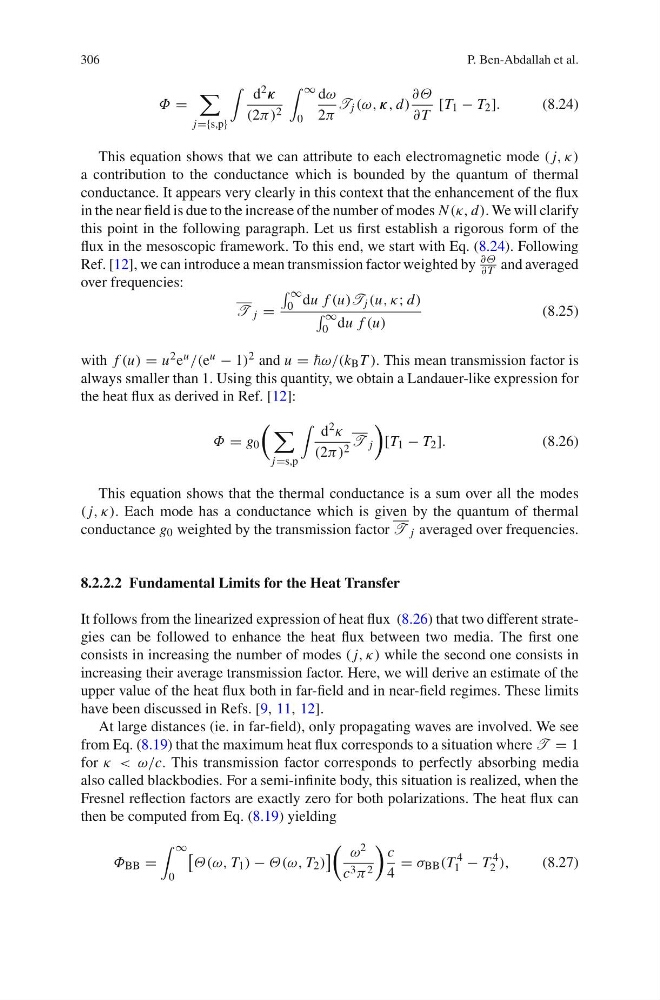
This equation shows that we can attribute to each electromagnetic mode ( j, κ)
a contribution to the conductance which is bounded by the quantum of thermal
conductance. It appears very clearly in this context that the enhancement of the flux
in the near field is due to the increase of the number of modes N (κ, d). We will clarify
this point in the following paragraph. Let us first establish a rigorous form of the
flux in the mesoscopic framework. To this end, we start with Eq. (8.24). Following
Ref. [12], we can introduce a mean transmission factor weighted by
∂Θ
∂ T and averaged
over frequencies:
T j =
∞
0 du f (u)T j (u, κ; d)
∞
0 du f (u)
(8.25)
with f (u) = u 2 e u /(e u − 1) 2 and u = ω/(k B T ). This mean transmission factor is
always smaller than 1. Using this quantity, we obtain a Landauer-like expression for
the heat flux as derived in Ref. [12]:
Φ = g 0
j=s,p
d 2 κ
(2π) 2 T j
[T 1 − T 2 ].
(8.26)
This equation shows that the thermal conductance is a sum over all the modes
( j, κ). Each mode has a conductance which is given by the quantum of thermal
conductance g 0 weighted by the transmission factor T j averaged over frequencies.
8.2.2.2 Fundamental Limits for the Heat Transfer
It follows from the linearized expression of heat flux (8.26) that two different strategies can be followed to enhance the heat flux between two media. The first one
consists in increasing the number of modes ( j, κ) while the second one consists in
increasing their average transmission factor. Here, we will derive an estimate of the
upper value of the heat flux both in far-field and in near-field regimes. These limits
have been discussed in Refs. [9, 11, 12].
At large distances (ie. in far-field), only propagating waves are involved. We see
from Eq. (8.19) that the maximum heat flux corresponds to a situation where T = 1
for κ < ω/c. This transmission factor corresponds to perfectly absorbing media
also called blackbodies. For a semi-infinite body, this situation is realized, when the
Fresnel reflection factors are exactly zero for both polarizations. The heat flux can
then be computed from Eq. (8.19) yielding
Φ BB =
∞
0
Θ(ω, T 1 ) − Θ(ω, T 2 )
ω 2
c 3 π 2
c
4
= σ BB (T
4
1 − T
4
2 ),
(8.27)
P. Ben-Abdallah et al.
Φ =
j={s,p}
d 2 κ
(2π) 2
∞
0
dω
2π
T j (ω, κ, d)
∂Θ
∂ T
[T 1 − T 2 ].
(8.24)
This equation shows that we can attribute to each electromagnetic mode ( j, κ)
a contribution to the conductance which is bounded by the quantum of thermal
conductance. It appears very clearly in this context that the enhancement of the flux
in the near field is due to the increase of the number of modes N (κ, d). We will clarify
this point in the following paragraph. Let us first establish a rigorous form of the
flux in the mesoscopic framework. To this end, we start with Eq. (8.24). Following
Ref. [12], we can introduce a mean transmission factor weighted by
∂Θ
∂ T and averaged
over frequencies:
T j =
∞
0 du f (u)T j (u, κ; d)
∞
0 du f (u)
(8.25)
with f (u) = u 2 e u /(e u − 1) 2 and u = ω/(k B T ). This mean transmission factor is
always smaller than 1. Using this quantity, we obtain a Landauer-like expression for
the heat flux as derived in Ref. [12]:
Φ = g 0
j=s,p
d 2 κ
(2π) 2 T j
[T 1 − T 2 ].
(8.26)
This equation shows that the thermal conductance is a sum over all the modes
( j, κ). Each mode has a conductance which is given by the quantum of thermal
conductance g 0 weighted by the transmission factor T j averaged over frequencies.
8.2.2.2 Fundamental Limits for the Heat Transfer
It follows from the linearized expression of heat flux (8.26) that two different strategies can be followed to enhance the heat flux between two media. The first one
consists in increasing the number of modes ( j, κ) while the second one consists in
increasing their average transmission factor. Here, we will derive an estimate of the
upper value of the heat flux both in far-field and in near-field regimes. These limits
have been discussed in Refs. [9, 11, 12].
At large distances (ie. in far-field), only propagating waves are involved. We see
from Eq. (8.19) that the maximum heat flux corresponds to a situation where T = 1
for κ < ω/c. This transmission factor corresponds to perfectly absorbing media
also called blackbodies. For a semi-infinite body, this situation is realized, when the
Fresnel reflection factors are exactly zero for both polarizations. The heat flux can
then be computed from Eq. (8.19) yielding
Φ BB =
∞
0
Θ(ω, T 1 ) − Θ(ω, T 2 )
ω 2
c 3 π 2
c
4
= σ BB (T
4
1 − T
4
2 ),
(8.27)