

296
P. Ben-Abdallah et al.
8.1.5 Polarization Effects: Coupling of s-Polarized Propagating
Waves and Surface Waves
Previous sections have been devoted to the study of the coupling between surface
waves and propagating waves. It is well known that surface plasmons or phonons
are p-polarized electromagnetic waves. It is thus tempting to think that propagating
waves excited by surface waves through the grating are also p-polarized. That is
true only in the emission plane perpendicular to the lines of the grating. Indeed,
when observing in another plane, it is possible to couple s-polarized propagating
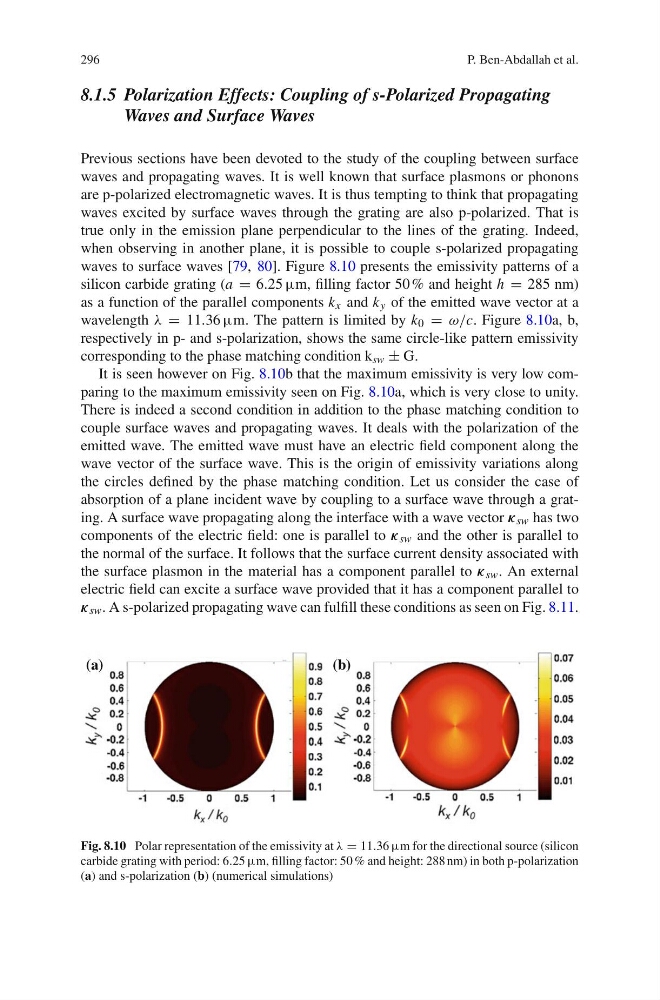
waves to surface waves [79, 80]. Figure 8.10 presents the emissivity patterns of a
silicon carbide grating (a = 6.25 µm, filling factor 50 % and height h = 285 nm)
as a function of the parallel components k x and k y of the emitted wave vector at a
wavelength λ = 11.36 µm. The pattern is limited by k 0 = ω/c. Figure 8.10a, b,
respectively in p- and s-polarization, shows the same circle-like pattern emissivity
corresponding to the phase matching condition k sw ± G.
It is seen however on Fig. 8.10b that the maximum emissivity is very low comparing to the maximum emissivity seen on Fig. 8.10a, which is very close to unity.
There is indeed a second condition in addition to the phase matching condition to
couple surface waves and propagating waves. It deals with the polarization of the
emitted wave. The emitted wave must have an electric field component along the
wave vector of the surface wave. This is the origin of emissivity variations along
the circles defined by the phase matching condition. Let us consider the case of
absorption of a plane incident wave by coupling to a surface wave through a grating. A surface wave propagating along the interface with a wave vector κ sw has two
components of the electric field: one is parallel to κ sw and the other is parallel to
the normal of the surface. It follows that the surface current density associated with
the surface plasmon in the material has a component parallel to κ sw . An external
electric field can excite a surface wave provided that it has a component parallel to
κ sw . A s-polarized propagating wave can fulfill these conditions as seen on Fig. 8.11.
(a)
(b)
Fig. 8.10 Polar representation of the emissivity at λ = 11.36 µm for the directional source (silicon
carbide grating with period: 6.25 µm, filling factor: 50 % and height: 288 nm) in both p-polarization
(a) and s-polarization (b) (numerical simulations)
P. Ben-Abdallah et al.
8.1.5 Polarization Effects: Coupling of s-Polarized Propagating
Waves and Surface Waves
Previous sections have been devoted to the study of the coupling between surface
waves and propagating waves. It is well known that surface plasmons or phonons
are p-polarized electromagnetic waves. It is thus tempting to think that propagating
waves excited by surface waves through the grating are also p-polarized. That is
true only in the emission plane perpendicular to the lines of the grating. Indeed,
when observing in another plane, it is possible to couple s-polarized propagating
waves to surface waves [79, 80]. Figure 8.10 presents the emissivity patterns of a
silicon carbide grating (a = 6.25 µm, filling factor 50 % and height h = 285 nm)
as a function of the parallel components k x and k y of the emitted wave vector at a
wavelength λ = 11.36 µm. The pattern is limited by k 0 = ω/c. Figure 8.10a, b,
respectively in p- and s-polarization, shows the same circle-like pattern emissivity
corresponding to the phase matching condition k sw ± G.
It is seen however on Fig. 8.10b that the maximum emissivity is very low comparing to the maximum emissivity seen on Fig. 8.10a, which is very close to unity.
There is indeed a second condition in addition to the phase matching condition to
couple surface waves and propagating waves. It deals with the polarization of the
emitted wave. The emitted wave must have an electric field component along the
wave vector of the surface wave. This is the origin of emissivity variations along
the circles defined by the phase matching condition. Let us consider the case of
absorption of a plane incident wave by coupling to a surface wave through a grating. A surface wave propagating along the interface with a wave vector κ sw has two
components of the electric field: one is parallel to κ sw and the other is parallel to
the normal of the surface. It follows that the surface current density associated with
the surface plasmon in the material has a component parallel to κ sw . An external
electric field can excite a surface wave provided that it has a component parallel to
κ sw . A s-polarized propagating wave can fulfill these conditions as seen on Fig. 8.11.
(a)
(b)
Fig. 8.10 Polar representation of the emissivity at λ = 11.36 µm for the directional source (silicon
carbide grating with period: 6.25 µm, filling factor: 50 % and height: 288 nm) in both p-polarization
(a) and s-polarization (b) (numerical simulations)