

8 Controlling Thermal Radiation with Surface Waves
295
8.1.4 Surface-Plasmons Assisted Thermal Emission
Results have been seen in the previous sections on silicon carbide structures, showing
an efficient coupling between surface phonons and propagating waves. That leads to
non-usual thermal emission characteristics, in particular spatial coherence. Similar
results can be obtained using surface plasmons on metals instead of surface phonons
on polar materials. Kreiter and coworkers studied thermal emission of a gold grating.
Heating their sample at 700 ◦ C, they observed narrow peaks of emission mediated by
surface plasmons at 710 and 810 nm. The full width at half maximum (FWHM) of the
peaks is of the order of 85 mrad. Dealing with thermal emission of metals, tungsten
appears as a good candidate. It is indeed widely used in thermal light applications
because of its high melting temperature. It is however not a very good emitter in the
infra red and works have been done to enhance its thermal emission [50]. Tungsten
does not support surfaces plasmons in the visible but in the near IR, there are modes
with very large propagation length. This may be surprising at first glance because
tungsten is a lossy metal. However, its dielectric constant is so large that the field
of the surface plasmon is mostly in the vacuum where there are no losses. Very
narrow peaks of emission are thus expected. A grating can be optimized to produce
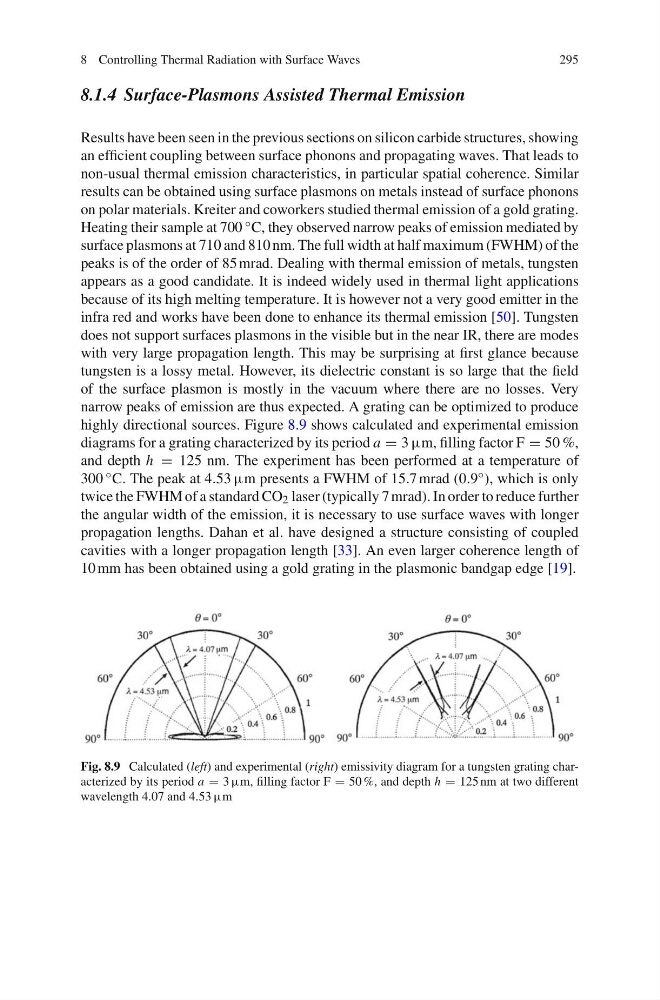
highly directional sources. Figure 8.9 shows calculated and experimental emission
diagrams for a grating characterized by its period a = 3 µm, filling factor F = 50 %,
and depth h = 125 nm. The experiment has been performed at a temperature of
300 ◦ C. The peak at 4.53 µm presents a FWHM of 15.7 mrad (0.9 ◦ ), which is only
twice the FWHM of a standard CO 2 laser (typically 7 mrad). In order to reduce further
the angular width of the emission, it is necessary to use surface waves with longer
propagation lengths. Dahan et al. have designed a structure consisting of coupled
cavities with a longer propagation length [33]. An even larger coherence length of
10 mm has been obtained using a gold grating in the plasmonic bandgap edge [19].
Fig. 8.9 Calculated (left) and experimental (right) emissivity diagram for a tungsten grating characterized by its period a = 3 µm, filling factor F = 50 %, and depth h = 125 nm at two different
wavelength 4.07 and 4.53 µm
295
8.1.4 Surface-Plasmons Assisted Thermal Emission
Results have been seen in the previous sections on silicon carbide structures, showing
an efficient coupling between surface phonons and propagating waves. That leads to
non-usual thermal emission characteristics, in particular spatial coherence. Similar
results can be obtained using surface plasmons on metals instead of surface phonons
on polar materials. Kreiter and coworkers studied thermal emission of a gold grating.
Heating their sample at 700 ◦ C, they observed narrow peaks of emission mediated by
surface plasmons at 710 and 810 nm. The full width at half maximum (FWHM) of the
peaks is of the order of 85 mrad. Dealing with thermal emission of metals, tungsten
appears as a good candidate. It is indeed widely used in thermal light applications
because of its high melting temperature. It is however not a very good emitter in the
infra red and works have been done to enhance its thermal emission [50]. Tungsten
does not support surfaces plasmons in the visible but in the near IR, there are modes
with very large propagation length. This may be surprising at first glance because
tungsten is a lossy metal. However, its dielectric constant is so large that the field
of the surface plasmon is mostly in the vacuum where there are no losses. Very
narrow peaks of emission are thus expected. A grating can be optimized to produce
highly directional sources. Figure 8.9 shows calculated and experimental emission
diagrams for a grating characterized by its period a = 3 µm, filling factor F = 50 %,
and depth h = 125 nm. The experiment has been performed at a temperature of
300 ◦ C. The peak at 4.53 µm presents a FWHM of 15.7 mrad (0.9 ◦ ), which is only
twice the FWHM of a standard CO 2 laser (typically 7 mrad). In order to reduce further
the angular width of the emission, it is necessary to use surface waves with longer
propagation lengths. Dahan et al. have designed a structure consisting of coupled
cavities with a longer propagation length [33]. An even larger coherence length of
10 mm has been obtained using a gold grating in the plasmonic bandgap edge [19].
Fig. 8.9 Calculated (left) and experimental (right) emissivity diagram for a tungsten grating characterized by its period a = 3 µm, filling factor F = 50 %, and depth h = 125 nm at two different
wavelength 4.07 and 4.53 µm