

294
P. Ben-Abdallah et al.
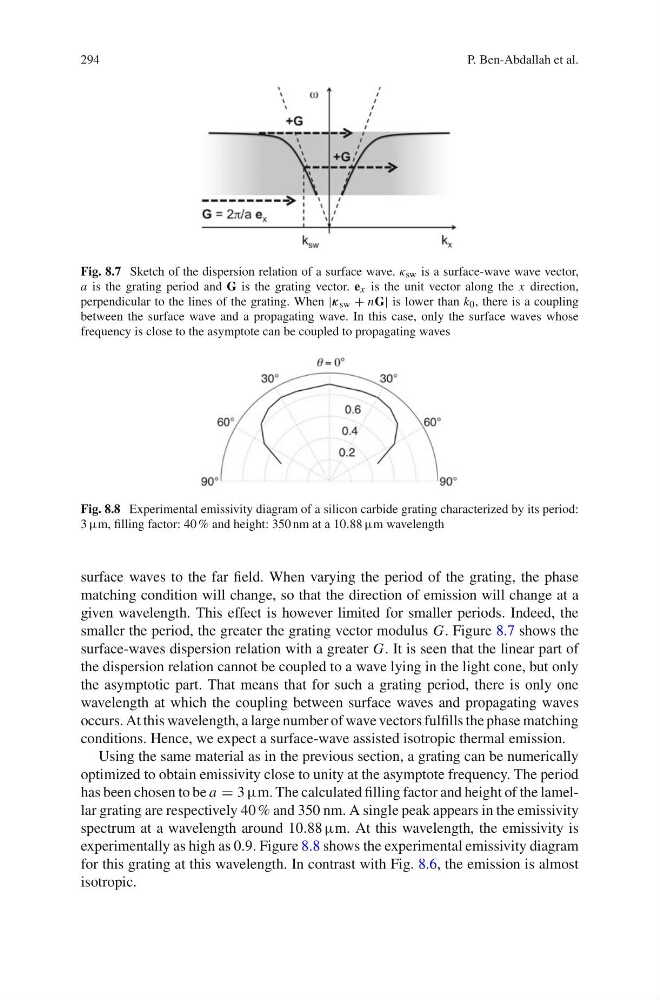
Fig. 8.7 Sketch of the dispersion relation of a surface wave. κ sw is a surface-wave wave vector,
a is the grating period and G is the grating vector. e x is the unit vector along the x direction,
perpendicular to the lines of the grating. When |κ sw + nG| is lower than k 0 , there is a coupling
between the surface wave and a propagating wave. In this case, only the surface waves whose
frequency is close to the asymptote can be coupled to propagating waves
Fig. 8.8 Experimental emissivity diagram of a silicon carbide grating characterized by its period:
3 µm, filling factor: 40 % and height: 350 nm at a 10.88 µm wavelength
surface waves to the far field. When varying the period of the grating, the phase
matching condition will change, so that the direction of emission will change at a
given wavelength. This effect is however limited for smaller periods. Indeed, the
smaller the period, the greater the grating vector modulus G. Figure 8.7 shows the
surface-waves dispersion relation with a greater G. It is seen that the linear part of
the dispersion relation cannot be coupled to a wave lying in the light cone, but only
the asymptotic part. That means that for such a grating period, there is only one
wavelength at which the coupling between surface waves and propagating waves
occurs. At this wavelength, a large number of wave vectors fulfills the phase matching
conditions. Hence, we expect a surface-wave assisted isotropic thermal emission.
Using the same material as in the previous section, a grating can be numerically
optimized to obtain emissivity close to unity at the asymptote frequency. The period
has been chosen to be a = 3 µm. The calculated filling factor and height of the lamellar grating are respectively 40 % and 350 nm. A single peak appears in the emissivity
spectrum at a wavelength around 10.88 µm. At this wavelength, the emissivity is
experimentally as high as 0.9. Figure 8.8 shows the experimental emissivity diagram
for this grating at this wavelength. In contrast with Fig. 8.6, the emission is almost
isotropic.
P. Ben-Abdallah et al.
Fig. 8.7 Sketch of the dispersion relation of a surface wave. κ sw is a surface-wave wave vector,
a is the grating period and G is the grating vector. e x is the unit vector along the x direction,
perpendicular to the lines of the grating. When |κ sw + nG| is lower than k 0 , there is a coupling
between the surface wave and a propagating wave. In this case, only the surface waves whose
frequency is close to the asymptote can be coupled to propagating waves
Fig. 8.8 Experimental emissivity diagram of a silicon carbide grating characterized by its period:
3 µm, filling factor: 40 % and height: 350 nm at a 10.88 µm wavelength
surface waves to the far field. When varying the period of the grating, the phase
matching condition will change, so that the direction of emission will change at a
given wavelength. This effect is however limited for smaller periods. Indeed, the
smaller the period, the greater the grating vector modulus G. Figure 8.7 shows the
surface-waves dispersion relation with a greater G. It is seen that the linear part of
the dispersion relation cannot be coupled to a wave lying in the light cone, but only
the asymptotic part. That means that for such a grating period, there is only one
wavelength at which the coupling between surface waves and propagating waves
occurs. At this wavelength, a large number of wave vectors fulfills the phase matching
conditions. Hence, we expect a surface-wave assisted isotropic thermal emission.
Using the same material as in the previous section, a grating can be numerically
optimized to obtain emissivity close to unity at the asymptote frequency. The period
has been chosen to be a = 3 µm. The calculated filling factor and height of the lamellar grating are respectively 40 % and 350 nm. A single peak appears in the emissivity
spectrum at a wavelength around 10.88 µm. At this wavelength, the emissivity is
experimentally as high as 0.9. Figure 8.8 shows the experimental emissivity diagram
for this grating at this wavelength. In contrast with Fig. 8.6, the emission is almost
isotropic.