

8 Controlling Thermal Radiation with Surface Waves
293
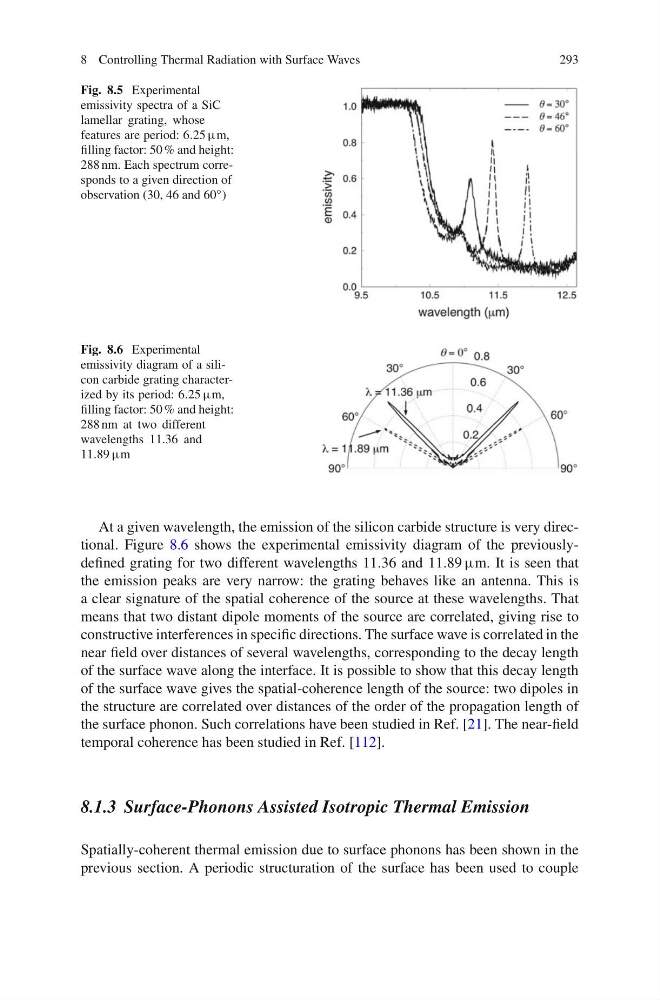
Fig. 8.5 Experimental
emissivity spectra of a SiC
lamellar grating, whose
features are period: 6.25 µm,
filling factor: 50 % and height:
288 nm. Each spectrum corresponds to a given direction of
observation (30, 46 and 60 ◦ )
Fig. 8.6 Experimental
emissivity diagram of a silicon carbide grating characterized by its period: 6.25 µm,
filling factor: 50 % and height:
288 nm at two different
wavelengths 11.36 and
11.89 µm
At a given wavelength, the emission of the silicon carbide structure is very directional. Figure 8.6 shows the experimental emissivity diagram of the previouslydefined grating for two different wavelengths 11.36 and 11.89 µm. It is seen that
the emission peaks are very narrow: the grating behaves like an antenna. This is
a clear signature of the spatial coherence of the source at these wavelengths. That
means that two distant dipole moments of the source are correlated, giving rise to
constructive interferences in specific directions. The surface wave is correlated in the
near field over distances of several wavelengths, corresponding to the decay length
of the surface wave along the interface. It is possible to show that this decay length
of the surface wave gives the spatial-coherence length of the source: two dipoles in
the structure are correlated over distances of the order of the propagation length of
the surface phonon. Such correlations have been studied in Ref. [21]. The near-field
temporal coherence has been studied in Ref. [112].
8.1.3 Surface-Phonons Assisted Isotropic Thermal Emission
Spatially-coherent thermal emission due to surface phonons has been shown in the
previous section. A periodic structuration of the surface has been used to couple
293
Fig. 8.5 Experimental
emissivity spectra of a SiC
lamellar grating, whose
features are period: 6.25 µm,
filling factor: 50 % and height:
288 nm. Each spectrum corresponds to a given direction of
observation (30, 46 and 60 ◦ )
Fig. 8.6 Experimental
emissivity diagram of a silicon carbide grating characterized by its period: 6.25 µm,
filling factor: 50 % and height:
288 nm at two different
wavelengths 11.36 and
11.89 µm
At a given wavelength, the emission of the silicon carbide structure is very directional. Figure 8.6 shows the experimental emissivity diagram of the previouslydefined grating for two different wavelengths 11.36 and 11.89 µm. It is seen that
the emission peaks are very narrow: the grating behaves like an antenna. This is
a clear signature of the spatial coherence of the source at these wavelengths. That
means that two distant dipole moments of the source are correlated, giving rise to
constructive interferences in specific directions. The surface wave is correlated in the
near field over distances of several wavelengths, corresponding to the decay length
of the surface wave along the interface. It is possible to show that this decay length
of the surface wave gives the spatial-coherence length of the source: two dipoles in
the structure are correlated over distances of the order of the propagation length of
the surface phonon. Such correlations have been studied in Ref. [21]. The near-field
temporal coherence has been studied in Ref. [112].
8.1.3 Surface-Phonons Assisted Isotropic Thermal Emission
Spatially-coherent thermal emission due to surface phonons has been shown in the
previous section. A periodic structuration of the surface has been used to couple