

8 Controlling Thermal Radiation with Surface Waves
291
factor. Thermal emission of lamellar gratings in the plane perpendicular to the lines
of the gratings is studied first. Section 8.1.5 shows then how the p-polarized surface
waves can be coupled to s-polarized propagating waves. The case of crossed gratings
will be also discussed.
8.1.2 Spatially-Coherent Thermal Emission: Surface-Phonons
Assisted Directional Thermal Emission
Surface waves and propagating waves are coupled here using a shallow periodic
structuration of the surface. More precisely, this structuration is a lamellar grating.
The x axis is chosen parallel to the mean surface and perpendicular to the lines of
the grating. The period of this grating is denoted by a. An incident wave is diffracted
by the structure in directions given by a phase matching condition: k diffracted,x =
k incident,x + nG, where n is an integer and G = 2π/a is the grating vector modulus.
We consider thermally-excited surface waves, characterized by a frequency ω and
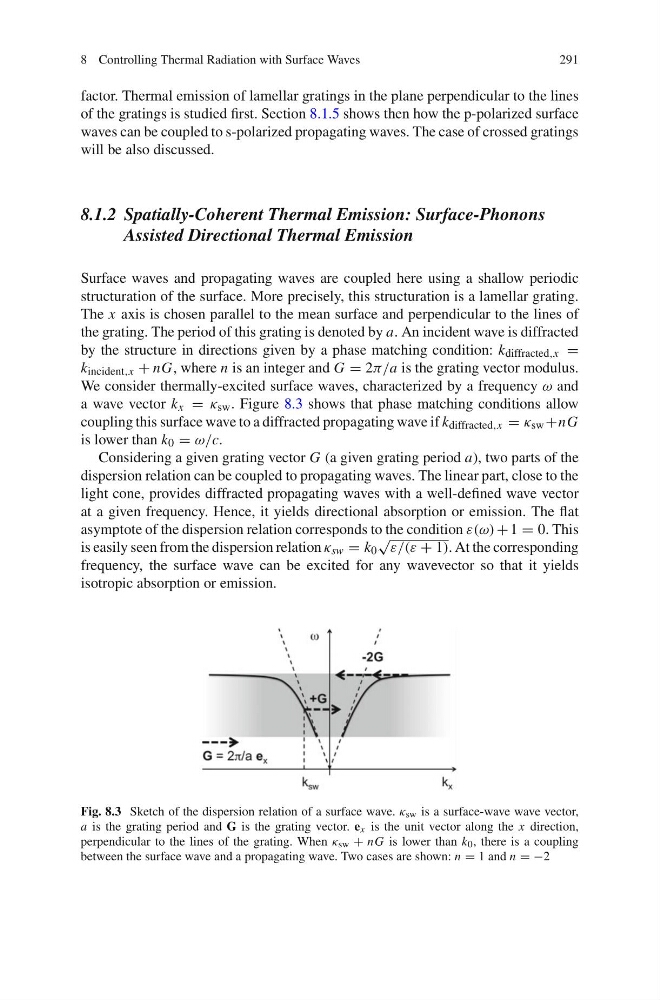
a wave vector k x = κ sw . Figure 8.3 shows that phase matching conditions allow
coupling this surface wave to a diffracted propagating wave if k diffracted,x = κ sw +nG
is lower than k 0 = ω/c.
Considering a given grating vector G (a given grating period a), two parts of the
dispersion relation can be coupled to propagating waves. The linear part, close to the
light cone, provides diffracted propagating waves with a well-defined wave vector
at a given frequency. Hence, it yields directional absorption or emission. The flat
asymptote of the dispersion relation corresponds to the condition ε(ω) + 1 = 0. This
is easily seen from the dispersion relation κ sw = k 0
√ ε/(ε + 1). At the corresponding
frequency, the surface wave can be excited for any wavevector so that it yields
isotropic absorption or emission.
Fig. 8.3 Sketch of the dispersion relation of a surface wave. κ sw is a surface-wave wave vector,
a is the grating period and G is the grating vector. e x is the unit vector along the x direction,
perpendicular to the lines of the grating. When κ sw + nG is lower than k 0 , there is a coupling
between the surface wave and a propagating wave. Two cases are shown: n = 1 and n = −2
291
factor. Thermal emission of lamellar gratings in the plane perpendicular to the lines
of the gratings is studied first. Section 8.1.5 shows then how the p-polarized surface
waves can be coupled to s-polarized propagating waves. The case of crossed gratings
will be also discussed.
8.1.2 Spatially-Coherent Thermal Emission: Surface-Phonons
Assisted Directional Thermal Emission
Surface waves and propagating waves are coupled here using a shallow periodic
structuration of the surface. More precisely, this structuration is a lamellar grating.
The x axis is chosen parallel to the mean surface and perpendicular to the lines of
the grating. The period of this grating is denoted by a. An incident wave is diffracted
by the structure in directions given by a phase matching condition: k diffracted,x =
k incident,x + nG, where n is an integer and G = 2π/a is the grating vector modulus.
We consider thermally-excited surface waves, characterized by a frequency ω and
a wave vector k x = κ sw . Figure 8.3 shows that phase matching conditions allow
coupling this surface wave to a diffracted propagating wave if k diffracted,x = κ sw +nG
is lower than k 0 = ω/c.
Considering a given grating vector G (a given grating period a), two parts of the
dispersion relation can be coupled to propagating waves. The linear part, close to the
light cone, provides diffracted propagating waves with a well-defined wave vector
at a given frequency. Hence, it yields directional absorption or emission. The flat
asymptote of the dispersion relation corresponds to the condition ε(ω) + 1 = 0. This
is easily seen from the dispersion relation κ sw = k 0
√ ε/(ε + 1). At the corresponding
frequency, the surface wave can be excited for any wavevector so that it yields
isotropic absorption or emission.
Fig. 8.3 Sketch of the dispersion relation of a surface wave. κ sw is a surface-wave wave vector,
a is the grating period and G is the grating vector. e x is the unit vector along the x direction,
perpendicular to the lines of the grating. When κ sw + nG is lower than k 0 , there is a coupling
between the surface wave and a propagating wave. Two cases are shown: n = 1 and n = −2