

274
M. B. Raschke et al.
0
-60 -40 -20
20 40 60
0
-60 -40 -20
20 40 60
Wavelength (nm)
Wavelength (nm)
2
4
6
8
4
12
18
24
30
0
36
0
10
x10 cps
cps
cps
420
410
400
390
380
430
370
420
410
400
390
380
430
370
Intensity (a.u.)
0.0
0.2
0.4
0.6
1.0
Amplitude (a.u.)
0.8
Phase (rad)
1. 4
1. 5
1.6
Energy (eV)
1.7
-3
2
-2
3
1
0
-1
0.0
0.2
0.4
0.6
1.0
Amplitude (a.u.)
0.8
Phase (rad)
1.4
1.5
1.6
Energy (eV)
1.7
-3
2
-2
3
1
0
-1
20 40 60 80
-4
6
-2
4
2
0
-6
0.0
0.2
0.4
0.8
0.6
1.0
Amplitude (a.u.)
Time (fs)
Phase (rad)
880 840 800 760 (nm)
-4
6
-2
4
2
0
-6
0
-20
20 40 60 80
0.0
0.2
0.4
0.8
0.6
1.0
Time (fs)
Phase (rad)
880 840 800 760
λ
(nm)
λ
0
Time (fs)
|E(ω)|
|P(ω)|
Φ(ω)
Φ (ω)
pl
IE(t)I 2
IP(t)I 2
Φ(t)
Φ (t)
pl
R(t)
R (t)
L
R(ω)
R (ω)
L
~
~
~
~
(a)
(c)
(e)
(f)
(d)
(b)
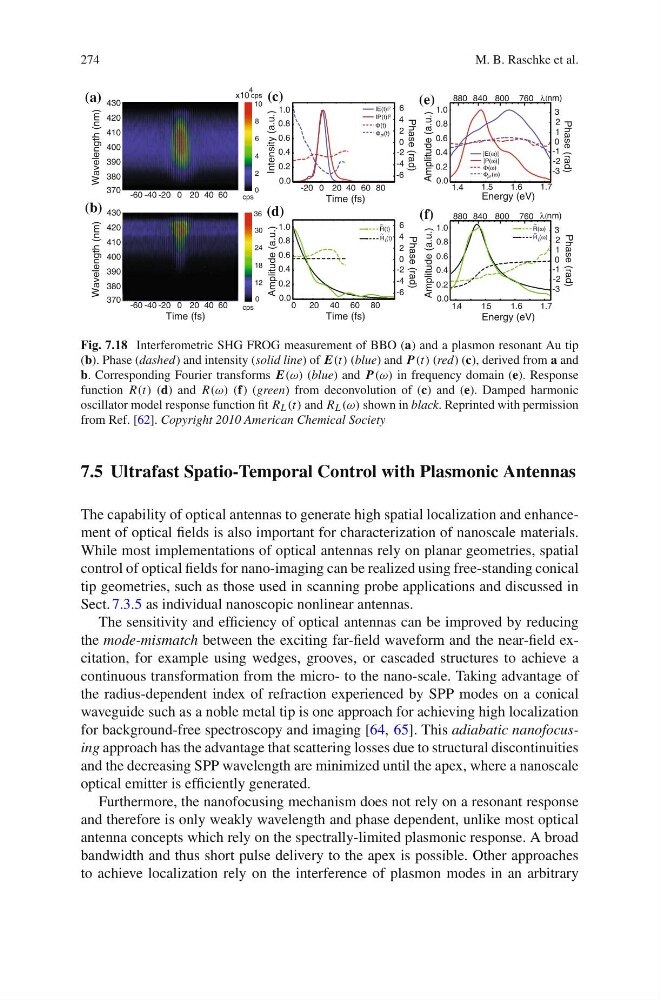
Fig. 7.18 Interferometric SHG FROG measurement of BBO (a) and a plasmon resonant Au tip
(b). Phase (dashed) and intensity (solid line) of E(t) (blue) and P(t) (red) (c), derived from a and
b. Corresponding Fourier transforms E(ω) (blue) and P(ω) in frequency domain (e). Response
function R(t) (d) and R(ω) (f) (green) from deconvolution of (c) and (e). Damped harmonic
oscillator model response function fit R L (t) and R L (ω) shown in black. Reprinted with permission
from Ref. [62]. Copyright 2010 American Chemical Society
7.5 Ultrafast Spatio-Temporal Control with Plasmonic Antennas
The capability of optical antennas to generate high spatial localization and enhancement of optical fields is also important for characterization of nanoscale materials.
While most implementations of optical antennas rely on planar geometries, spatial
control of optical fields for nano-imaging can be realized using free-standing conical
tip geometries, such as those used in scanning probe applications and discussed in
Sect. 7.3.5 as individual nanoscopic nonlinear antennas.
The sensitivity and efficiency of optical antennas can be improved by reducing
the mode-mismatch between the exciting far-field waveform and the near-field excitation, for example using wedges, grooves, or cascaded structures to achieve a
continuous transformation from the micro- to the nano-scale. Taking advantage of
the radius-dependent index of refraction experienced by SPP modes on a conical
waveguide such as a noble metal tip is one approach for achieving high localization
for background-free spectroscopy and imaging [64, 65]. This adiabatic nanofocusing approach has the advantage that scattering losses due to structural discontinuities
and the decreasing SPP wavelength are minimized until the apex, where a nanoscale
optical emitter is efficiently generated.
Furthermore, the nanofocusing mechanism does not rely on a resonant response
and therefore is only weakly wavelength and phase dependent, unlike most optical
antenna concepts which rely on the spectrally-limited plasmonic response. A broad
bandwidth and thus short pulse delivery to the apex is possible. Other approaches
to achieve localization rely on the interference of plasmon modes in an arbitrary
M. B. Raschke et al.
0
-60 -40 -20
20 40 60
0
-60 -40 -20
20 40 60
Wavelength (nm)
Wavelength (nm)
2
4
6
8
4
12
18
24
30
0
36
0
10
x10 cps
cps
cps
420
410
400
390
380
430
370
420
410
400
390
380
430
370
Intensity (a.u.)
0.0
0.2
0.4
0.6
1.0
Amplitude (a.u.)
0.8
Phase (rad)
1. 4
1. 5
1.6
Energy (eV)
1.7
-3
2
-2
3
1
0
-1
0.0
0.2
0.4
0.6
1.0
Amplitude (a.u.)
0.8
Phase (rad)
1.4
1.5
1.6
Energy (eV)
1.7
-3
2
-2
3
1
0
-1
20 40 60 80
-4
6
-2
4
2
0
-6
0.0
0.2
0.4
0.8
0.6
1.0
Amplitude (a.u.)
Time (fs)
Phase (rad)
880 840 800 760 (nm)
-4
6
-2
4
2
0
-6
0
-20
20 40 60 80
0.0
0.2
0.4
0.8
0.6
1.0
Time (fs)
Phase (rad)
880 840 800 760
λ
(nm)
λ
0
Time (fs)
|E(ω)|
|P(ω)|
Φ(ω)
Φ (ω)
pl
IE(t)I 2
IP(t)I 2
Φ(t)
Φ (t)
pl
R(t)
R (t)
L
R(ω)
R (ω)
L
~
~
~
~
(a)
(c)
(e)
(f)
(d)
(b)
Fig. 7.18 Interferometric SHG FROG measurement of BBO (a) and a plasmon resonant Au tip
(b). Phase (dashed) and intensity (solid line) of E(t) (blue) and P(t) (red) (c), derived from a and
b. Corresponding Fourier transforms E(ω) (blue) and P(ω) in frequency domain (e). Response
function R(t) (d) and R(ω) (f) (green) from deconvolution of (c) and (e). Damped harmonic
oscillator model response function fit R L (t) and R L (ω) shown in black. Reprinted with permission
from Ref. [62]. Copyright 2010 American Chemical Society
7.5 Ultrafast Spatio-Temporal Control with Plasmonic Antennas
The capability of optical antennas to generate high spatial localization and enhancement of optical fields is also important for characterization of nanoscale materials.
While most implementations of optical antennas rely on planar geometries, spatial
control of optical fields for nano-imaging can be realized using free-standing conical
tip geometries, such as those used in scanning probe applications and discussed in
Sect. 7.3.5 as individual nanoscopic nonlinear antennas.
The sensitivity and efficiency of optical antennas can be improved by reducing
the mode-mismatch between the exciting far-field waveform and the near-field excitation, for example using wedges, grooves, or cascaded structures to achieve a
continuous transformation from the micro- to the nano-scale. Taking advantage of
the radius-dependent index of refraction experienced by SPP modes on a conical
waveguide such as a noble metal tip is one approach for achieving high localization
for background-free spectroscopy and imaging [64, 65]. This adiabatic nanofocusing approach has the advantage that scattering losses due to structural discontinuities
and the decreasing SPP wavelength are minimized until the apex, where a nanoscale
optical emitter is efficiently generated.
Furthermore, the nanofocusing mechanism does not rely on a resonant response
and therefore is only weakly wavelength and phase dependent, unlike most optical
antenna concepts which rely on the spectrally-limited plasmonic response. A broad
bandwidth and thus short pulse delivery to the apex is possible. Other approaches
to achieve localization rely on the interference of plasmon modes in an arbitrary