

272
M. B. Raschke et al.
0
20
40
-20
0
1
-1
Time (fs)
60
E(t)
P pl (t)
80 100
0
2 0
40
Time (fs)
60
80 100
R(t)
(a)
(b)
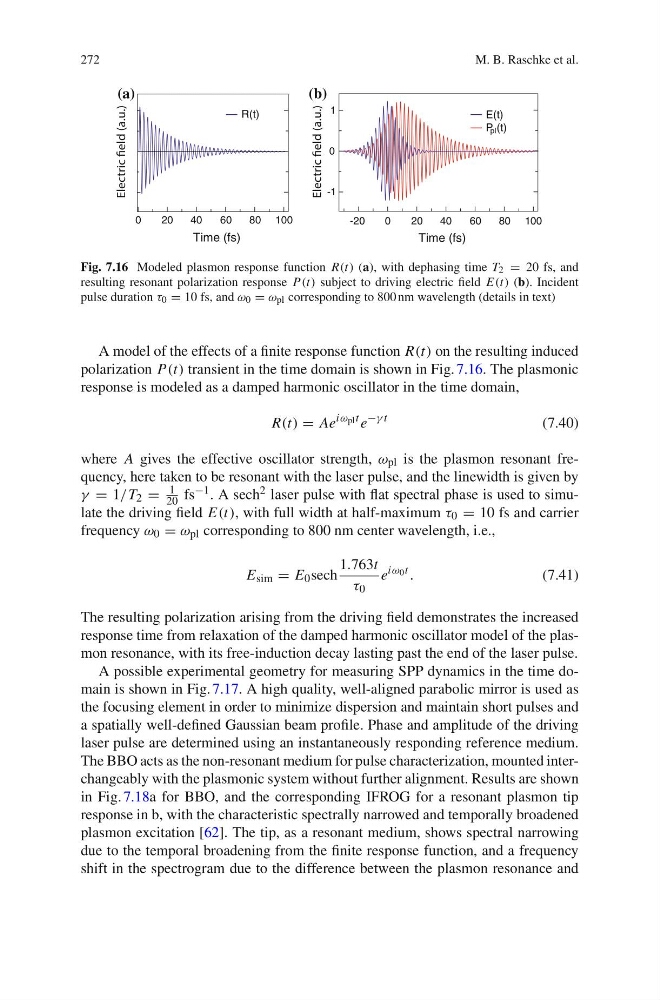
Fig. 7.16 Modeled plasmon response function R(t) (a), with dephasing time T 2 = 20 fs, and
resulting resonant polarization response P(t) subject to driving electric field E(t) (b). Incident
pulse duration τ 0 = 10 fs, and ω 0 = ω pl corresponding to 800 nm wavelength (details in text)
A model of the effects of a finite response function R(t) on the resulting induced
polarization P(t) transient in the time domain is shown in Fig. 7.16. The plasmonic
response is modeled as a damped harmonic oscillator in the time domain,
R(t) = Ae
iω pl t e
−γ t
(7.40)
where A gives the effective oscillator strength, ω pl is the plasmon resonant frequency, here taken to be resonant with the laser pulse, and the linewidth is given by
γ = 1/T 2 =
1
20 fs −1 . A sech 2 laser pulse with flat spectral phase is used to simulate the driving field E(t), with full width at half-maximum τ 0 = 10 fs and carrier
frequency ω 0 = ω pl corresponding to 800 nm center wavelength, i.e.,
E sim = E 0 sech
1.763t
τ 0
e
iω 0 t
.
(7.41)
The resulting polarization arising from the driving field demonstrates the increased
response time from relaxation of the damped harmonic oscillator model of the plasmon resonance, with its free-induction decay lasting past the end of the laser pulse.
A possible experimental geometry for measuring SPP dynamics in the time domain is shown in Fig. 7.17. A high quality, well-aligned parabolic mirror is used as
the focusing element in order to minimize dispersion and maintain short pulses and
a spatially well-defined Gaussian beam profile. Phase and amplitude of the driving
laser pulse are determined using an instantaneously responding reference medium.
The BBO acts as the non-resonant medium for pulse characterization, mounted interchangeably with the plasmonic system without further alignment. Results are shown
in Fig. 7.18a for BBO, and the corresponding IFROG for a resonant plasmon tip
response in b, with the characteristic spectrally narrowed and temporally broadened
plasmon excitation [62]. The tip, as a resonant medium, shows spectral narrowing
due to the temporal broadening from the finite response function, and a frequency
shift in the spectrogram due to the difference between the plasmon resonance and
M. B. Raschke et al.
0
20
40
-20
0
1
-1
Time (fs)
60
E(t)
P pl (t)
80 100
0
2 0
40
Time (fs)
60
80 100
R(t)
(a)
(b)
Fig. 7.16 Modeled plasmon response function R(t) (a), with dephasing time T 2 = 20 fs, and
resulting resonant polarization response P(t) subject to driving electric field E(t) (b). Incident
pulse duration τ 0 = 10 fs, and ω 0 = ω pl corresponding to 800 nm wavelength (details in text)
A model of the effects of a finite response function R(t) on the resulting induced
polarization P(t) transient in the time domain is shown in Fig. 7.16. The plasmonic
response is modeled as a damped harmonic oscillator in the time domain,
R(t) = Ae
iω pl t e
−γ t
(7.40)
where A gives the effective oscillator strength, ω pl is the plasmon resonant frequency, here taken to be resonant with the laser pulse, and the linewidth is given by
γ = 1/T 2 =
1
20 fs −1 . A sech 2 laser pulse with flat spectral phase is used to simulate the driving field E(t), with full width at half-maximum τ 0 = 10 fs and carrier
frequency ω 0 = ω pl corresponding to 800 nm center wavelength, i.e.,
E sim = E 0 sech
1.763t
τ 0
e
iω 0 t
.
(7.41)
The resulting polarization arising from the driving field demonstrates the increased
response time from relaxation of the damped harmonic oscillator model of the plasmon resonance, with its free-induction decay lasting past the end of the laser pulse.
A possible experimental geometry for measuring SPP dynamics in the time domain is shown in Fig. 7.17. A high quality, well-aligned parabolic mirror is used as
the focusing element in order to minimize dispersion and maintain short pulses and
a spatially well-defined Gaussian beam profile. Phase and amplitude of the driving
laser pulse are determined using an instantaneously responding reference medium.
The BBO acts as the non-resonant medium for pulse characterization, mounted interchangeably with the plasmonic system without further alignment. Results are shown
in Fig. 7.18a for BBO, and the corresponding IFROG for a resonant plasmon tip
response in b, with the characteristic spectrally narrowed and temporally broadened
plasmon excitation [62]. The tip, as a resonant medium, shows spectral narrowing
due to the temporal broadening from the finite response function, and a frequency
shift in the spectrogram due to the difference between the plasmon resonance and