

7 Ultrafast and Nonlinear Plasmon Dynamics
271
ditionally provide insight into more complicated effects such as the interaction of
the various resonance decay channels and interface relaxation time, and the effect
of spatial confinement on scattering. Measurements of the temporal dynamics of
plasmon resonances in the visible range are challenging, since the few-femtosecond
resolution necessary is comparable to the shortest possible pulse duration in the desirable visible to near-IR local SPP resonance energy range. However, achieving the
required temporal resolution is not necessarily limited by the shortest pulse available,
but rather by the signal to noise ratio and precise characterization of the full optical
transient in amplitude and phase.
Plasmonic interactions can be probed with interferometric homodyne or heterodyne techniques or electro-optic sampling to extract the response function defined
in Eq. 7.4. These techniques can resolve the ultrashort dynamics of the plasmon response R(t) with exact reconstruction of the response function by deconvolution
from autocorrelation and cross-correlation measurements. Spectrally resolved nonlinear techniques can provide the simultaneous phase and amplitude information
needed for the unambiguous reconstruction of both the driving field and the resonant
polarization transient response, for example through a frequency resolved optical
gating (FROG)-based technique [61].
FROG allows the determination of a pulse amplitude and phase through measurement of the self-gated pulse in the time-frequency domain. The most common
implementation of FROG is based on the SHG response arising from two pulses
interacting in a medium, given by (X (t) + X (t − τ )) 2 , where X (t) is the field transient of the pulse and τ is the time delay between the two pulses. In a non-collinear
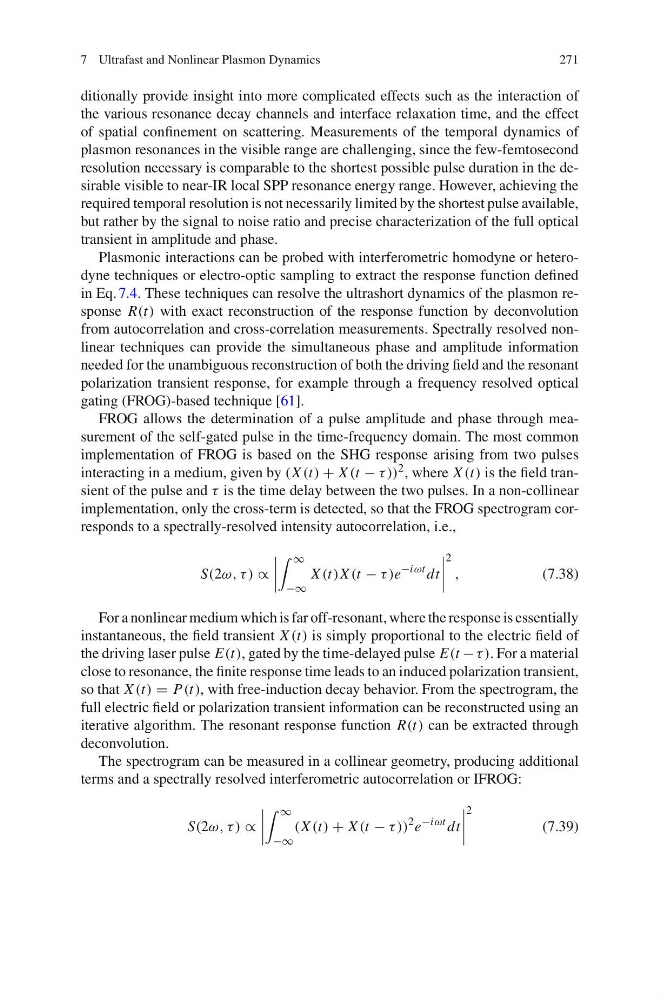
implementation, only the cross-term is detected, so that the FROG spectrogram corresponds to a spectrally-resolved intensity autocorrelation, i.e.,
S(2ω, τ ) ◦
≈
−≈
X (t)X (t − τ )e
−iωt dt
2
,
(7.38)
For a nonlinear medium which is far off-resonant, where the response is essentially
instantaneous, the field transient X (t) is simply proportional to the electric field of
the driving laser pulse E(t), gated by the time-delayed pulse E(t − τ ). For a material
close to resonance, the finite response time leads to an induced polarization transient,
so that X (t) = P(t), with free-induction decay behavior. From the spectrogram, the
full electric field or polarization transient information can be reconstructed using an
iterative algorithm. The resonant response function R(t) can be extracted through
deconvolution.
The spectrogram can be measured in a collinear geometry, producing additional
terms and a spectrally resolved interferometric autocorrelation or IFROG:
S(2ω, τ ) ◦
≈
−≈
(X (t) + X (t − τ ))
2 e
−iωt dt
2
(7.39)
271
ditionally provide insight into more complicated effects such as the interaction of
the various resonance decay channels and interface relaxation time, and the effect
of spatial confinement on scattering. Measurements of the temporal dynamics of
plasmon resonances in the visible range are challenging, since the few-femtosecond
resolution necessary is comparable to the shortest possible pulse duration in the desirable visible to near-IR local SPP resonance energy range. However, achieving the
required temporal resolution is not necessarily limited by the shortest pulse available,
but rather by the signal to noise ratio and precise characterization of the full optical
transient in amplitude and phase.
Plasmonic interactions can be probed with interferometric homodyne or heterodyne techniques or electro-optic sampling to extract the response function defined
in Eq. 7.4. These techniques can resolve the ultrashort dynamics of the plasmon response R(t) with exact reconstruction of the response function by deconvolution
from autocorrelation and cross-correlation measurements. Spectrally resolved nonlinear techniques can provide the simultaneous phase and amplitude information
needed for the unambiguous reconstruction of both the driving field and the resonant
polarization transient response, for example through a frequency resolved optical
gating (FROG)-based technique [61].
FROG allows the determination of a pulse amplitude and phase through measurement of the self-gated pulse in the time-frequency domain. The most common
implementation of FROG is based on the SHG response arising from two pulses
interacting in a medium, given by (X (t) + X (t − τ )) 2 , where X (t) is the field transient of the pulse and τ is the time delay between the two pulses. In a non-collinear
implementation, only the cross-term is detected, so that the FROG spectrogram corresponds to a spectrally-resolved intensity autocorrelation, i.e.,
S(2ω, τ ) ◦
≈
−≈
X (t)X (t − τ )e
−iωt dt
2
,
(7.38)
For a nonlinear medium which is far off-resonant, where the response is essentially
instantaneous, the field transient X (t) is simply proportional to the electric field of
the driving laser pulse E(t), gated by the time-delayed pulse E(t − τ ). For a material
close to resonance, the finite response time leads to an induced polarization transient,
so that X (t) = P(t), with free-induction decay behavior. From the spectrogram, the
full electric field or polarization transient information can be reconstructed using an
iterative algorithm. The resonant response function R(t) can be extracted through
deconvolution.
The spectrogram can be measured in a collinear geometry, producing additional
terms and a spectrally resolved interferometric autocorrelation or IFROG:
S(2ω, τ ) ◦
≈
−≈
(X (t) + X (t − τ ))
2 e
−iωt dt
2
(7.39)