

270
M. B. Raschke et al.
ω 1
ω 2
L(ω)
χ (n) (ω)
ω
I
|L Ω (Ω)|
2
ω 2
ω 1
Ω
|L 1 (ω 1 )|
2
|L 2 (ω 2 )|
2
χ χ
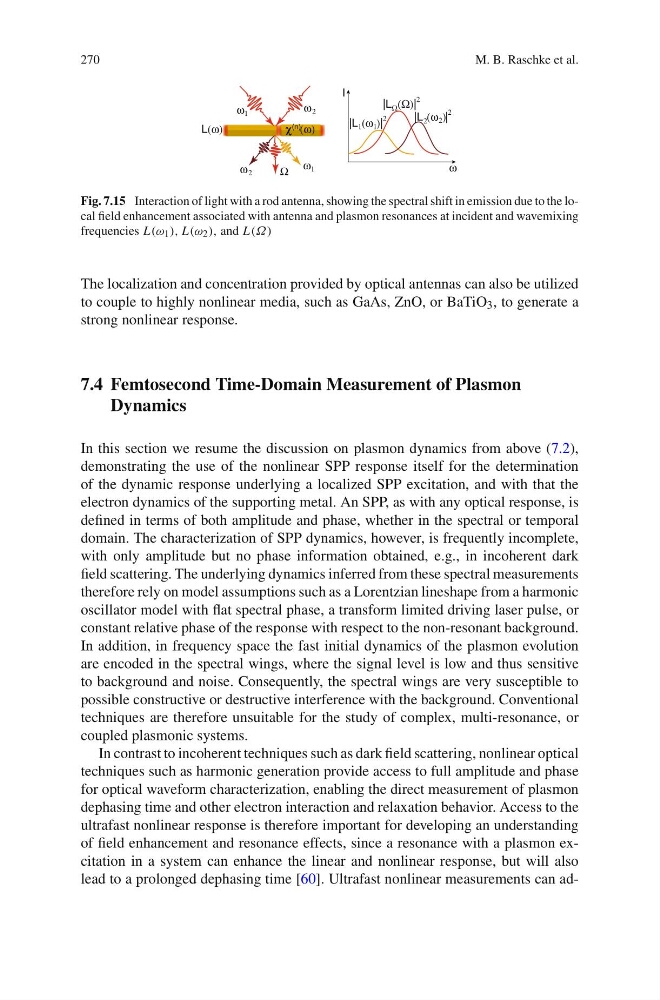
Fig. 7.15 Interaction of light with a rod antenna, showing the spectral shift in emission due to the local field enhancement associated with antenna and plasmon resonances at incident and wavemixing
frequencies L(ω 1 ), L(ω 2 ), and L(Ω)
The localization and concentration provided by optical antennas can also be utilized
to couple to highly nonlinear media, such as GaAs, ZnO, or BaTiO 3 , to generate a
strong nonlinear response.
7.4 Femtosecond Time-Domain Measurement of Plasmon
Dynamics
In this section we resume the discussion on plasmon dynamics from above (7.2),
demonstrating the use of the nonlinear SPP response itself for the determination
of the dynamic response underlying a localized SPP excitation, and with that the
electron dynamics of the supporting metal. An SPP, as with any optical response, is
defined in terms of both amplitude and phase, whether in the spectral or temporal
domain. The characterization of SPP dynamics, however, is frequently incomplete,
with only amplitude but no phase information obtained, e.g., in incoherent dark
field scattering. The underlying dynamics inferred from these spectral measurements
therefore rely on model assumptions such as a Lorentzian lineshape from a harmonic
oscillator model with flat spectral phase, a transform limited driving laser pulse, or
constant relative phase of the response with respect to the non-resonant background.
In addition, in frequency space the fast initial dynamics of the plasmon evolution
are encoded in the spectral wings, where the signal level is low and thus sensitive
to background and noise. Consequently, the spectral wings are very susceptible to
possible constructive or destructive interference with the background. Conventional
techniques are therefore unsuitable for the study of complex, multi-resonance, or
coupled plasmonic systems.
In contrast to incoherent techniques such as dark field scattering, nonlinear optical
techniques such as harmonic generation provide access to full amplitude and phase
for optical waveform characterization, enabling the direct measurement of plasmon
dephasing time and other electron interaction and relaxation behavior. Access to the
ultrafast nonlinear response is therefore important for developing an understanding
of field enhancement and resonance effects, since a resonance with a plasmon excitation in a system can enhance the linear and nonlinear response, but will also
lead to a prolonged dephasing time [60]. Ultrafast nonlinear measurements can ad-
M. B. Raschke et al.
ω 1
ω 2
L(ω)
χ (n) (ω)
ω
I
|L Ω (Ω)|
2
ω 2
ω 1
Ω
|L 1 (ω 1 )|
2
|L 2 (ω 2 )|
2
χ χ
Fig. 7.15 Interaction of light with a rod antenna, showing the spectral shift in emission due to the local field enhancement associated with antenna and plasmon resonances at incident and wavemixing
frequencies L(ω 1 ), L(ω 2 ), and L(Ω)
The localization and concentration provided by optical antennas can also be utilized
to couple to highly nonlinear media, such as GaAs, ZnO, or BaTiO 3 , to generate a
strong nonlinear response.
7.4 Femtosecond Time-Domain Measurement of Plasmon
Dynamics
In this section we resume the discussion on plasmon dynamics from above (7.2),
demonstrating the use of the nonlinear SPP response itself for the determination
of the dynamic response underlying a localized SPP excitation, and with that the
electron dynamics of the supporting metal. An SPP, as with any optical response, is
defined in terms of both amplitude and phase, whether in the spectral or temporal
domain. The characterization of SPP dynamics, however, is frequently incomplete,
with only amplitude but no phase information obtained, e.g., in incoherent dark
field scattering. The underlying dynamics inferred from these spectral measurements
therefore rely on model assumptions such as a Lorentzian lineshape from a harmonic
oscillator model with flat spectral phase, a transform limited driving laser pulse, or
constant relative phase of the response with respect to the non-resonant background.
In addition, in frequency space the fast initial dynamics of the plasmon evolution
are encoded in the spectral wings, where the signal level is low and thus sensitive
to background and noise. Consequently, the spectral wings are very susceptible to
possible constructive or destructive interference with the background. Conventional
techniques are therefore unsuitable for the study of complex, multi-resonance, or
coupled plasmonic systems.
In contrast to incoherent techniques such as dark field scattering, nonlinear optical
techniques such as harmonic generation provide access to full amplitude and phase
for optical waveform characterization, enabling the direct measurement of plasmon
dephasing time and other electron interaction and relaxation behavior. Access to the
ultrafast nonlinear response is therefore important for developing an understanding
of field enhancement and resonance effects, since a resonance with a plasmon excitation in a system can enhance the linear and nonlinear response, but will also
lead to a prolonged dephasing time [60]. Ultrafast nonlinear measurements can ad-