

264
M. B. Raschke et al.
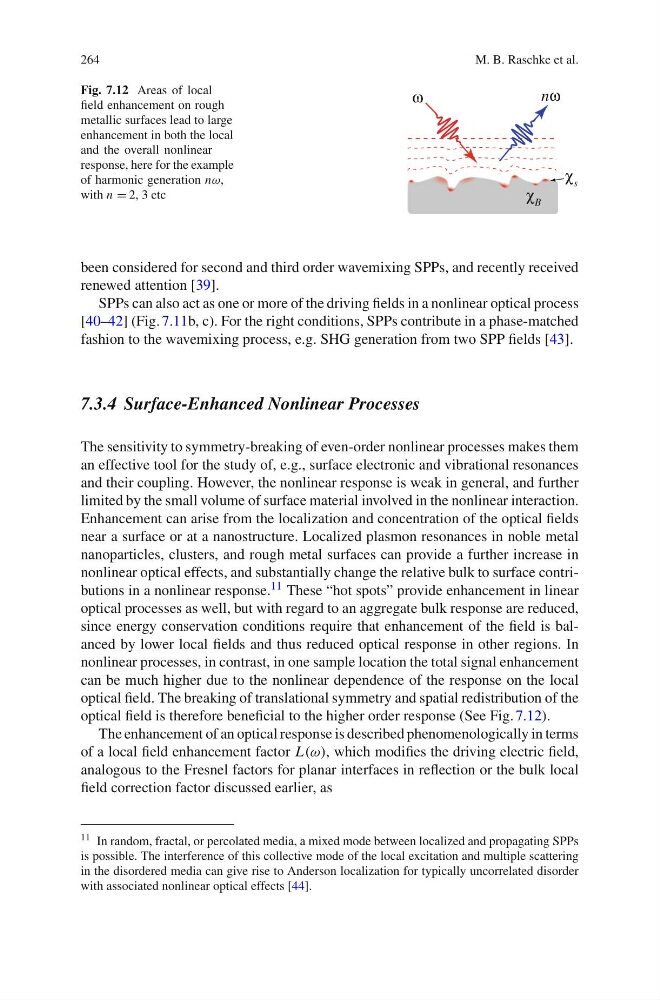
Fig. 7.12 Areas of local
field enhancement on rough
metallic surfaces lead to large
enhancement in both the local
and the overall nonlinear
response, here for the example
of harmonic generation nω,
with n = 2, 3 etc
ω
nω
χ s
χ B
been considered for second and third order wavemixing SPPs, and recently received
renewed attention [39].
SPPs can also act as one or more of the driving fields in a nonlinear optical process
[40–42] (Fig. 7.11b, c). For the right conditions, SPPs contribute in a phase-matched
fashion to the wavemixing process, e.g. SHG generation from two SPP fields [43].
7.3.4 Surface-Enhanced Nonlinear Processes
The sensitivity to symmetry-breaking of even-order nonlinear processes makes them
an effective tool for the study of, e.g., surface electronic and vibrational resonances
and their coupling. However, the nonlinear response is weak in general, and further
limited by the small volume of surface material involved in the nonlinear interaction.
Enhancement can arise from the localization and concentration of the optical fields
near a surface or at a nanostructure. Localized plasmon resonances in noble metal
nanoparticles, clusters, and rough metal surfaces can provide a further increase in
nonlinear optical effects, and substantially change the relative bulk to surface contributions in a nonlinear response. 11 These “hot spots” provide enhancement in linear
optical processes as well, but with regard to an aggregate bulk response are reduced,
since energy conservation conditions require that enhancement of the field is balanced by lower local fields and thus reduced optical response in other regions. In
nonlinear processes, in contrast, in one sample location the total signal enhancement
can be much higher due to the nonlinear dependence of the response on the local
optical field. The breaking of translational symmetry and spatial redistribution of the
optical field is therefore beneficial to the higher order response (See Fig. 7.12).
The enhancement of an optical response is described phenomenologically in terms
of a local field enhancement factor L(ω), which modifies the driving electric field,
analogous to the Fresnel factors for planar interfaces in reflection or the bulk local
field correction factor discussed earlier, as
11 In random, fractal, or percolated media, a mixed mode between localized and propagating SPPs
is possible. The interference of this collective mode of the local excitation and multiple scattering
in the disordered media can give rise to Anderson localization for typically uncorrelated disorder
with associated nonlinear optical effects [44].
M. B. Raschke et al.
Fig. 7.12 Areas of local
field enhancement on rough
metallic surfaces lead to large
enhancement in both the local
and the overall nonlinear
response, here for the example
of harmonic generation nω,
with n = 2, 3 etc
ω
nω
χ s
χ B
been considered for second and third order wavemixing SPPs, and recently received
renewed attention [39].
SPPs can also act as one or more of the driving fields in a nonlinear optical process
[40–42] (Fig. 7.11b, c). For the right conditions, SPPs contribute in a phase-matched
fashion to the wavemixing process, e.g. SHG generation from two SPP fields [43].
7.3.4 Surface-Enhanced Nonlinear Processes
The sensitivity to symmetry-breaking of even-order nonlinear processes makes them
an effective tool for the study of, e.g., surface electronic and vibrational resonances
and their coupling. However, the nonlinear response is weak in general, and further
limited by the small volume of surface material involved in the nonlinear interaction.
Enhancement can arise from the localization and concentration of the optical fields
near a surface or at a nanostructure. Localized plasmon resonances in noble metal
nanoparticles, clusters, and rough metal surfaces can provide a further increase in
nonlinear optical effects, and substantially change the relative bulk to surface contributions in a nonlinear response. 11 These “hot spots” provide enhancement in linear
optical processes as well, but with regard to an aggregate bulk response are reduced,
since energy conservation conditions require that enhancement of the field is balanced by lower local fields and thus reduced optical response in other regions. In
nonlinear processes, in contrast, in one sample location the total signal enhancement
can be much higher due to the nonlinear dependence of the response on the local
optical field. The breaking of translational symmetry and spatial redistribution of the
optical field is therefore beneficial to the higher order response (See Fig. 7.12).
The enhancement of an optical response is described phenomenologically in terms
of a local field enhancement factor L(ω), which modifies the driving electric field,
analogous to the Fresnel factors for planar interfaces in reflection or the bulk local
field correction factor discussed earlier, as
11 In random, fractal, or percolated media, a mixed mode between localized and propagating SPPs
is possible. The interference of this collective mode of the local excitation and multiple scattering
in the disordered media can give rise to Anderson localization for typically uncorrelated disorder
with associated nonlinear optical effects [44].