

7 Ultrafast and Nonlinear Plasmon Dynamics
263
χ NL
k 1 (ω 1 )
k 2 (ω 2 )
k SPP (ω SPP )
χ NL
k 1 (ω 1 )
k 2 (ω 2 )
k SPP (ω SPP )
χ NL
k 1 (ω 1 )
k SPP (ω SPP )
k SPP (ω SPP )
χ NL
k 1 (ω 1 )
k 3 (ω 3 )
k SPP (ω SPP )
(a)
(b)
(c)
(d)
k 2 (ω 2 )
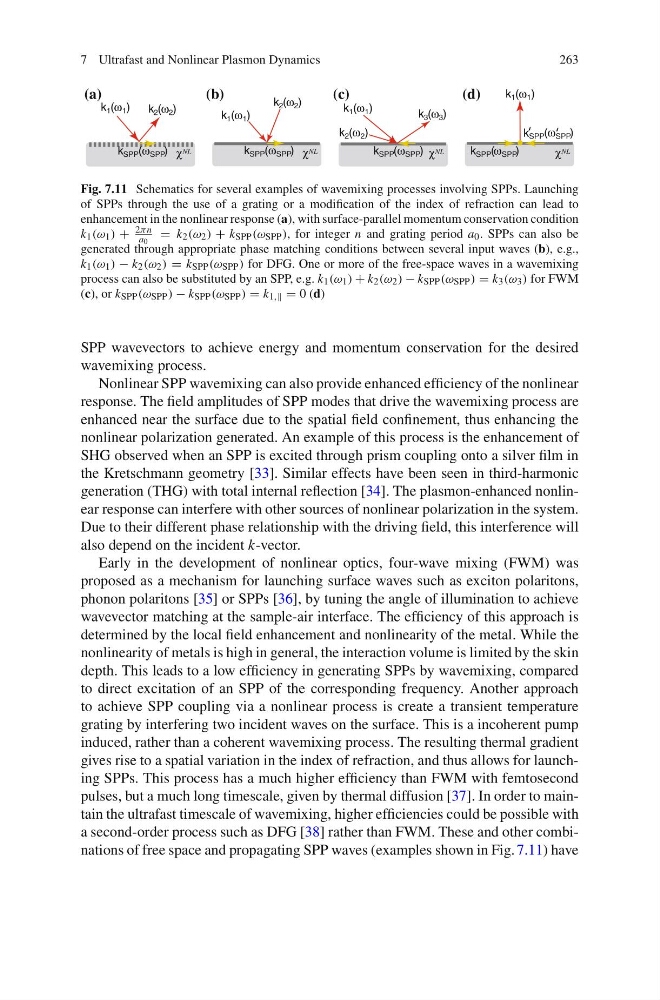
Fig. 7.11 Schematics for several examples of wavemixing processes involving SPPs. Launching
of SPPs through the use of a grating or a modification of the index of refraction can lead to
enhancement in the nonlinear response (a), with surface-parallel momentum conservation condition
k 1 (ω 1 ) +
2π n
a0 = k 2 (ω 2 ) + k SPP (ω SPP ), for integer n and grating period a 0 . SPPs can also be
generated through appropriate phase matching conditions between several input waves (b), e.g.,
k 1 (ω 1 ) − k 2 (ω 2 ) = k SPP (ω SPP ) for DFG. One or more of the free-space waves in a wavemixing
process can also be substituted by an SPP, e.g. k 1 (ω 1 ) + k 2 (ω 2 ) − k SPP (ω SPP ) = k 3 (ω 3 ) for FWM
(c), or k SPP (ω SPP ) − k SPP (ω SPP ) = k 1,∗ = 0 (d)
SPP wavevectors to achieve energy and momentum conservation for the desired
wavemixing process.
Nonlinear SPP wavemixing can also provide enhanced efficiency of the nonlinear
response. The field amplitudes of SPP modes that drive the wavemixing process are
enhanced near the surface due to the spatial field confinement, thus enhancing the
nonlinear polarization generated. An example of this process is the enhancement of
SHG observed when an SPP is excited through prism coupling onto a silver film in
the Kretschmann geometry [33]. Similar effects have been seen in third-harmonic
generation (THG) with total internal reflection [34]. The plasmon-enhanced nonlinear response can interfere with other sources of nonlinear polarization in the system.
Due to their different phase relationship with the driving field, this interference will
also depend on the incident k-vector.
Early in the development of nonlinear optics, four-wave mixing (FWM) was
proposed as a mechanism for launching surface waves such as exciton polaritons,
phonon polaritons [35] or SPPs [36], by tuning the angle of illumination to achieve
wavevector matching at the sample-air interface. The efficiency of this approach is
determined by the local field enhancement and nonlinearity of the metal. While the
nonlinearity of metals is high in general, the interaction volume is limited by the skin
depth. This leads to a low efficiency in generating SPPs by wavemixing, compared
to direct excitation of an SPP of the corresponding frequency. Another approach
to achieve SPP coupling via a nonlinear process is create a transient temperature
grating by interfering two incident waves on the surface. This is a incoherent pump
induced, rather than a coherent wavemixing process. The resulting thermal gradient
gives rise to a spatial variation in the index of refraction, and thus allows for launching SPPs. This process has a much higher efficiency than FWM with femtosecond
pulses, but a much long timescale, given by thermal diffusion [37]. In order to maintain the ultrafast timescale of wavemixing, higher efficiencies could be possible with
a second-order process such as DFG [38] rather than FWM. These and other combinations of free space and propagating SPP waves (examples shown in Fig. 7.11) have
263
χ NL
k 1 (ω 1 )
k 2 (ω 2 )
k SPP (ω SPP )
χ NL
k 1 (ω 1 )
k 2 (ω 2 )
k SPP (ω SPP )
χ NL
k 1 (ω 1 )
k SPP (ω SPP )
k SPP (ω SPP )
χ NL
k 1 (ω 1 )
k 3 (ω 3 )
k SPP (ω SPP )
(a)
(b)
(c)
(d)
k 2 (ω 2 )
Fig. 7.11 Schematics for several examples of wavemixing processes involving SPPs. Launching
of SPPs through the use of a grating or a modification of the index of refraction can lead to
enhancement in the nonlinear response (a), with surface-parallel momentum conservation condition
k 1 (ω 1 ) +
2π n
a0 = k 2 (ω 2 ) + k SPP (ω SPP ), for integer n and grating period a 0 . SPPs can also be
generated through appropriate phase matching conditions between several input waves (b), e.g.,
k 1 (ω 1 ) − k 2 (ω 2 ) = k SPP (ω SPP ) for DFG. One or more of the free-space waves in a wavemixing
process can also be substituted by an SPP, e.g. k 1 (ω 1 ) + k 2 (ω 2 ) − k SPP (ω SPP ) = k 3 (ω 3 ) for FWM
(c), or k SPP (ω SPP ) − k SPP (ω SPP ) = k 1,∗ = 0 (d)
SPP wavevectors to achieve energy and momentum conservation for the desired
wavemixing process.
Nonlinear SPP wavemixing can also provide enhanced efficiency of the nonlinear
response. The field amplitudes of SPP modes that drive the wavemixing process are
enhanced near the surface due to the spatial field confinement, thus enhancing the
nonlinear polarization generated. An example of this process is the enhancement of
SHG observed when an SPP is excited through prism coupling onto a silver film in
the Kretschmann geometry [33]. Similar effects have been seen in third-harmonic
generation (THG) with total internal reflection [34]. The plasmon-enhanced nonlinear response can interfere with other sources of nonlinear polarization in the system.
Due to their different phase relationship with the driving field, this interference will
also depend on the incident k-vector.
Early in the development of nonlinear optics, four-wave mixing (FWM) was
proposed as a mechanism for launching surface waves such as exciton polaritons,
phonon polaritons [35] or SPPs [36], by tuning the angle of illumination to achieve
wavevector matching at the sample-air interface. The efficiency of this approach is
determined by the local field enhancement and nonlinearity of the metal. While the
nonlinearity of metals is high in general, the interaction volume is limited by the skin
depth. This leads to a low efficiency in generating SPPs by wavemixing, compared
to direct excitation of an SPP of the corresponding frequency. Another approach
to achieve SPP coupling via a nonlinear process is create a transient temperature
grating by interfering two incident waves on the surface. This is a incoherent pump
induced, rather than a coherent wavemixing process. The resulting thermal gradient
gives rise to a spatial variation in the index of refraction, and thus allows for launching SPPs. This process has a much higher efficiency than FWM with femtosecond
pulses, but a much long timescale, given by thermal diffusion [37]. In order to maintain the ultrafast timescale of wavemixing, higher efficiencies could be possible with
a second-order process such as DFG [38] rather than FWM. These and other combinations of free space and propagating SPP waves (examples shown in Fig. 7.11) have