

7 Ultrafast and Nonlinear Plasmon Dynamics
265
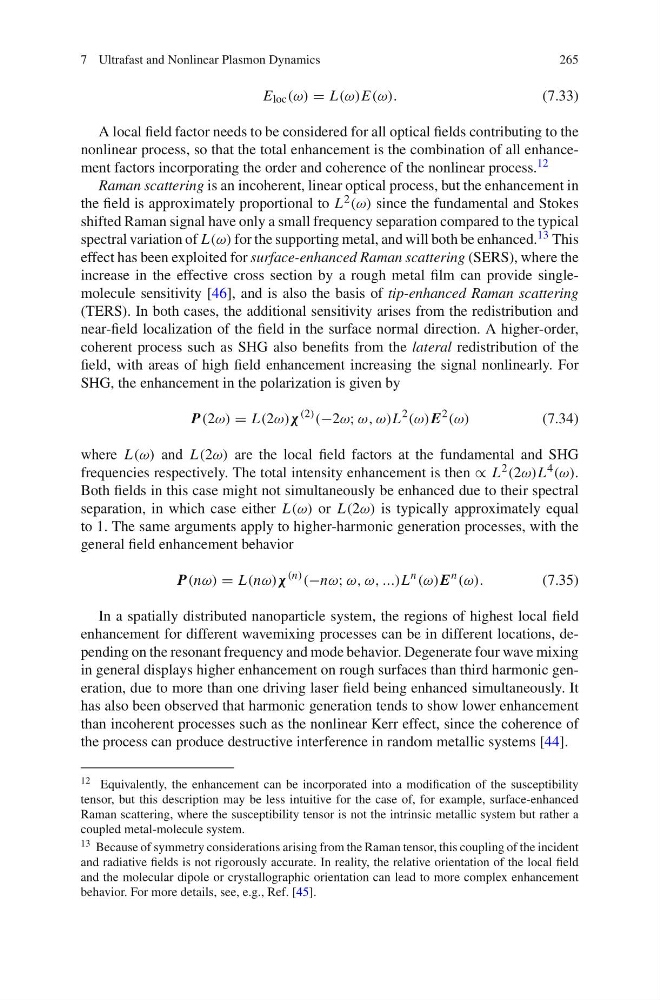
E loc (ω) = L(ω)E(ω).
(7.33)
A local field factor needs to be considered for all optical fields contributing to the
nonlinear process, so that the total enhancement is the combination of all enhancement factors incorporating the order and coherence of the nonlinear process. 12
Raman scattering is an incoherent, linear optical process, but the enhancement in
the field is approximately proportional to L 2 (ω) since the fundamental and Stokes
shifted Raman signal have only a small frequency separation compared to the typical
spectral variation of L(ω) for the supporting metal, and will both be enhanced. 13 This
effect has been exploited for surface-enhanced Raman scattering (SERS), where the
increase in the effective cross section by a rough metal film can provide singlemolecule sensitivity [46], and is also the basis of tip-enhanced Raman scattering
(TERS). In both cases, the additional sensitivity arises from the redistribution and
near-field localization of the field in the surface normal direction. A higher-order,
coherent process such as SHG also benefits from the lateral redistribution of the
field, with areas of high field enhancement increasing the signal nonlinearly. For
SHG, the enhancement in the polarization is given by
P(2ω) = L(2ω)χ
(2)
(−2ω; ω, ω)L
2
(ω)E
2
(ω)
(7.34)
where L(ω) and L(2ω) are the local field factors at the fundamental and SHG
frequencies respectively. The total intensity enhancement is then ◦ L 2 (2ω)L 4 (ω).
Both fields in this case might not simultaneously be enhanced due to their spectral
separation, in which case either L(ω) or L(2ω) is typically approximately equal
to 1. The same arguments apply to higher-harmonic generation processes, with the
general field enhancement behavior
P(nω) = L(nω)χ
(n)
(−nω; ω, ω, ...)L
n
(ω)E
n
(ω).
(7.35)
In a spatially distributed nanoparticle system, the regions of highest local field
enhancement for different wavemixing processes can be in different locations, depending on the resonant frequency and mode behavior. Degenerate four wave mixing
in general displays higher enhancement on rough surfaces than third harmonic generation, due to more than one driving laser field being enhanced simultaneously. It
has also been observed that harmonic generation tends to show lower enhancement
than incoherent processes such as the nonlinear Kerr effect, since the coherence of
the process can produce destructive interference in random metallic systems [44].
12 Equivalently, the enhancement can be incorporated into a modification of the susceptibility
tensor, but this description may be less intuitive for the case of, for example, surface-enhanced
Raman scattering, where the susceptibility tensor is not the intrinsic metallic system but rather a
coupled metal-molecule system.
13 Because of symmetry considerations arising from the Raman tensor, this coupling of the incident
and radiative fields is not rigorously accurate. In reality, the relative orientation of the local field
and the molecular dipole or crystallographic orientation can lead to more complex enhancement
behavior. For more details, see, e.g., Ref. [45].
265
E loc (ω) = L(ω)E(ω).
(7.33)
A local field factor needs to be considered for all optical fields contributing to the
nonlinear process, so that the total enhancement is the combination of all enhancement factors incorporating the order and coherence of the nonlinear process. 12
Raman scattering is an incoherent, linear optical process, but the enhancement in
the field is approximately proportional to L 2 (ω) since the fundamental and Stokes
shifted Raman signal have only a small frequency separation compared to the typical
spectral variation of L(ω) for the supporting metal, and will both be enhanced. 13 This
effect has been exploited for surface-enhanced Raman scattering (SERS), where the
increase in the effective cross section by a rough metal film can provide singlemolecule sensitivity [46], and is also the basis of tip-enhanced Raman scattering
(TERS). In both cases, the additional sensitivity arises from the redistribution and
near-field localization of the field in the surface normal direction. A higher-order,
coherent process such as SHG also benefits from the lateral redistribution of the
field, with areas of high field enhancement increasing the signal nonlinearly. For
SHG, the enhancement in the polarization is given by
P(2ω) = L(2ω)χ
(2)
(−2ω; ω, ω)L
2
(ω)E
2
(ω)
(7.34)
where L(ω) and L(2ω) are the local field factors at the fundamental and SHG
frequencies respectively. The total intensity enhancement is then ◦ L 2 (2ω)L 4 (ω).
Both fields in this case might not simultaneously be enhanced due to their spectral
separation, in which case either L(ω) or L(2ω) is typically approximately equal
to 1. The same arguments apply to higher-harmonic generation processes, with the
general field enhancement behavior
P(nω) = L(nω)χ
(n)
(−nω; ω, ω, ...)L
n
(ω)E
n
(ω).
(7.35)
In a spatially distributed nanoparticle system, the regions of highest local field
enhancement for different wavemixing processes can be in different locations, depending on the resonant frequency and mode behavior. Degenerate four wave mixing
in general displays higher enhancement on rough surfaces than third harmonic generation, due to more than one driving laser field being enhanced simultaneously. It
has also been observed that harmonic generation tends to show lower enhancement
than incoherent processes such as the nonlinear Kerr effect, since the coherence of
the process can produce destructive interference in random metallic systems [44].
12 Equivalently, the enhancement can be incorporated into a modification of the susceptibility
tensor, but this description may be less intuitive for the case of, for example, surface-enhanced
Raman scattering, where the susceptibility tensor is not the intrinsic metallic system but rather a
coupled metal-molecule system.
13 Because of symmetry considerations arising from the Raman tensor, this coupling of the incident
and radiative fields is not rigorously accurate. In reality, the relative orientation of the local field
and the molecular dipole or crystallographic orientation can lead to more complex enhancement
behavior. For more details, see, e.g., Ref. [45].