

7 Ultrafast and Nonlinear Plasmon Dynamics
259
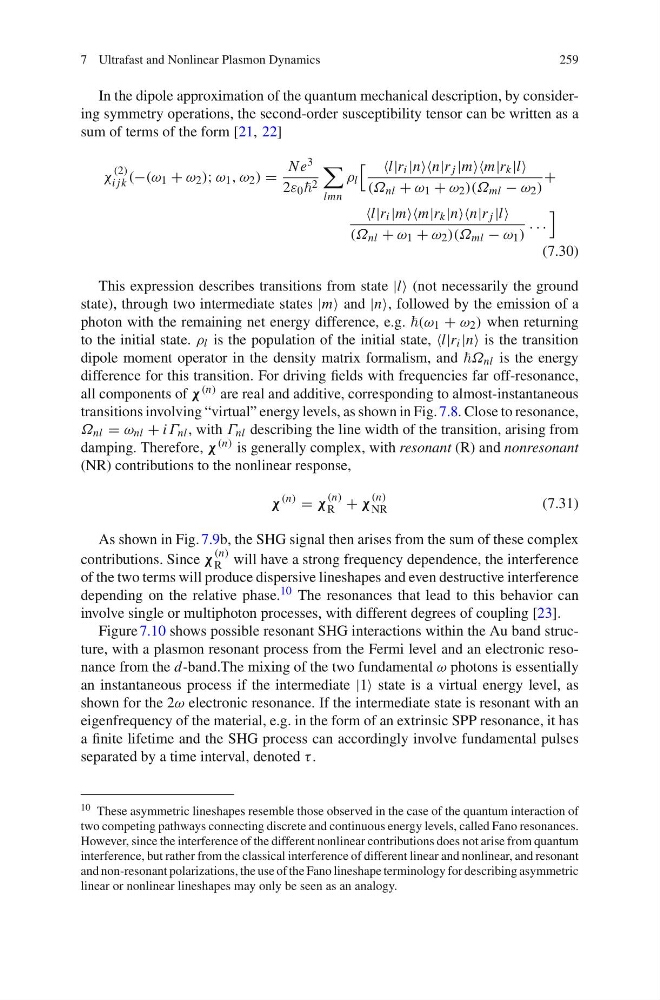
In the dipole approximation of the quantum mechanical description, by considering symmetry operations, the second-order susceptibility tensor can be written as a
sum of terms of the form [21, 22]
χ
(2)
i jk (−(ω 1 + ω 2 ); ω 1 , ω 2 ) =
N e 3
2ε 0 2
lmn
ρ l
l|r i |nn|r j |mm|r k |l
(Ω nl + ω 1 + ω 2 )(Ω ml − ω 2 )
+
l|r i |mm|r k |nn|r j |l
(Ω nl + ω 1 + ω 2 )(Ω ml − ω 1 )
. . .
(7.30)
This expression describes transitions from state |l (not necessarily the ground
state), through two intermediate states |m and |n, followed by the emission of a
photon with the remaining net energy difference, e.g. (ω 1 + ω 2 ) when returning
to the initial state. ρ l is the population of the initial state, l|r i |n is the transition
dipole moment operator in the density matrix formalism, and Ω nl is the energy
difference for this transition. For driving fields with frequencies far off-resonance,
all components of χ (n) are real and additive, corresponding to almost-instantaneous
transitions involving “virtual” energy levels, as shown in Fig. 7.8. Close to resonance,
Ω nl = ω nl + iΓ nl , with Γ nl describing the line width of the transition, arising from
damping. Therefore, χ (n) is generally complex, with resonant (R) and nonresonant
(NR) contributions to the nonlinear response,
χ
(n)
= χ
(n)
R + χ
(n)
NR
(7.31)
As shown in Fig. 7.9b, the SHG signal then arises from the sum of these complex
contributions. Since χ
(n)
R will have a strong frequency dependence, the interference
of the two terms will produce dispersive lineshapes and even destructive interference
depending on the relative phase. 10 The resonances that lead to this behavior can
involve single or multiphoton processes, with different degrees of coupling [23].
Figure 7.10 shows possible resonant SHG interactions within the Au band structure, with a plasmon resonant process from the Fermi level and an electronic resonance from the d-band.The mixing of the two fundamental ω photons is essentially
an instantaneous process if the intermediate |1 state is a virtual energy level, as
shown for the 2ω electronic resonance. If the intermediate state is resonant with an
eigenfrequency of the material, e.g. in the form of an extrinsic SPP resonance, it has
a finite lifetime and the SHG process can accordingly involve fundamental pulses
separated by a time interval, denoted τ .
10 These asymmetric lineshapes resemble those observed in the case of the quantum interaction of
two competing pathways connecting discrete and continuous energy levels, called Fano resonances.
However, since the interference of the different nonlinear contributions does not arise from quantum
interference, but rather from the classical interference of different linear and nonlinear, and resonant
and non-resonant polarizations, the use of the Fano lineshape terminology for describing asymmetric
linear or nonlinear lineshapes may only be seen as an analogy.
259
In the dipole approximation of the quantum mechanical description, by considering symmetry operations, the second-order susceptibility tensor can be written as a
sum of terms of the form [21, 22]
χ
(2)
i jk (−(ω 1 + ω 2 ); ω 1 , ω 2 ) =
N e 3
2ε 0 2
lmn
ρ l
l|r i |nn|r j |mm|r k |l
(Ω nl + ω 1 + ω 2 )(Ω ml − ω 2 )
+
l|r i |mm|r k |nn|r j |l
(Ω nl + ω 1 + ω 2 )(Ω ml − ω 1 )
. . .
(7.30)
This expression describes transitions from state |l (not necessarily the ground
state), through two intermediate states |m and |n, followed by the emission of a
photon with the remaining net energy difference, e.g. (ω 1 + ω 2 ) when returning
to the initial state. ρ l is the population of the initial state, l|r i |n is the transition
dipole moment operator in the density matrix formalism, and Ω nl is the energy
difference for this transition. For driving fields with frequencies far off-resonance,
all components of χ (n) are real and additive, corresponding to almost-instantaneous
transitions involving “virtual” energy levels, as shown in Fig. 7.8. Close to resonance,
Ω nl = ω nl + iΓ nl , with Γ nl describing the line width of the transition, arising from
damping. Therefore, χ (n) is generally complex, with resonant (R) and nonresonant
(NR) contributions to the nonlinear response,
χ
(n)
= χ
(n)
R + χ
(n)
NR
(7.31)
As shown in Fig. 7.9b, the SHG signal then arises from the sum of these complex
contributions. Since χ
(n)
R will have a strong frequency dependence, the interference
of the two terms will produce dispersive lineshapes and even destructive interference
depending on the relative phase. 10 The resonances that lead to this behavior can
involve single or multiphoton processes, with different degrees of coupling [23].
Figure 7.10 shows possible resonant SHG interactions within the Au band structure, with a plasmon resonant process from the Fermi level and an electronic resonance from the d-band.The mixing of the two fundamental ω photons is essentially
an instantaneous process if the intermediate |1 state is a virtual energy level, as
shown for the 2ω electronic resonance. If the intermediate state is resonant with an
eigenfrequency of the material, e.g. in the form of an extrinsic SPP resonance, it has
a finite lifetime and the SHG process can accordingly involve fundamental pulses
separated by a time interval, denoted τ .
10 These asymmetric lineshapes resemble those observed in the case of the quantum interaction of
two competing pathways connecting discrete and continuous energy levels, called Fano resonances.
However, since the interference of the different nonlinear contributions does not arise from quantum
interference, but rather from the classical interference of different linear and nonlinear, and resonant
and non-resonant polarizations, the use of the Fano lineshape terminology for describing asymmetric
linear or nonlinear lineshapes may only be seen as an analogy.