

260
M. B. Raschke et al.
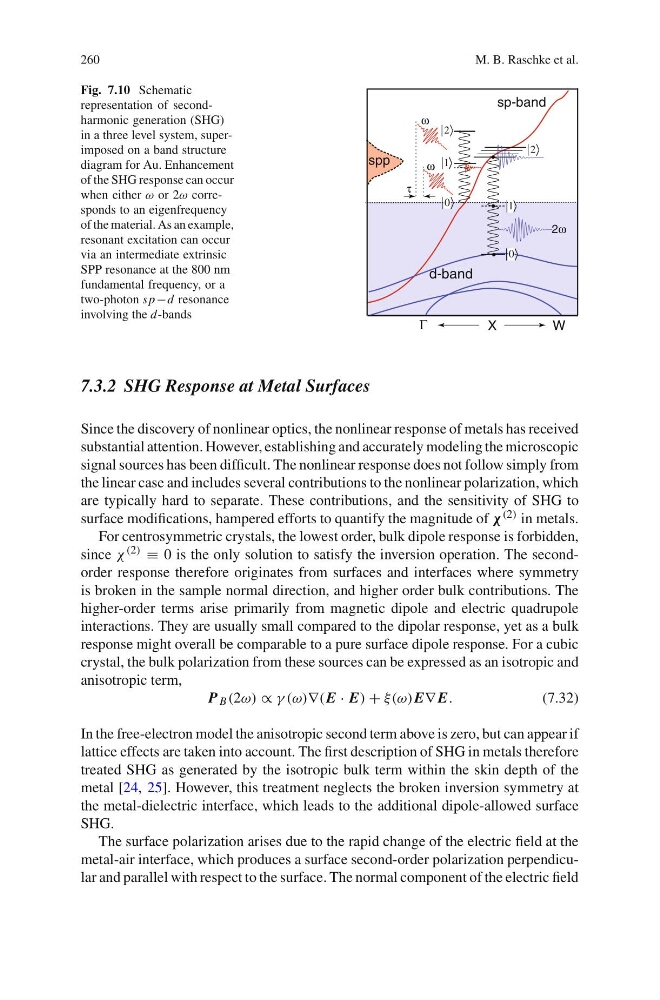
Fig. 7.10 Schematic
representation of secondharmonic generation (SHG)
in a three level system, superimposed on a band structure
diagram for Au. Enhancement
of the SHG response can occur
when either ω or 2ω corresponds to an eigenfrequency
of the material. As an example,
resonant excitation can occur
via an intermediate extrinsic
SPP resonance at the 800 nm
fundamental frequency, or a
two-photon sp−d resonance
involving the d-bands
W
X
d-band
sp-band
2ω
spp
1
2
ω
2
ω
0
1
0
Γ
7.3.2 SHG Response at Metal Surfaces
Since the discovery of nonlinear optics, the nonlinear response of metals has received
substantial attention. However, establishing and accurately modeling the microscopic
signal sources has been difficult. The nonlinear response does not follow simply from
the linear case and includes several contributions to the nonlinear polarization, which
are typically hard to separate. These contributions, and the sensitivity of SHG to
surface modifications, hampered efforts to quantify the magnitude of χ (2) in metals.
For centrosymmetric crystals, the lowest order, bulk dipole response is forbidden,
since χ (2) ≡ 0 is the only solution to satisfy the inversion operation. The secondorder response therefore originates from surfaces and interfaces where symmetry
is broken in the sample normal direction, and higher order bulk contributions. The
higher-order terms arise primarily from magnetic dipole and electric quadrupole
interactions. They are usually small compared to the dipolar response, yet as a bulk
response might overall be comparable to a pure surface dipole response. For a cubic
crystal, the bulk polarization from these sources can be expressed as an isotropic and
anisotropic term,
P B (2ω) ◦ γ (ω)∇(E · E) + ξ(ω)E∇ E.
(7.32)
In the free-electron model the anisotropic second term above is zero, but can appear if
lattice effects are taken into account. The first description of SHG in metals therefore
treated SHG as generated by the isotropic bulk term within the skin depth of the
metal [24, 25]. However, this treatment neglects the broken inversion symmetry at
the metal-dielectric interface, which leads to the additional dipole-allowed surface
SHG.
The surface polarization arises due to the rapid change of the electric field at the
metal-air interface, which produces a surface second-order polarization perpendicular and parallel with respect to the surface. The normal component of the electric field
M. B. Raschke et al.
Fig. 7.10 Schematic
representation of secondharmonic generation (SHG)
in a three level system, superimposed on a band structure
diagram for Au. Enhancement
of the SHG response can occur
when either ω or 2ω corresponds to an eigenfrequency
of the material. As an example,
resonant excitation can occur
via an intermediate extrinsic
SPP resonance at the 800 nm
fundamental frequency, or a
two-photon sp−d resonance
involving the d-bands
W
X
d-band
sp-band
2ω
spp
1
2
ω
2
ω
0
1
0
Γ
7.3.2 SHG Response at Metal Surfaces
Since the discovery of nonlinear optics, the nonlinear response of metals has received
substantial attention. However, establishing and accurately modeling the microscopic
signal sources has been difficult. The nonlinear response does not follow simply from
the linear case and includes several contributions to the nonlinear polarization, which
are typically hard to separate. These contributions, and the sensitivity of SHG to
surface modifications, hampered efforts to quantify the magnitude of χ (2) in metals.
For centrosymmetric crystals, the lowest order, bulk dipole response is forbidden,
since χ (2) ≡ 0 is the only solution to satisfy the inversion operation. The secondorder response therefore originates from surfaces and interfaces where symmetry
is broken in the sample normal direction, and higher order bulk contributions. The
higher-order terms arise primarily from magnetic dipole and electric quadrupole
interactions. They are usually small compared to the dipolar response, yet as a bulk
response might overall be comparable to a pure surface dipole response. For a cubic
crystal, the bulk polarization from these sources can be expressed as an isotropic and
anisotropic term,
P B (2ω) ◦ γ (ω)∇(E · E) + ξ(ω)E∇ E.
(7.32)
In the free-electron model the anisotropic second term above is zero, but can appear if
lattice effects are taken into account. The first description of SHG in metals therefore
treated SHG as generated by the isotropic bulk term within the skin depth of the
metal [24, 25]. However, this treatment neglects the broken inversion symmetry at
the metal-dielectric interface, which leads to the additional dipole-allowed surface
SHG.
The surface polarization arises due to the rapid change of the electric field at the
metal-air interface, which produces a surface second-order polarization perpendicular and parallel with respect to the surface. The normal component of the electric field