

258
M. B. Raschke et al.
enhancement provided by both intrinsic material and extrinsic structural resonances
can also lead to a significant increase in the efficiency of nonlinear processes. A
discussion of plasmon-resonant metallic systems, where the nonlinear enhancement
scales with the order of the process, can be found in Sect. 7.3.4. The coherent nature
of the wavemixing processes leads to a strong dependence on the phase of the driving
field and material response, which provides additional information for characterization and control. This is particularly useful for the study of the ultrafast dynamics
in complex metallic nanostructures, where nonlinear techniques provide more degrees of freedom to probe multiple resonances and their coupling than linear optics.
The multiple driving fields in nonlinear optics also enable probing of changes in the
complex dielectric function and therefore propagation characteristics of SPPs under
strong-pump illumination, an important consideration for active plasmonics.
7.3.1 Second-Order Nonlinear Optics
Here we will provide a more detailed discussion of the origins and theory associated
with the lowest, second-order nonlinear response. Although the symmetry considerations associated with even-order responses are different from odd-order nonlinearities, much of what follows can be readily extended to third-order and higher
nonlinear processes.
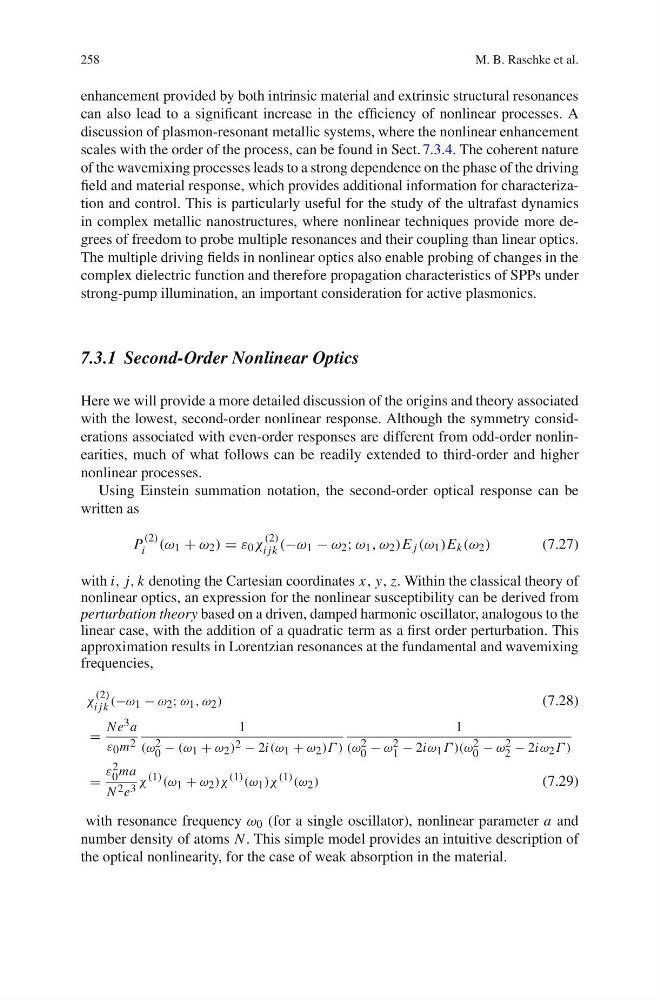
Using Einstein summation notation, the second-order optical response can be
written as
P
(2)
i (ω 1 + ω 2 ) = ε 0 χ
(2)
i jk (−ω 1 − ω 2 ; ω 1 , ω 2 )E j (ω 1 )E k (ω 2 )
(7.27)
with i, j, k denoting the Cartesian coordinates x, y, z. Within the classical theory of
nonlinear optics, an expression for the nonlinear susceptibility can be derived from
perturbation theory based on a driven, damped harmonic oscillator, analogous to the
linear case, with the addition of a quadratic term as a first order perturbation. This
approximation results in Lorentzian resonances at the fundamental and wavemixing
frequencies,
χ
(2)
i jk (−ω 1 − ω 2 ; ω 1 , ω 2 )
(7.28)
=
N e 3 a
ε 0 m 2
1
(ω 2
0 − (ω 1 + ω 2 ) 2 − 2i(ω 1 + ω 2 )Γ )
1
(ω 2
0 − ω 2
1 − 2iω 1 Γ )(ω 2
0 − ω 2
2 − 2iω 2 Γ )
=
ε 2
0 ma
N 2 e 3 χ (1) (ω 1 + ω 2 )χ (1) (ω 1 )χ (1) (ω 2 )
(7.29)
with resonance frequency ω 0 (for a single oscillator), nonlinear parameter a and
number density of atoms N . This simple model provides an intuitive description of
the optical nonlinearity, for the case of weak absorption in the material.
M. B. Raschke et al.
enhancement provided by both intrinsic material and extrinsic structural resonances
can also lead to a significant increase in the efficiency of nonlinear processes. A
discussion of plasmon-resonant metallic systems, where the nonlinear enhancement
scales with the order of the process, can be found in Sect. 7.3.4. The coherent nature
of the wavemixing processes leads to a strong dependence on the phase of the driving
field and material response, which provides additional information for characterization and control. This is particularly useful for the study of the ultrafast dynamics
in complex metallic nanostructures, where nonlinear techniques provide more degrees of freedom to probe multiple resonances and their coupling than linear optics.
The multiple driving fields in nonlinear optics also enable probing of changes in the
complex dielectric function and therefore propagation characteristics of SPPs under
strong-pump illumination, an important consideration for active plasmonics.
7.3.1 Second-Order Nonlinear Optics
Here we will provide a more detailed discussion of the origins and theory associated
with the lowest, second-order nonlinear response. Although the symmetry considerations associated with even-order responses are different from odd-order nonlinearities, much of what follows can be readily extended to third-order and higher
nonlinear processes.
Using Einstein summation notation, the second-order optical response can be
written as
P
(2)
i (ω 1 + ω 2 ) = ε 0 χ
(2)
i jk (−ω 1 − ω 2 ; ω 1 , ω 2 )E j (ω 1 )E k (ω 2 )
(7.27)
with i, j, k denoting the Cartesian coordinates x, y, z. Within the classical theory of
nonlinear optics, an expression for the nonlinear susceptibility can be derived from
perturbation theory based on a driven, damped harmonic oscillator, analogous to the
linear case, with the addition of a quadratic term as a first order perturbation. This
approximation results in Lorentzian resonances at the fundamental and wavemixing
frequencies,
χ
(2)
i jk (−ω 1 − ω 2 ; ω 1 , ω 2 )
(7.28)
=
N e 3 a
ε 0 m 2
1
(ω 2
0 − (ω 1 + ω 2 ) 2 − 2i(ω 1 + ω 2 )Γ )
1
(ω 2
0 − ω 2
1 − 2iω 1 Γ )(ω 2
0 − ω 2
2 − 2iω 2 Γ )
=
ε 2
0 ma
N 2 e 3 χ (1) (ω 1 + ω 2 )χ (1) (ω 1 )χ (1) (ω 2 )
(7.29)
with resonance frequency ω 0 (for a single oscillator), nonlinear parameter a and
number density of atoms N . This simple model provides an intuitive description of
the optical nonlinearity, for the case of weak absorption in the material.