

7 Ultrafast and Nonlinear Plasmon Dynamics
257
χ B
χ s
Re
Im
χ NR
χ R
φ
(a)
(b)
ω 1 + ω 2
ω 1
χ TOT
2ω 1
2ω 2
ω 1
− ω 2
ω 2
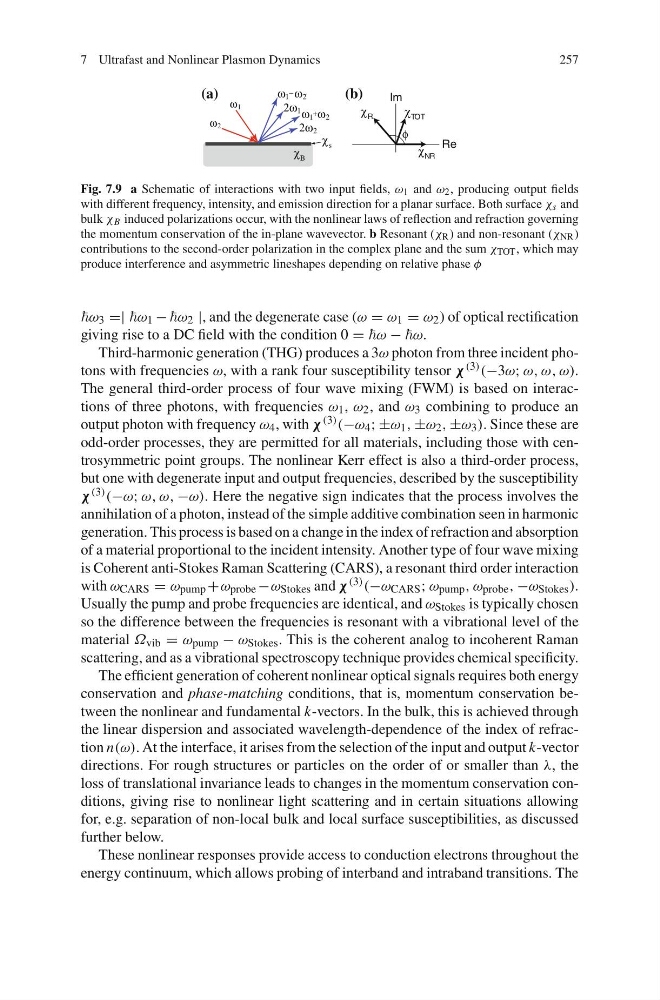
Fig. 7.9 a Schematic of interactions with two input fields, ω 1 and ω 2 , producing output fields
with different frequency, intensity, and emission direction for a planar surface. Both surface χ s and
bulk χ B induced polarizations occur, with the nonlinear laws of reflection and refraction governing
the momentum conservation of the in-plane wavevector. b Resonant (χ R ) and non-resonant (χ NR )
contributions to the second-order polarization in the complex plane and the sum χ TOT , which may
produce interference and asymmetric lineshapes depending on relative phase φ
ω 3 =| ω 1 − ω 2 |, and the degenerate case (ω = ω 1 = ω 2 ) of optical rectification
giving rise to a DC field with the condition 0 = ω − ω.
Third-harmonic generation (THG) produces a 3ω photon from three incident photons with frequencies ω, with a rank four susceptibility tensor χ (3) (−3ω; ω, ω, ω).
The general third-order process of four wave mixing (FWM) is based on interactions of three photons, with frequencies ω 1 , ω 2 , and ω 3 combining to produce an
output photon with frequency ω 4 , with χ (3) (−ω 4 ; ±ω 1 , ±ω 2 , ±ω 3 ). Since these are
odd-order processes, they are permitted for all materials, including those with centrosymmetric point groups. The nonlinear Kerr effect is also a third-order process,
but one with degenerate input and output frequencies, described by the susceptibility
χ (3) (−ω; ω, ω, −ω). Here the negative sign indicates that the process involves the
annihilation of a photon, instead of the simple additive combination seen in harmonic
generation. This process is based on a change in the index of refraction and absorption
of a material proportional to the incident intensity. Another type of four wave mixing
is Coherent anti-Stokes Raman Scattering (CARS), a resonant third order interaction
with ω CARS = ω pump +ω probe −ω Stokes and χ (3) (−ω CARS ; ω pump , ω probe , −ω Stokes ).
Usually the pump and probe frequencies are identical, and ω Stokes is typically chosen
so the difference between the frequencies is resonant with a vibrational level of the
material Ω vib = ω pump − ω Stokes . This is the coherent analog to incoherent Raman
scattering, and as a vibrational spectroscopy technique provides chemical specificity.
The efficient generation of coherent nonlinear optical signals requires both energy
conservation and phase-matching conditions, that is, momentum conservation between the nonlinear and fundamental k-vectors. In the bulk, this is achieved through
the linear dispersion and associated wavelength-dependence of the index of refraction n(ω). At the interface, it arises from the selection of the input and output k-vector
directions. For rough structures or particles on the order of or smaller than λ, the
loss of translational invariance leads to changes in the momentum conservation conditions, giving rise to nonlinear light scattering and in certain situations allowing
for, e.g. separation of non-local bulk and local surface susceptibilities, as discussed
further below.
These nonlinear responses provide access to conduction electrons throughout the
energy continuum, which allows probing of interband and intraband transitions. The
257
χ B
χ s
Re
Im
χ NR
χ R
φ
(a)
(b)
ω 1 + ω 2
ω 1
χ TOT
2ω 1
2ω 2
ω 1
− ω 2
ω 2
Fig. 7.9 a Schematic of interactions with two input fields, ω 1 and ω 2 , producing output fields
with different frequency, intensity, and emission direction for a planar surface. Both surface χ s and
bulk χ B induced polarizations occur, with the nonlinear laws of reflection and refraction governing
the momentum conservation of the in-plane wavevector. b Resonant (χ R ) and non-resonant (χ NR )
contributions to the second-order polarization in the complex plane and the sum χ TOT , which may
produce interference and asymmetric lineshapes depending on relative phase φ
ω 3 =| ω 1 − ω 2 |, and the degenerate case (ω = ω 1 = ω 2 ) of optical rectification
giving rise to a DC field with the condition 0 = ω − ω.
Third-harmonic generation (THG) produces a 3ω photon from three incident photons with frequencies ω, with a rank four susceptibility tensor χ (3) (−3ω; ω, ω, ω).
The general third-order process of four wave mixing (FWM) is based on interactions of three photons, with frequencies ω 1 , ω 2 , and ω 3 combining to produce an
output photon with frequency ω 4 , with χ (3) (−ω 4 ; ±ω 1 , ±ω 2 , ±ω 3 ). Since these are
odd-order processes, they are permitted for all materials, including those with centrosymmetric point groups. The nonlinear Kerr effect is also a third-order process,
but one with degenerate input and output frequencies, described by the susceptibility
χ (3) (−ω; ω, ω, −ω). Here the negative sign indicates that the process involves the
annihilation of a photon, instead of the simple additive combination seen in harmonic
generation. This process is based on a change in the index of refraction and absorption
of a material proportional to the incident intensity. Another type of four wave mixing
is Coherent anti-Stokes Raman Scattering (CARS), a resonant third order interaction
with ω CARS = ω pump +ω probe −ω Stokes and χ (3) (−ω CARS ; ω pump , ω probe , −ω Stokes ).
Usually the pump and probe frequencies are identical, and ω Stokes is typically chosen
so the difference between the frequencies is resonant with a vibrational level of the
material Ω vib = ω pump − ω Stokes . This is the coherent analog to incoherent Raman
scattering, and as a vibrational spectroscopy technique provides chemical specificity.
The efficient generation of coherent nonlinear optical signals requires both energy
conservation and phase-matching conditions, that is, momentum conservation between the nonlinear and fundamental k-vectors. In the bulk, this is achieved through
the linear dispersion and associated wavelength-dependence of the index of refraction n(ω). At the interface, it arises from the selection of the input and output k-vector
directions. For rough structures or particles on the order of or smaller than λ, the
loss of translational invariance leads to changes in the momentum conservation conditions, giving rise to nonlinear light scattering and in certain situations allowing
for, e.g. separation of non-local bulk and local surface susceptibilities, as discussed
further below.
These nonlinear responses provide access to conduction electrons throughout the
energy continuum, which allows probing of interband and intraband transitions. The