

256
M. B. Raschke et al.
ω
ω
pump
Ω vib
ω
3 = ω
1 + ω
2
SHG
SFG
ω
ω
3 = ω
1 − ω
2
DFG
ω
Stokes
ω
probe
ω
CARS
ω
ω
ω
THG
CARS
χ
(3)
χ
(2)
l
m
n
ω
2
ω
1
2ω
ω
2
ω
1
3ω
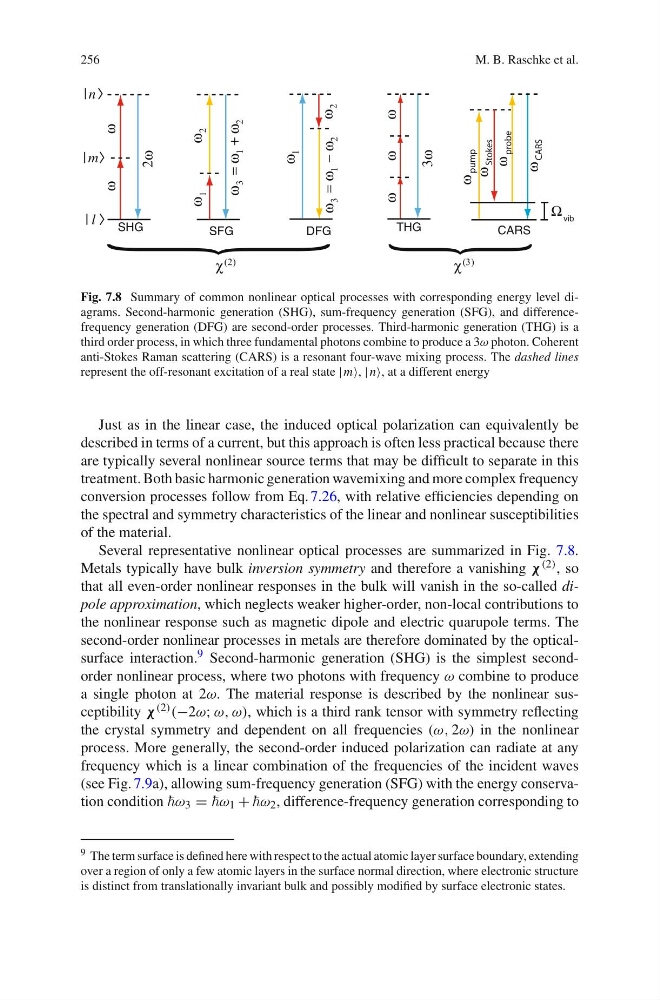
Fig. 7.8 Summary of common nonlinear optical processes with corresponding energy level diagrams. Second-harmonic generation (SHG), sum-frequency generation (SFG), and differencefrequency generation (DFG) are second-order processes. Third-harmonic generation (THG) is a
third order process, in which three fundamental photons combine to produce a 3ω photon. Coherent
anti-Stokes Raman scattering (CARS) is a resonant four-wave mixing process. The dashed lines
represent the off-resonant excitation of a real state | m, | n, at a different energy
Just as in the linear case, the induced optical polarization can equivalently be
described in terms of a current, but this approach is often less practical because there
are typically several nonlinear source terms that may be difficult to separate in this
treatment. Both basic harmonic generation wavemixing and more complex frequency
conversion processes follow from Eq. 7.26, with relative efficiencies depending on
the spectral and symmetry characteristics of the linear and nonlinear susceptibilities
of the material.
Several representative nonlinear optical processes are summarized in Fig. 7.8.
Metals typically have bulk inversion symmetry and therefore a vanishing χ (2) , so
that all even-order nonlinear responses in the bulk will vanish in the so-called dipole approximation, which neglects weaker higher-order, non-local contributions to
the nonlinear response such as magnetic dipole and electric quarupole terms. The
second-order nonlinear processes in metals are therefore dominated by the opticalsurface interaction. 9 Second-harmonic generation (SHG) is the simplest secondorder nonlinear process, where two photons with frequency ω combine to produce
a single photon at 2ω. The material response is described by the nonlinear susceptibility χ (2) (−2ω; ω, ω), which is a third rank tensor with symmetry reflecting
the crystal symmetry and dependent on all frequencies (ω, 2ω) in the nonlinear
process. More generally, the second-order induced polarization can radiate at any
frequency which is a linear combination of the frequencies of the incident waves
(see Fig. 7.9a), allowing sum-frequency generation (SFG) with the energy conservation condition ω 3 = ω 1 + ω 2 , difference-frequency generation corresponding to
9 The term surface is defined here with respect to the actual atomic layer surface boundary, extending
over a region of only a few atomic layers in the surface normal direction, where electronic structure
is distinct from translationally invariant bulk and possibly modified by surface electronic states.
M. B. Raschke et al.
ω
ω
pump
Ω vib
ω
3 = ω
1 + ω
2
SHG
SFG
ω
ω
3 = ω
1 − ω
2
DFG
ω
Stokes
ω
probe
ω
CARS
ω
ω
ω
THG
CARS
χ
(3)
χ
(2)
l
m
n
ω
2
ω
1
2ω
ω
2
ω
1
3ω
Fig. 7.8 Summary of common nonlinear optical processes with corresponding energy level diagrams. Second-harmonic generation (SHG), sum-frequency generation (SFG), and differencefrequency generation (DFG) are second-order processes. Third-harmonic generation (THG) is a
third order process, in which three fundamental photons combine to produce a 3ω photon. Coherent
anti-Stokes Raman scattering (CARS) is a resonant four-wave mixing process. The dashed lines
represent the off-resonant excitation of a real state | m, | n, at a different energy
Just as in the linear case, the induced optical polarization can equivalently be
described in terms of a current, but this approach is often less practical because there
are typically several nonlinear source terms that may be difficult to separate in this
treatment. Both basic harmonic generation wavemixing and more complex frequency
conversion processes follow from Eq. 7.26, with relative efficiencies depending on
the spectral and symmetry characteristics of the linear and nonlinear susceptibilities
of the material.
Several representative nonlinear optical processes are summarized in Fig. 7.8.
Metals typically have bulk inversion symmetry and therefore a vanishing χ (2) , so
that all even-order nonlinear responses in the bulk will vanish in the so-called dipole approximation, which neglects weaker higher-order, non-local contributions to
the nonlinear response such as magnetic dipole and electric quarupole terms. The
second-order nonlinear processes in metals are therefore dominated by the opticalsurface interaction. 9 Second-harmonic generation (SHG) is the simplest secondorder nonlinear process, where two photons with frequency ω combine to produce
a single photon at 2ω. The material response is described by the nonlinear susceptibility χ (2) (−2ω; ω, ω), which is a third rank tensor with symmetry reflecting
the crystal symmetry and dependent on all frequencies (ω, 2ω) in the nonlinear
process. More generally, the second-order induced polarization can radiate at any
frequency which is a linear combination of the frequencies of the incident waves
(see Fig. 7.9a), allowing sum-frequency generation (SFG) with the energy conservation condition ω 3 = ω 1 + ω 2 , difference-frequency generation corresponding to
9 The term surface is defined here with respect to the actual atomic layer surface boundary, extending
over a region of only a few atomic layers in the surface normal direction, where electronic structure
is distinct from translationally invariant bulk and possibly modified by surface electronic states.