

7 Ultrafast and Nonlinear Plasmon Dynamics
255
E(t)
Linear polarization P(t)
r
E
t
t
P(t) ~ E(t) + E
2
(t)
P(t) ~ E(t) + E
3
(t)
Bound electron
Harmonic potential
r
(a)
(b)
(c)
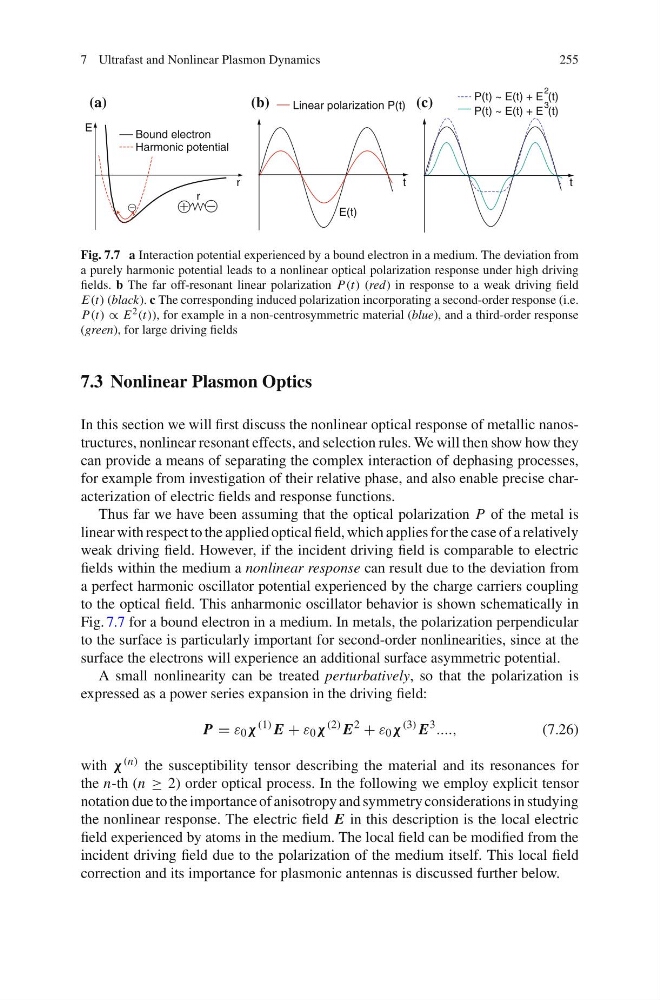
Fig. 7.7 a Interaction potential experienced by a bound electron in a medium. The deviation from
a purely harmonic potential leads to a nonlinear optical polarization response under high driving
fields. b The far off-resonant linear polarization P(t) (red) in response to a weak driving field
E(t) (black). c The corresponding induced polarization incorporating a second-order response (i.e.
P(t) ◦ E 2 (t)), for example in a non-centrosymmetric material (blue), and a third-order response
(green), for large driving fields
7.3 Nonlinear Plasmon Optics
In this section we will first discuss the nonlinear optical response of metallic nanostructures, nonlinear resonant effects, and selection rules. We will then show how they
can provide a means of separating the complex interaction of dephasing processes,
for example from investigation of their relative phase, and also enable precise characterization of electric fields and response functions.
Thus far we have been assuming that the optical polarization P of the metal is
linear with respect to the applied optical field, which applies for the case of a relatively
weak driving field. However, if the incident driving field is comparable to electric
fields within the medium a nonlinear response can result due to the deviation from
a perfect harmonic oscillator potential experienced by the charge carriers coupling
to the optical field. This anharmonic oscillator behavior is shown schematically in
Fig. 7.7 for a bound electron in a medium. In metals, the polarization perpendicular
to the surface is particularly important for second-order nonlinearities, since at the
surface the electrons will experience an additional surface asymmetric potential.
A small nonlinearity can be treated perturbatively, so that the polarization is
expressed as a power series expansion in the driving field:
P = ε 0 χ
(1) E + ε 0 χ
(2) E
2
+ ε 0 χ
(3) E
3
....,
(7.26)
with χ (n) the susceptibility tensor describing the material and its resonances for
the n-th (n ∇ 2) order optical process. In the following we employ explicit tensor
notation due to the importance of anisotropy and symmetry considerations in studying
the nonlinear response. The electric field E in this description is the local electric
field experienced by atoms in the medium. The local field can be modified from the
incident driving field due to the polarization of the medium itself. This local field
correction and its importance for plasmonic antennas is discussed further below.
255
E(t)
Linear polarization P(t)
r
E
t
t
P(t) ~ E(t) + E
2
(t)
P(t) ~ E(t) + E
3
(t)
Bound electron
Harmonic potential
r
(a)
(b)
(c)
Fig. 7.7 a Interaction potential experienced by a bound electron in a medium. The deviation from
a purely harmonic potential leads to a nonlinear optical polarization response under high driving
fields. b The far off-resonant linear polarization P(t) (red) in response to a weak driving field
E(t) (black). c The corresponding induced polarization incorporating a second-order response (i.e.
P(t) ◦ E 2 (t)), for example in a non-centrosymmetric material (blue), and a third-order response
(green), for large driving fields
7.3 Nonlinear Plasmon Optics
In this section we will first discuss the nonlinear optical response of metallic nanostructures, nonlinear resonant effects, and selection rules. We will then show how they
can provide a means of separating the complex interaction of dephasing processes,
for example from investigation of their relative phase, and also enable precise characterization of electric fields and response functions.
Thus far we have been assuming that the optical polarization P of the metal is
linear with respect to the applied optical field, which applies for the case of a relatively
weak driving field. However, if the incident driving field is comparable to electric
fields within the medium a nonlinear response can result due to the deviation from
a perfect harmonic oscillator potential experienced by the charge carriers coupling
to the optical field. This anharmonic oscillator behavior is shown schematically in
Fig. 7.7 for a bound electron in a medium. In metals, the polarization perpendicular
to the surface is particularly important for second-order nonlinearities, since at the
surface the electrons will experience an additional surface asymmetric potential.
A small nonlinearity can be treated perturbatively, so that the polarization is
expressed as a power series expansion in the driving field:
P = ε 0 χ
(1) E + ε 0 χ
(2) E
2
+ ε 0 χ
(3) E
3
....,
(7.26)
with χ (n) the susceptibility tensor describing the material and its resonances for
the n-th (n ∇ 2) order optical process. In the following we employ explicit tensor
notation due to the importance of anisotropy and symmetry considerations in studying
the nonlinear response. The electric field E in this description is the local electric
field experienced by atoms in the medium. The local field can be modified from the
incident driving field due to the polarization of the medium itself. This local field
correction and its importance for plasmonic antennas is discussed further below.